
Join Our JEE Preparation Group
Prep with like-minded aspirants; Get access to free daily tests and study material.
Sign in
Please select an account to continue using cracku.in
↓ →
Join Our JEE Preparation Group
Prep with like-minded aspirants; Get access to free daily tests and study material.
If an unbiased die, marked with $$-2, -1, 0, 1, 2, 3$$ on its faces is thrown five times, then the probability that the product of the outcomes is positive, is:
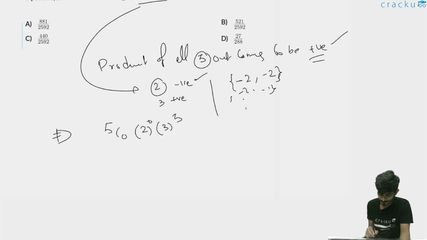
For the product of five rolled numbers to be strictly positive, none of the rolls can be $$0$$ and the number of negative values obtained must be even. The positive faces of the die are $$\{1,2,3\}$$ giving $$3$$ choices, while the negative faces are $$\{-2,-1\}$$ giving $$2$$ choices.
If there are no negative numbers, all five outcomes are positive. The number of such outcomes is
$$\binom{5}{0}(2)^0(3)^5 = 243$$
If there are exactly two negative numbers, the number of outcomes is
$$\binom{5}{2}(2)^2(3)^3 = 1080$$
If there are exactly four negative numbers, the number of outcomes is
$$\binom{5}{4}(2)^4(3)^1 = 240$$
Hence, the total number of favorable outcomes is
$$243+1080+240 = 1563$$
The total number of possible outcomes when the die is rolled five times is
$$6^5 = 7776$$
Therefore, the required probability is
$$\frac{1563}{7776} = \frac{521}{2592}$$
Hence, the required probability is
$$\boxed{\frac{521}{2592}}$$
Was this solution helpful?
Click on the Email ☝️ to Watch the Video Solution
Create a FREE account and get:
_1.webp)

Educational materials for JEE preparation

Ask our AI anything

AI can make mistakes. Please verify important information.
AI can make mistakes. Please verify important information.


