
Join Our JEE Preparation Group
Prep with like-minded aspirants; Get access to free daily tests and study material.
Sign in
Please select an account to continue using cracku.in
↓ →
Join Our JEE Preparation Group
Prep with like-minded aspirants; Get access to free daily tests and study material.
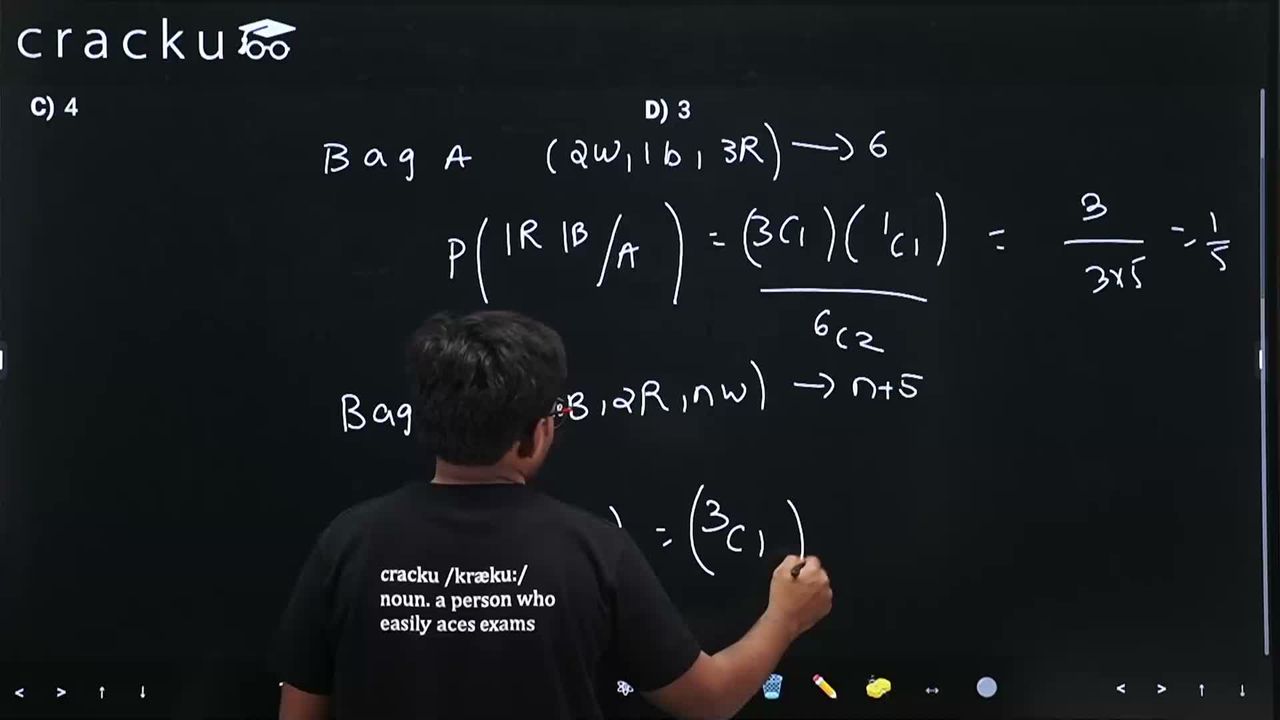
Bag $$A$$ contains $$2$$ white, $$1$$ black and $$3$$ red balls and bag $$B$$ contains $$3$$ black, $$2$$ red and $$n$$ white balls. One bag is chosen at random and $$2$$ balls drawn from it at random are found to be $$1$$ red and $$1$$ black. If the probability that both balls come from Bag $$A$$ is $$\frac{6}{11}$$, then $$n$$ is equal to
Bag A has 2 white, 1 black, 3 red balls (6 total). Bag B has 3 black, 2 red, $$n$$ white balls ($$(5+n)$$ total).
Compute the probability of drawing 1 red and 1 black from each bag.
From Bag A: $$P(1R, 1B | A) = \frac{\binom{3}{1}\binom{1}{1}}{\binom{6}{2}} = \frac{3}{15} = \frac{1}{5}$$
From Bag B: $$P(1R, 1B | B) = \frac{\binom{2}{1}\binom{3}{1}}{\binom{5+n}{2}} = \frac{6}{\frac{(5+n)(4+n)}{2}} = \frac{12}{(5+n)(4+n)}$$
Apply Bayes' theorem.
$$P(A | 1R,1B) = \frac{\frac{1}{2} \cdot \frac{1}{5}}{\frac{1}{2} \cdot \frac{1}{5} + \frac{1}{2} \cdot \frac{12}{(5+n)(4+n)}} = \frac{6}{11}$$
Simplify and solve.
$$\frac{\frac{1}{5}}{\frac{1}{5} + \frac{12}{(5+n)(4+n)}} = \frac{6}{11}$$
Cross-multiplying: $$\frac{11}{5} = 6\left(\frac{1}{5} + \frac{12}{(5+n)(4+n)}\right)$$
$$\frac{11}{5} = \frac{6}{5} + \frac{72}{(5+n)(4+n)}$$
$$1 = \frac{72}{(5+n)(4+n)}$$
$$(5+n)(4+n) = 72$$
$$n^2 + 9n + 20 = 72$$
$$n^2 + 9n - 52 = 0$$
$$(n + 13)(n - 4) = 0$$
Since $$n > 0$$, we get $$n = 4$$.
Answer: Option C (n = 4)
Was this solution helpful?
Click on the Email ☝️ to Watch the Video Solution
Create a FREE account and get:
_1.webp)

Educational materials for JEE preparation

Ask our AI anything

AI can make mistakes. Please verify important information.
AI can make mistakes. Please verify important information.
