
Join Our JEE Preparation Group
Prep with like-minded aspirants; Get access to free daily tests and study material.
Sign in
Please select an account to continue using cracku.in
↓ →
Join Our JEE Preparation Group
Prep with like-minded aspirants; Get access to free daily tests and study material.
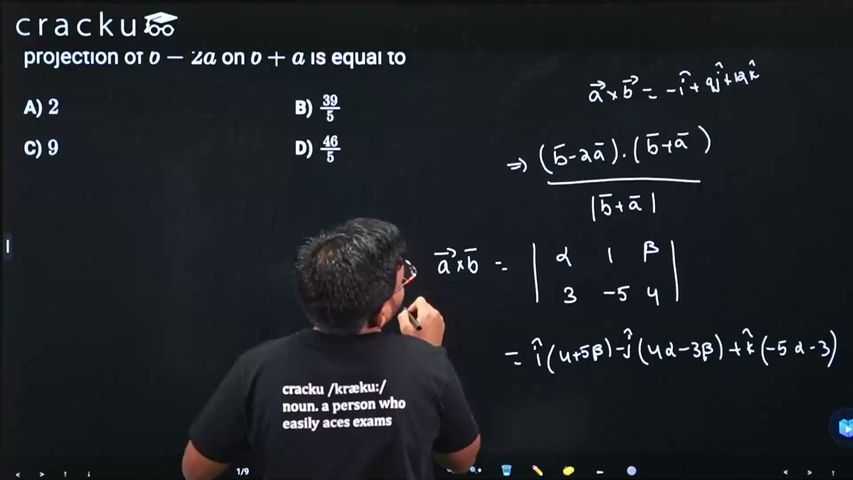
Let $$\vec{a} = \alpha \hat{i} + \hat{j} + \beta \hat{k}$$ and $$\vec{b} = 3\hat{i} - 5\hat{j} + 4\hat{k}$$ be two vectors, such that $$\vec{a} \times \vec{b} = -\hat{i} + 9\hat{j} + 12\hat{k}$$. Then the projection of $$\vec{b} - 2\vec{a}$$ on $$\vec{b} + \vec{a}$$ is equal to
Given
$$\vec a=(\alpha,1,\beta)$$
and
$$\vec b=(3,-5,4)$$
Compute the cross product:
$$\vec a\times\vec b=\begin{vmatrix}\hat i&\hat j&\hat k\\ \alpha&1&\beta\\ 3&-5&4\end{vmatrix}$$
$$=(4+5\beta)\hat i-(4\alpha-3\beta)\hat j+(-5\alpha-3)\hat k$$
Comparing with
$$-\hat i+9\hat j+12\hat k$$
we get
$$4+5\beta=-1$$
$$\beta=-1$$
Also,
$$-5\alpha-3=12$$
$$\alpha=-3$$
Hence
$$\vec a=-3\hat i+\hat j-\hat k$$
Now,
$$\vec b-2\vec a=(3,-5,4)-(-6,2,-2)=(9,-7,6)$$
and
$$\vec b+\vec a=(3,-5,4)+(-3,1,-1)=(0,-4,3)$$
The scalar projection of
$$\vec b-2\vec a$$
on
$$\vec b+\vec a$$
is
$$\frac{(\vec b-2\vec a)\cdot(\vec b+\vec a)}{|\vec b+\vec a|}$$
Now,
$$ (9,-7,6)\cdot(0,-4,3)=0+28+18=46 $$
and
$$ |\vec b+\vec a|=\sqrt{0^2+(-4)^2+3^2}=5 $$
Therefore the required projection is
$$\frac{46}{5}$$
Final Answer :
$$\frac{46}{5}$$
Was this solution helpful?
Click on the Email ☝️ to Watch the Video Solution
Create a FREE account and get:
_1.webp)

Educational materials for JEE preparation

Ask our AI anything

AI can make mistakes. Please verify important information.
AI can make mistakes. Please verify important information.
