
Join Our JEE Preparation Group
Prep with like-minded aspirants; Get access to free daily tests and study material.
Sign in
Please select an account to continue using cracku.in
↓ →
Join Our JEE Preparation Group
Prep with like-minded aspirants; Get access to free daily tests and study material.
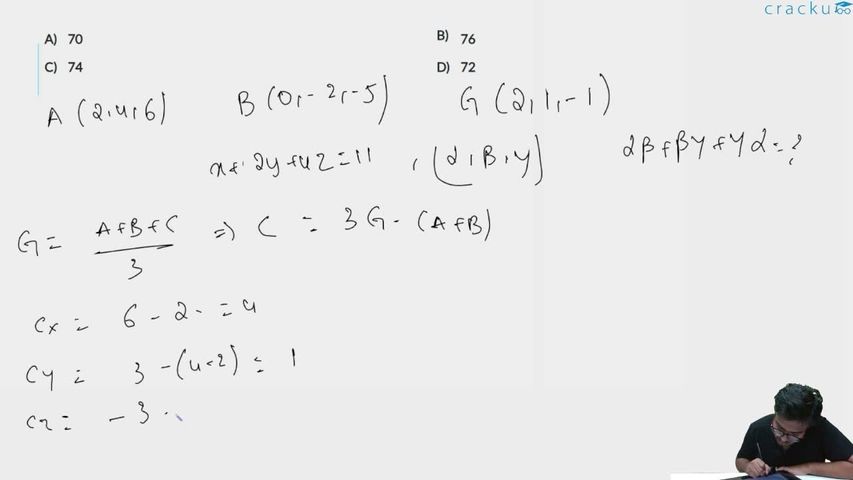
Let two vertices of a triangle $$ABC$$ be $$(2, 4, 6)$$ and $$(0, -2, -5)$$, and its centroid be $$(2, 1, -1)$$. If the image of the third vertex in the plane $$x + 2y + 4z = 11$$ is $$(\alpha, \beta, \gamma)$$, then $$\alpha\beta + \beta\gamma + \gamma\alpha$$ is equal to
Two vertices of triangle ABC are $$(2,4,6)$$ and $$(0,-2,-5)$$ with centroid $$(2,1,-1)$$. We need to find $$\alpha\beta + \beta\gamma + \gamma\alpha$$ where $$(\alpha,\beta,\gamma)$$ is the image of the third vertex in the plane $$x + 2y + 4z = 11$$.
Since the centroid formula gives $$G = \frac{A + B + C}{3}$$ and we have $$A = (2,4,6)$$, $$B = (0,-2,-5)$$, and $$G = (2,1,-1)$$, it follows that
$$x_C = 3(2) - 2 - 0 = 4$$
$$y_C = 3(1) - 4 - (-2) = 1$$
$$z_C = 3(-1) - 6 - (-5) = -4$$
Hence $$C = (4,1,-4)\,. $$
To reflect $$C$$ across the plane $$x + 2y + 4z = 11$$ (with parameters $$a=1,\,b=2,\,c=4,\,d=-11$$), we compute
$$t = \frac{-2\,(a x_0 + b y_0 + c z_0 + d)}{a^2 + b^2 + c^2} = \frac{-2\,(4 + 2 - 16 - 11)}{1 + 4 + 16} = \frac{-2(-21)}{21} = 2\,. $$
Therefore
$$\alpha = 4 + 1\cdot 2 = 6\,,\quad \beta = 1 + 2\cdot 2 = 5\,,\quad \gamma = -4 + 4\cdot 2 = 4\,. $$
Finally, the sum is
$$\alpha\beta + \beta\gamma + \gamma\alpha = 6\cdot5 + 5\cdot4 + 4\cdot6 = 30 + 20 + 24 = 74\,. $$
Was this solution helpful?
Click on the Email ☝️ to Watch the Video Solution
Create a FREE account and get:
_1.webp)

Educational materials for JEE preparation

Ask our AI anything

AI can make mistakes. Please verify important information.
AI can make mistakes. Please verify important information.
