
Join Our JEE Preparation Group
Prep with like-minded aspirants; Get access to free daily tests and study material.
Sign in
Please select an account to continue using cracku.in
↓ →
Join Our JEE Preparation Group
Prep with like-minded aspirants; Get access to free daily tests and study material.
If the curve $$y = y(x)$$ is the solution of the differential equation $$2(x^2 + x^{5/4})dy - y(x + x^{1/4})dx = 2x^{9/4}dx$$, $$x > 0$$ which passes through the point $$\left(1, 1 - \frac{4}{3}\log_e 2\right)$$, then the value of $$y(16)$$ is equal to:
The differential equation is $$2(x^2 + x^{5/4})\,dy - y(x + x^{1/4})\,dx = 2x^{9/4}\,dx$$ with $$x > 0$$.
Dividing both sides by $$2(x^2 + x^{5/4})$$: $$dy - \frac{y(x + x^{1/4})}{2(x^2 + x^{5/4})}\,dx = \frac{2x^{9/4}}{2(x^2 + x^{5/4})}\,dx$$.
Simplifying the coefficients. Factor $$x^2 + x^{5/4} = x^{5/4}(x^{3/4} + 1)$$ and $$x + x^{1/4} = x^{1/4}(x^{3/4} + 1)$$.
The coefficient of $$y$$: $$\frac{x^{1/4}(x^{3/4}+1)}{2x^{5/4}(x^{3/4}+1)} = \frac{1}{2x}$$.
The right side: $$\frac{x^{9/4}}{x^{5/4}(x^{3/4}+1)} = \frac{x}{x^{3/4}+1}$$.
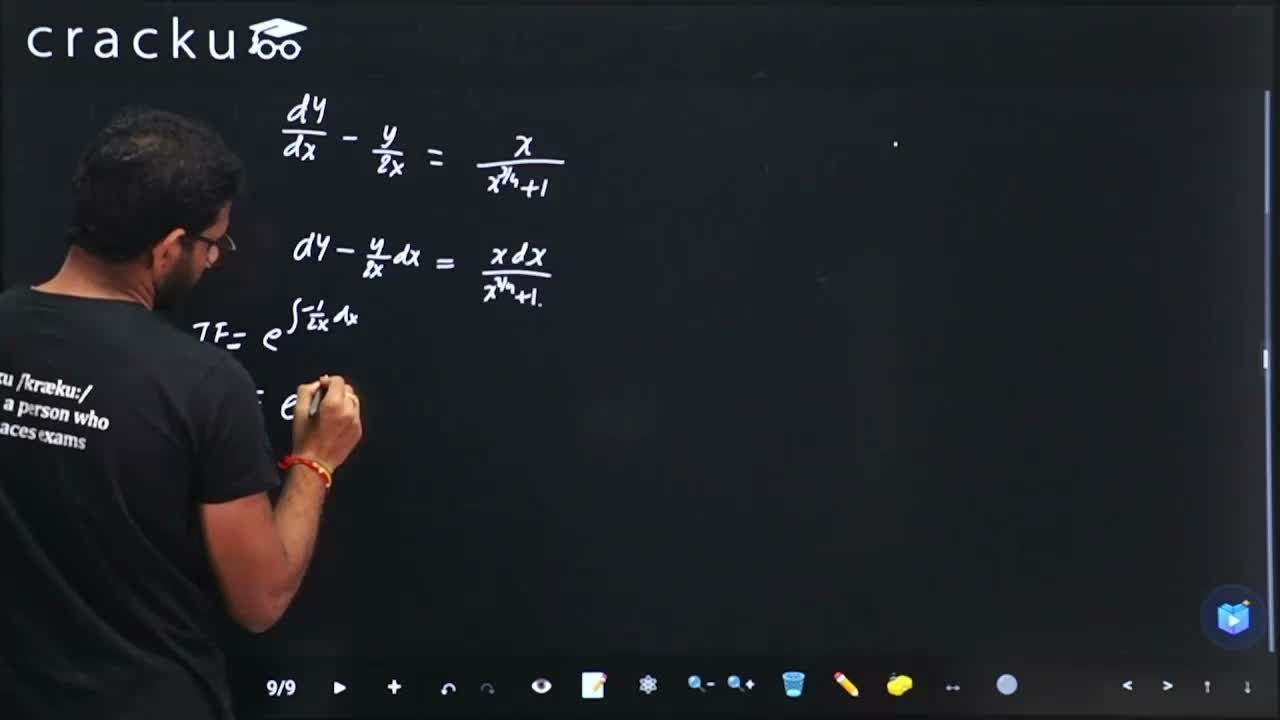
So the ODE becomes: $$\frac{dy}{dx} - \frac{y}{2x} = \frac{x}{x^{3/4}+1}$$.
This is a first-order linear ODE. The integrating factor is $$e^{\int -\frac{1}{2x}\,dx} = e^{-\frac{1}{2}\ln x} = x^{-1/2}$$.
Multiplying by $$x^{-1/2}$$: $$\frac{d}{dx}\left(yx^{-1/2}\right) = \frac{x^{1/2}}{x^{3/4}+1} = \frac{x^{1/2}}{x^{3/4}+1}$$.
Let $$t = x^{1/4}$$, so $$x = t^4$$ and $$dx = 4t^3\,dt$$. Then $$x^{1/2} = t^2$$ and $$x^{3/4} = t^3$$.
$$\int \frac{x^{1/2}}{x^{3/4}+1}\,dx = \int \frac{t^2}{t^3+1} \cdot 4t^3\,dt = 4\int \frac{t^5}{t^3+1}\,dt$$.
Performing polynomial division: $$\frac{t^5}{t^3+1} = t^2 - \frac{t^2}{t^3+1}$$. So: $$4\int\left(t^2 - \frac{t^2}{t^3+1}\right)dt = 4\left(\frac{t^3}{3} - \frac{1}{3}\ln|t^3+1|\right) + C$$.
Substituting back $$t = x^{1/4}$$: $$= 4\left(\frac{x^{3/4}}{3} - \frac{1}{3}\ln(x^{3/4}+1)\right) + C = \frac{4x^{3/4}}{3} - \frac{4}{3}\ln(x^{3/4}+1) + C$$.
So $$yx^{-1/2} = \frac{4x^{3/4}}{3} - \frac{4}{3}\ln(x^{3/4}+1) + C$$, giving $$y = x^{1/2}\left(\frac{4x^{3/4}}{3} - \frac{4}{3}\ln(x^{3/4}+1) + C\right)$$.
Applying the initial condition: the curve passes through $$\left(1, 1 - \frac{4}{3}\log_e 2\right)$$. At $$x = 1$$: $$x^{1/2} = 1$$, $$x^{3/4} = 1$$.
$$1 - \frac{4}{3}\ln 2 = 1\left(\frac{4}{3} - \frac{4}{3}\ln 2 + C\right) = \frac{4}{3} - \frac{4}{3}\ln 2 + C$$.
$$C = 1 - \frac{4}{3}\ln 2 - \frac{4}{3} + \frac{4}{3}\ln 2 = 1 - \frac{4}{3} = -\frac{1}{3}$$.
At $$x = 16$$: $$x^{1/2} = 4$$, $$x^{3/4} = 16^{3/4} = (2^4)^{3/4} = 2^3 = 8$$.
$$y(16) = 4\left(\frac{4 \cdot 8}{3} - \frac{4}{3}\ln 9 - \frac{1}{3}\right) = 4\left(\frac{32}{3} - \frac{4}{3}\ln 9 - \frac{1}{3}\right) = 4\left(\frac{31}{3} - \frac{4}{3}\ln 9\right)$$.
Since $$\ln 9 = 2\ln 3$$: $$y(16) = 4\left(\frac{31}{3} - \frac{8}{3}\ln 3\right) = 4\left(\frac{31}{3} - \frac{8}{3}\log_e 3\right)$$.
The answer is $$4\left(\frac{31}{3} - \frac{8}{3}\log_e 3\right)$$, which is Option C.
Was this solution helpful?
Click on the Email ☝️ to Watch the Video Solution
Create a FREE account and get:
_1.webp)

Educational materials for JEE preparation

Ask our AI anything

AI can make mistakes. Please verify important information.
AI can make mistakes. Please verify important information.


