
Join Our JEE Preparation Group
Prep with like-minded aspirants; Get access to free daily tests and study material.
Sign in
Please select an account to continue using cracku.in
↓ →
Join Our JEE Preparation Group
Prep with like-minded aspirants; Get access to free daily tests and study material.
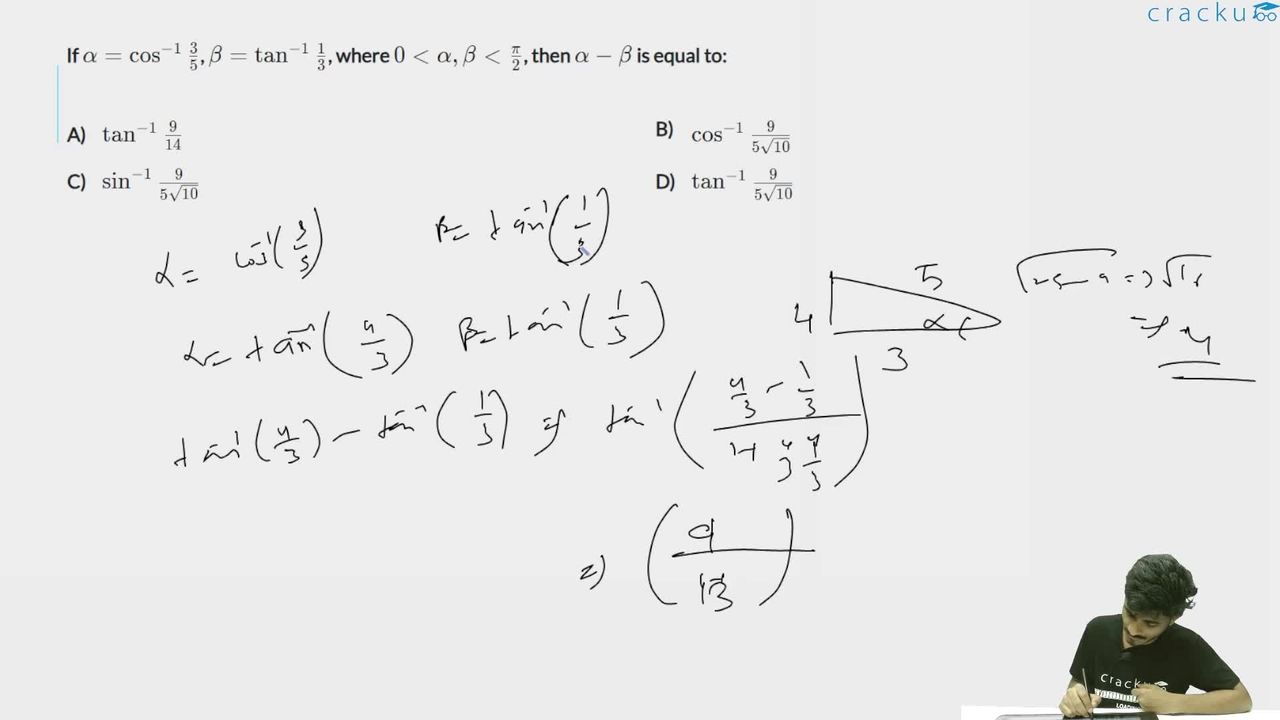
If $$\alpha = \cos^{-1}\frac{3}{5}$$, $$\beta = \tan^{-1}\frac{1}{3}$$, where $$0 < \alpha, \beta < \frac{\pi}{2}$$, then $$\alpha - \beta$$ is equal to:
We are given $$\alpha=\cos^{-1}\frac35$$ and $$\beta=\tan^{-1}\frac13$$ with $$0<\alpha,\beta<\dfrac{\pi}{2}$$, so both angles lie in the first quadrant. Because they are first-quadrant angles, every trigonometric ratio of each angle is positive.
From $$\alpha=\cos^{-1}\dfrac35$$ we have, by definition of the inverse cosine,
$$\cos\alpha=\dfrac35.$$
To find $$\sin\alpha$$ and $$\tan\alpha$$ we use the Pythagorean identity
$$\sin^2\theta+\cos^2\theta=1.$$
Substituting $$\cos\alpha=\dfrac35$$ gives
$$\sin^2\alpha+ \left(\dfrac35\right)^2 = 1 \quad\Longrightarrow\quad \sin^2\alpha + \dfrac9{25}=1.$$
Moving the fraction to the right side, we get
$$\sin^2\alpha = 1-\dfrac9{25}=\dfrac{25}{25}-\dfrac9{25}=\dfrac{16}{25}.$$
Taking the positive square root (because $$\alpha$$ is in the first quadrant) gives
$$\sin\alpha=\dfrac45.$$
Now $$\tan\alpha$$ can be written as
$$\tan\alpha=\dfrac{\sin\alpha}{\cos\alpha}=\dfrac{\dfrac45}{\dfrac35}=\dfrac43.$$
Next consider $$\beta=\tan^{-1}\dfrac13.$$ By definition,
$$\tan\beta=\dfrac13.$$
To compute $$\sin\beta$$ and $$\cos\beta$$, imagine a right-angled triangle in which the side opposite $$\beta$$ is $$1$$ and the side adjacent to $$\beta$$ is $$3$$. The hypotenuse is obtained from the Pythagorean theorem:
$$\text{hypotenuse}=\sqrt{1^{2}+3^{2}}=\sqrt{1+9}=\sqrt{10}.$$
Therefore
$$\sin\beta=\dfrac{\text{opposite}}{\text{hypotenuse}}=\dfrac1{\sqrt{10}}, \qquad \cos\beta=\dfrac{\text{adjacent}}{\text{hypotenuse}}=\dfrac3{\sqrt{10}}.$$
We now need $$\alpha-\beta.$$ To relate this difference to a single trigonometric ratio we use the sine difference formula:
$$\sin(A-B)=\sin A\cos B-\cos A\sin B.$$
Taking $$A=\alpha$$ and $$B=\beta$$ gives
$$\sin(\alpha-\beta)=\sin\alpha\cos\beta-\cos\alpha\sin\beta.$$
We substitute the values already found:
$$\sin(\alpha-\beta)=\left(\dfrac45\right)\!\left(\dfrac3{\sqrt{10}}\right)-\left(\dfrac35\right)\!\left(\dfrac1{\sqrt{10}}\right).$$
Multiplying numerators and denominators separately, we obtain
$$\sin(\alpha-\beta)=\dfrac{4\cdot3}{5\sqrt{10}}-\dfrac{3\cdot1}{5\sqrt{10}} =\dfrac{12}{5\sqrt{10}}-\dfrac{3}{5\sqrt{10}} =\dfrac{12-3}{5\sqrt{10}} =\dfrac9{5\sqrt{10}}.$$
So
$$\sin(\alpha-\beta)=\dfrac9{5\sqrt{10}}.$$
Because $$0<\alpha<\dfrac{\pi}{2}$$ and $$0<\beta<\dfrac{\pi}{2},$$ their difference also satisfies $$0<\alpha-\beta<\dfrac{\pi}{2}.$$ In this interval the arcsine function is single-valued, hence
$$\alpha-\beta=\sin^{-1}\!\left(\dfrac9{5\sqrt{10}}\right).$$
Looking at the options, this matches exactly Option C.
Hence, the correct answer is Option C.
Was this solution helpful?
Click on the Email ☝️ to Watch the Video Solution
Create a FREE account and get:
Educational materials for JEE preparation

Ask our AI anything

AI can make mistakes. Please verify important information.
AI can make mistakes. Please verify important information.

_1.webp)
