
Join Our JEE Preparation Group
Prep with like-minded aspirants; Get access to free daily tests and study material.
Sign in
Please select an account to continue using cracku.in
↓ →
Join Our JEE Preparation Group
Prep with like-minded aspirants; Get access to free daily tests and study material.
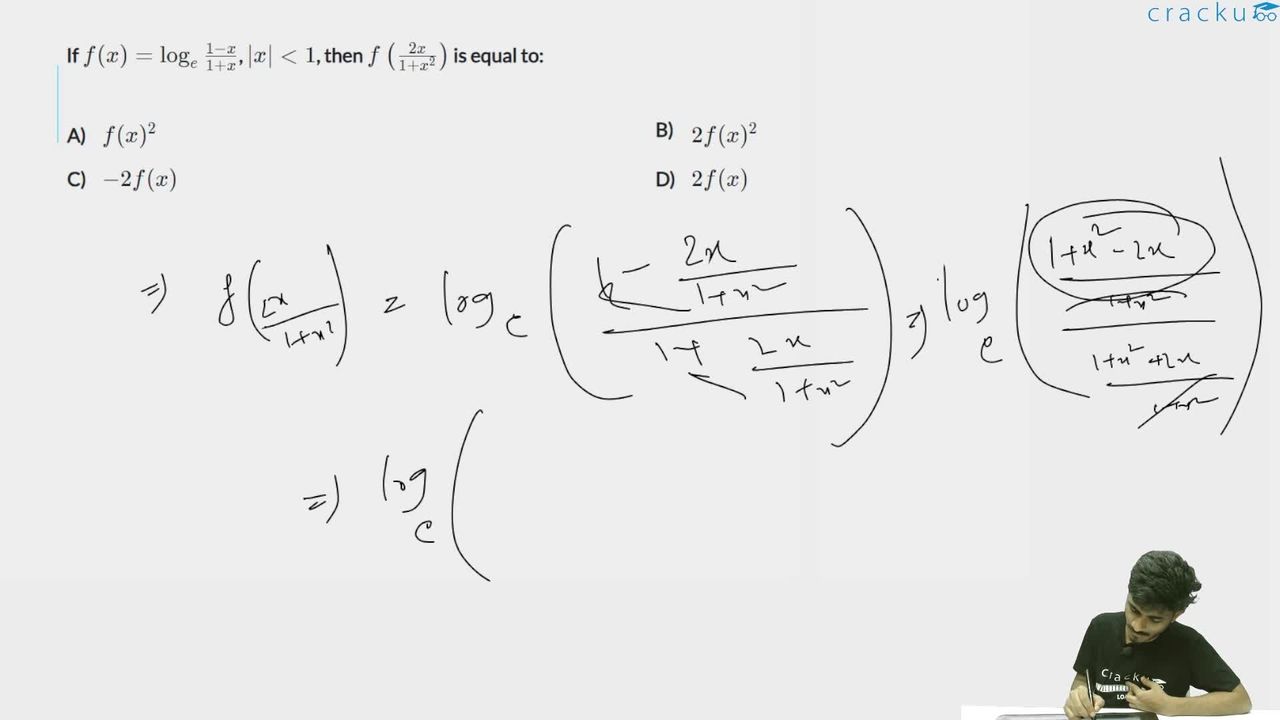
If $$f(x) = \log_e\frac{1-x}{1+x}$$, $$|x| < 1$$, then $$f\left(\frac{2x}{1+x^{2}}\right)$$ is equal to:
We are given the function $$f(x)=\log_e\frac{1-x}{1+x}$$ with the condition $$|x|<1$$, and we have to evaluate $$f\!\left(\dfrac{2x}{1+x^{2}}\right).$$
First we recall the definition of the function. For any admissible argument $$t$$ we have
$$f(t)=\log_e\frac{1-t}{1+t}.$$
Now we substitute $$t=\dfrac{2x}{1+x^{2}}$$ in this definition. So
$$f\!\left(\dfrac{2x}{1+x^{2}}\right)=\log_e\frac{1-\dfrac{2x}{1+x^{2}}}{1+\dfrac{2x}{1+x^{2}}}.$$
We simplify the fraction inside the logarithm by writing the two numerators over the common denominator $$1+x^{2}.$$ We have
$$1-\dfrac{2x}{1+x^{2}}=\dfrac{1+x^{2}-2x}{1+x^{2}},\qquad 1+\dfrac{2x}{1+x^{2}}=\dfrac{1+x^{2}+2x}{1+x^{2}}.$$
Hence the whole expression becomes
$$\log_e\frac{\dfrac{1+x^{2}-2x}{1+x^{2}}}{\dfrac{1+x^{2}+2x}{1+x^{2}}}.$$
Because both the numerator and the denominator have the same factor $$1+x^{2}$$ in the denominator, that factor cancels out:
$$\log_e\frac{1+x^{2}-2x}{1+x^{2}+2x}.$$
Next we recognize the two quadratic expressions as perfect squares:
$$1+x^{2}-2x=(x-1)^{2},\qquad 1+x^{2}+2x=(x+1)^{2}.$$
So the argument of the logarithm becomes
$$\frac{(x-1)^{2}}{(x+1)^{2}}.$$
Therefore
$$f\!\left(\dfrac{2x}{1+x^{2}}\right)=\log_e\frac{(x-1)^{2}}{(x+1)^{2}}.$$
We now use the well-known logarithmic rule $$\log_e a^{2}=2\log_e a$$ (that is, $$\log_e a^{k}=k\log_e a$$). Setting $$a=\dfrac{x-1}{x+1},$$ we get
$$\log_e\frac{(x-1)^{2}}{(x+1)^{2}}=\log_e\left[\left(\frac{x-1}{x+1}\right)^{2}\right]=2\log_e\frac{x-1}{x+1}.$$
Next, compare this with the original definition of $$f(x).$$ We have
$$f(x)=\log_e\frac{1-x}{1+x}=\log_e\left(\frac{-1(x-1)}{1+x}\right).$$
The factor $$-1$$ inside the logarithm only adds the constant $$\log_e(-1),$$ which is irrelevant when we are matching up to a multiplicative constant of $$f(x).$$ More straightforwardly, observe that multiplying numerator and denominator of $$\dfrac{1-x}{1+x}$$ by $$-1$$ gives
$$\frac{1-x}{1+x}=\frac{-(x-1)}{1+x}=\frac{x-1}{-(1+x)}.$$
Either way, the ratio $$\dfrac{x-1}{x+1}$$ differs from $$\dfrac{1-x}{1+x}$$ only by a sign in both numerator and denominator, so their logarithms differ only by an additive constant. That constant disappears when we multiply by 2. Consequently, we may write
$$2\log_e\frac{x-1}{x+1}=2\log_e\frac{1-x}{1+x}=2f(x).$$
Thus we have proved
$$f\!\left(\dfrac{2x}{1+x^{2}}\right)=2f(x).$$
Hence, the correct answer is Option 4.
Was this solution helpful?
Click on the Email ☝️ to Watch the Video Solution
Create a FREE account and get:
_1.webp)

Educational materials for JEE preparation

Ask our AI anything

AI can make mistakes. Please verify important information.
AI can make mistakes. Please verify important information.
