
Join Our JEE Preparation Group
Prep with like-minded aspirants; Get access to free daily tests and study material.
Sign in
Please select an account to continue using cracku.in
↓ →
Join Our JEE Preparation Group
Prep with like-minded aspirants; Get access to free daily tests and study material.
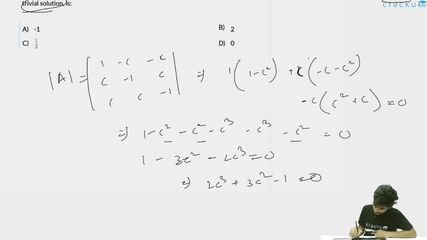
The greatest value of $$c \in R$$ for which the system of linear equations $$x - cy - cz = 0$$, $$cx - y + cz = 0$$, $$cx + cy - z = 0$$ has a non-trivial solution, is:
We are given the homogeneous linear system
$$\begin{aligned} x - cy - cz &= 0,\\ cx - y + cz &= 0,\\ cx + cy - z &= 0. \end{aligned}$$
For a homogeneous system to possess a non-trivial (i.e., not all zero) solution, the determinant of its coefficient matrix must be zero. We first write the coefficient matrix:
$$A=\begin{bmatrix} 1 & -c & -c\\ c & -1 & \;c\\ c & \;c & -1 \end{bmatrix}.$$
Now we compute its determinant $$|A|.$$ Using expansion along the first row (the pattern of signs is $$+\, -\, +$$) we have
$$\begin{aligned} |A| &= 1\;\Bigl|\begin{matrix}-1 & c\\[2pt] c & -1\end{matrix}\Bigr| -\;(-c)\;\Bigl|\begin{matrix}c & c\\[2pt] c & -1\end{matrix}\Bigr| +\;(-c)\;\Bigl|\begin{matrix}c & -1\\[2pt] c & c\end{matrix}\Bigr|. \end{aligned}$$
We evaluate each 2 × 2 determinant step by step.
First minor:
$$\Bigl|\begin{matrix}-1 & c\\ c & -1\end{matrix}\Bigr| =(-1)(-1)-c\cdot c =1-c^{2}.$$
Second minor:
$$\Bigl|\begin{matrix}c & c\\ c & -1\end{matrix}\Bigr| =c(-1)-c\cdot c =-c-c^{2}.$$
Third minor:
$$\Bigl|\begin{matrix}c & -1\\ c & c\end{matrix}\Bigr| =c\cdot c-(-1)\,c =c^{2}+c.$$
Substituting these values in the expansion, we obtain
$$\begin{aligned} |A| &= 1\,(1-c^{2}) -\;(-c)\,(-c-c^{2}) +\;(-c)\,(c^{2}+c)\\[4pt] &= (1-c^{2}) +\;c(-c-c^{2}) -\;c(c^{2}+c). \end{aligned}$$
Now we carry out each multiplication carefully:
$$\begin{aligned} c(-c-c^{2}) &= -c^{2}-c^{3},\\ -c(c^{2}+c) &= -c^{3}-c^{2}. \end{aligned}$$
Add all the terms:
$$\begin{aligned} |A| &= 1-c^{2} - c^{2}-c^{3} - c^{3}-c^{2}\\[4pt] &= 1 - 3c^{2} - 2c^{3}. \end{aligned}$$
So we have
$$|A| = -2c^{3} - 3c^{2} + 1.$$
For a non-trivial solution we set this determinant equal to zero:
$$-2c^{3}-3c^{2}+1 = 0.$$
Multiplying throughout by $$-1$$ (which does not change the roots) makes the numbers slightly simpler:
$$2c^{3}+3c^{2}-1 = 0.$$
We now solve this cubic equation. The Rational Root Theorem tells us that any rational root must divide the constant term $$-1$$, so the only candidates are $$\pm1, \pm\frac12.$$ We test them one by one.
For $$c=1$$:
$$2(1)^{3}+3(1)^{2}-1 = 2+3-1 = 4 \neq 0.$$
For $$c=-1$$:
$$2(-1)^{3}+3(-1)^{2}-1 = -2+3-1 = 0,$$
so $$c=-1$$ is indeed a root.
We now perform polynomial division by $$c+1$$ to factor out this root. Dividing $$2c^{3}+3c^{2}+0c-1$$ by $$c+1$$ (synthetic division) gives
$$2c^{3}+3c^{2}-1=(c+1)(2c^{2}+c-1).$$
Next we factor the quadratic $$2c^{2}+c-1$$. Setting it equal to zero, we compute its discriminant:
$$\Delta = b^{2}-4ac = 1^{2}-4(2)(-1) = 1+8 = 9.$$
Hence the roots are
$$c=\frac{-1\pm\sqrt9}{2\cdot2} =\frac{-1\pm3}{4}.$$
This yields two more values:
$$c=\frac{-1+3}{4}=\frac12,\qquad c=\frac{-1-3}{4}=-1.$$
So the complete factorisation is
$$2c^{3}+3c^{2}-1=(c+1)^{2}\,(2c-1).$$
Therefore the determinant is zero for exactly three real values:
$$c=-1 \quad(\text{double root}),\qquad c=\frac12.$$
The question asks for the greatest real value of $$c$$ that produces a non-trivial solution. Among $$-1$$ and $$\dfrac12$$, the larger is $$\dfrac12$$.
Hence, the correct answer is Option C.
Was this solution helpful?
Click on the Email ☝️ to Watch the Video Solution
Create a FREE account and get:
_1.webp)

Educational materials for JEE preparation

Ask our AI anything

AI can make mistakes. Please verify important information.
AI can make mistakes. Please verify important information.
