
Join Our JEE Preparation Group
Prep with like-minded aspirants; Get access to free daily tests and study material.
Sign in
Please select an account to continue using cracku.in
↓ →
Join Our JEE Preparation Group
Prep with like-minded aspirants; Get access to free daily tests and study material.
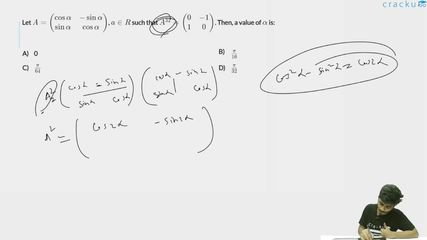
Let $$A = \begin{pmatrix} \cos\alpha & -\sin\alpha \\ \sin\alpha & \cos\alpha \end{pmatrix}$$, $$a \in R$$ such that $$A^{32} = \begin{pmatrix} 0 & -1 \\ 1 & 0 \end{pmatrix}$$. Then, a value of $$\alpha$$ is:
We have the matrix $$A=\begin{pmatrix}\cos\alpha & -\sin\alpha\\ \sin\alpha & \cos\alpha\end{pmatrix}.$$
This is the standard rotation matrix in the plane. A basic fact from linear algebra is that multiplying two rotation matrices adds their angles. Explicitly, for any real numbers $$\theta_1,\,\theta_2$$,
$$\begin{pmatrix}\cos\theta_1 & -\sin\theta_1\\ \sin\theta_1 & \cos\theta_1\end{pmatrix}\, \begin{pmatrix}\cos\theta_2 & -\sin\theta_2\\ \sin\theta_2 & \cos\theta_2\end{pmatrix} =\begin{pmatrix}\cos(\theta_1+\theta_2) & -\sin(\theta_1+\theta_2)\\ \sin(\theta_1+\theta_2) & \cos(\theta_1+\theta_2)\end{pmatrix}.$$
By repeated use of this rule, the power $$A^{n}$$ is still a rotation matrix whose angle is the sum of $$n$$ copies of $$\alpha$$, namely $$n\alpha$$. Therefore,
$$A^{n}=\begin{pmatrix}\cos(n\alpha) & -\sin(n\alpha)\\ \sin(n\alpha) & \cos(n\alpha)\end{pmatrix}.$$
Now we are told that $$A^{32}=\begin{pmatrix}0 & -1\\ 1 & 0\end{pmatrix}.$$ Comparing this with the general formula just obtained, we can equate the angles:
$$\cos(32\alpha)=0,\quad -\sin(32\alpha)=-1\quad\Longrightarrow\quad \begin{cases} \cos(32\alpha)=0,\\ \sin(32\alpha)=1. \end{cases}$$
Both conditions hold when the angle is $$\dfrac{\pi}{2}$$ plus an integral multiple of $$2\pi$$. Symbolically,
$$32\alpha=\dfrac{\pi}{2}+2k\pi,\qquad k\in\mathbb Z.$$
Solving for $$\alpha$$ gives
$$\alpha=\dfrac{\dfrac{\pi}{2}+2k\pi}{32} =\dfrac{\pi}{64}+\dfrac{k\pi}{16},\qquad k\in\mathbb Z.$$
We now look for those values among the options provided. Setting $$k=0$$ yields
$$\alpha=\dfrac{\pi}{64},$$
which is exactly Option 3 in the list.
Other integral choices of $$k$$ give angles that differ by multiples of $$\dfrac{\pi}{16}$$ and hence do not match the remaining options. Thus, the only option consistent with the given equation is $$\alpha=\dfrac{\pi}{64}$$.
Hence, the correct answer is Option 3.
Was this solution helpful?
Click on the Email ☝️ to Watch the Video Solution
Create a FREE account and get:
_1.webp)

Educational materials for JEE preparation

Ask our AI anything

AI can make mistakes. Please verify important information.
AI can make mistakes. Please verify important information.
