
Join Our JEE Preparation Group
Prep with like-minded aspirants; Get access to free daily tests and study material.
Sign in
Please select an account to continue using cracku.in
↓ →
Join Our JEE Preparation Group
Prep with like-minded aspirants; Get access to free daily tests and study material.
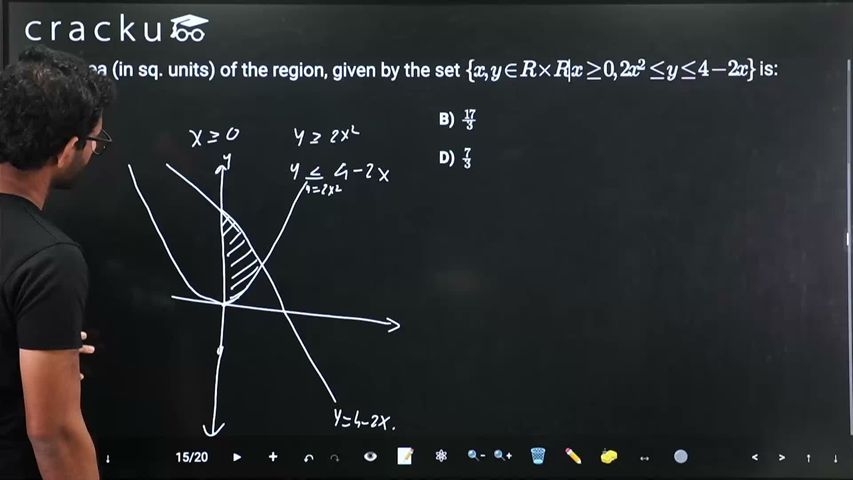
The area (in sq. units) of the region, given by the set $$\{x, y \in R \times R | x \ge 0, 2x^2 \le y \le 4 - 2x\}$$ is:
We have to find the area enclosed by all the points $$(x,y)$$ that satisfy three simultaneous conditions:
1. $$x \ge 0$$ 2. $$y \ge 2x^{2}$$ 3. $$y \le 4-2x$$
Geometrically, the second and third conditions say that the ordinate $$y$$ is sandwiched between the parabola $$y = 2x^{2}$$ (opening upward) and the straight line $$y = 4-2x$$ (slanting downward). The first job is to locate the $$x$$-interval over which the parabola actually lies below the line, because only there can a vertical strip exist whose top is on the line and bottom is on the parabola.
So we impose the inequality “parabola is below or touching the line”:
$$2x^{2} \le 4 - 2x.$$
Let us bring every term to the left side so that $$0$$ sits on the right:
$$2x^{2} + 2x - 4 \le 0.$$
Dividing by the positive constant $$2$$ keeps the inequality direction unchanged:
$$x^{2} + x - 2 \le 0.$$
Next we locate the roots of the quadratic $$x^{2} + x - 2 = 0$$ using the quadratic-formula statement
For $$ax^{2}+bx+c=0,\;x=\dfrac{-b\pm\sqrt{b^{2}-4ac}}{2a}.$$
Here $$a=1,\;b=1,\;c=-2,$$ so
$$x=\dfrac{-1\pm\sqrt{1^{2}-4(1)(-2)}}{2(1)} =\dfrac{-1\pm\sqrt{1+8}}{2} =\dfrac{-1\pm 3}{2}.$$
Thus the two real roots are
$$x=-2\quad\text{and}\quad x=1.$$
The parabola $$x^{2}+x-2$$ opens upward, so the inequality $$x^{2}+x-2 \le 0$$ is satisfied between the roots:
$$-2 \le x \le 1.$$
But the original statement also insists on $$x \ge 0,$$ therefore the effective common $$x$$-range reduces to
$$0 \le x \le 1.$$
Within this strip every vertical line segment from $$y=2x^{2}$$ up to $$y=4-2x$$ belongs to the required region. To compute the area we now employ the standard “top minus bottom” integral formula:
For a region bounded between $$x=a$$ and $$x=b$$ by an upper curve $$y_{\text{upper}}$$ and a lower curve $$y_{\text{lower}},$$ the area is
$$\text{Area} = \int_{a}^{b}\bigl[y_{\text{upper}} - y_{\text{lower}}\bigr]\;dx.$$
In our situation $$a=0,\;b=1,\;y_{\text{upper}} = 4-2x,\;y_{\text{lower}} = 2x^{2}.$$ Hence
$$\text{Area} = \int_{0}^{1}\bigl[(4-2x) - 2x^{2}\bigr]\;dx.$$ $$= \int_{0}^{1}\bigl(4 - 2x - 2x^{2}\bigr)\;dx.$$
Now we integrate term by term, recalling the antiderivatives
$$\int 4\,dx = 4x,\quad \int (-2x)\,dx = -x^{2},\quad \int (-2x^{2})\,dx = -\frac{2}{3}x^{3}.$$
So the combined antiderivative is
$$4x - x^{2} - \frac{2}{3}x^{3}.$$
Next we evaluate it from $$x=0$$ to $$x=1$$ (Fundamental Theorem of Calculus):
At $$x=1: \; 4(1) - (1)^{2} - \dfrac{2}{3}(1)^{3} = 4 - 1 - \dfrac{2}{3} = 3 - \dfrac{2}{3} = \dfrac{9}{3} - \dfrac{2}{3} = \dfrac{7}{3}.$$
At $$x=0: \; 4(0) - 0^{2} - \dfrac{2}{3}0^{3} = 0.$$
Subtracting the lower limit value from the upper limit value we obtain
$$\text{Area} = \dfrac{7}{3} - 0 = \dfrac{7}{3} \text{ square units}.$$
Hence, the correct answer is Option D.
Was this solution helpful?
Click on the Email ☝️ to Watch the Video Solution
Create a FREE account and get:
_1.webp)

Educational materials for JEE preparation

Ask our AI anything

AI can make mistakes. Please verify important information.
AI can make mistakes. Please verify important information.
