
Join Our JEE Preparation Group
Prep with like-minded aspirants; Get access to free daily tests and study material.
Sign in
Please select an account to continue using cracku.in
↓ →
Join Our JEE Preparation Group
Prep with like-minded aspirants; Get access to free daily tests and study material.
The value of the definite integral $$\int_{\pi/24}^{5\pi/24} \frac{dx}{1 + \sqrt[3]{\tan 2x}}$$ is:
We have to evaluate the definite integral
$$I=\int_{\pi/24}^{5\pi/24}\frac{dx}{1+\sqrt[3]{\tan 2x}}.$$
First, we simplify the integrand by introducing a new variable. Let us set
$$t=2x\;,\qquad\text{so that}\quad x=\frac{t}{2}\quad\text{and}\quad dx=\frac{dt}{2}.$$
Under this substitution the lower and upper limits transform as follows:
When $$x=\frac{\pi}{24},\quad t=2x=\frac{\pi}{12},$$
and when $$x=\frac{5\pi}{24},\quad t=2x=\frac{5\pi}{12}.$$
Substituting everything into the integral we obtain
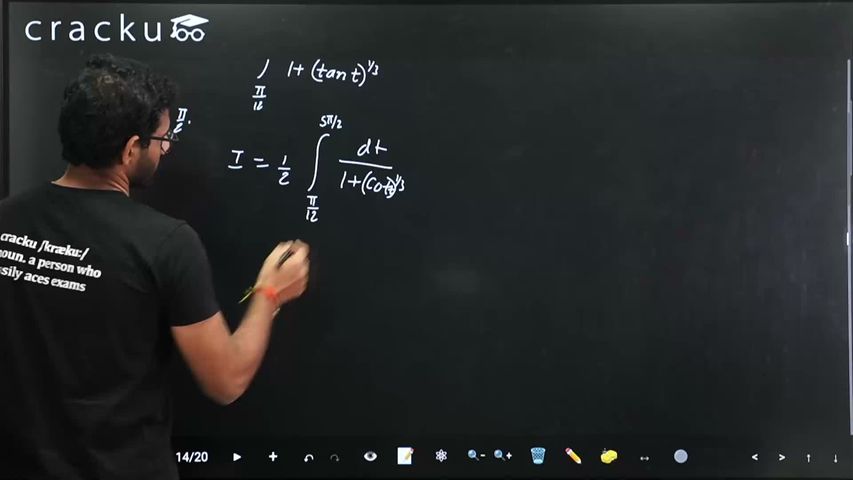
$$I=\int_{x=\pi/24}^{x=5\pi/24}\frac{dx}{1+\sqrt[3]{\tan 2x}} =\int_{t=\pi/12}^{t=5\pi/12}\frac{\dfrac{dt}{2}} {1+\sqrt[3]{\tan t}} =\frac12\int_{\pi/12}^{5\pi/12}\frac{dt}{1+\bigl(\tan t\bigr)^{1/3}}.$$
For convenience, denote
$$J=\int_{\pi/12}^{5\pi/12}\frac{dt}{1+\bigl(\tan t\bigr)^{1/3}},$$
so that $$I=\dfrac12\,J.$$ Our next task is to compute $$J.$$
To evaluate $$J,$$ we exploit a symmetry property of definite integrals. The key observation is that the interval $$\left[\dfrac{\pi}{12},\dfrac{5\pi}{12}\right]$$ is symmetric about $$\dfrac{\pi}{4},$$ because
$$\frac{\pi}{12}+\frac{5\pi}{12}= \frac{6\pi}{12}= \frac{\pi}{2}.$$
We therefore look at the substitution $$t\longrightarrow\frac{\pi}{2}-t,$$ which reflects a point in the interval around its centre. First recall the trigonometric identity
$$\tan\left(\frac{\pi}{2}-t\right)=\cot t=\frac{1}{\tan t}.$$
Using this, define a companion function
$$f(t)=\frac1{1+\bigl(\tan t\bigr)^{1/3}},$$
and look at $$f\!\left(\frac{\pi}{2}-t\right):$$
$$f\!\left(\frac{\pi}{2}-t\right) =\frac1{1+\left(\tan\!\left(\frac{\pi}{2}-t\right)\right)^{1/3}} =\frac1{1+\bigl(\cot t\bigr)^{1/3}} =\frac1{1+\left(\dfrac1{\tan t}\right)^{1/3}} =\frac1{1+\dfrac1{(\tan t)^{1/3}}}.$$
For clarity, set
$$y=(\tan t)^{1/3}\quad\bigl(\text{i.e. }y^3=\tan t\bigr),$$
so that
$$f(t)=\frac1{1+y},\qquad f\!\left(\frac{\pi}{2}-t\right)=\frac1{1+1/y}=\frac{y}{1+y}.$$
Hence their sum is remarkably simple:
$$f(t)+f\!\left(\frac{\pi}{2}-t\right) =\frac1{1+y}+\frac{y}{1+y} =\frac{1+y}{1+y}=1.$$
We have thus proved the identity
$$f(t)+f\!\left(\frac{\pi}{2}-t\right)=1\quad\text{for every }t.$$
Now integrate this identity from $$t=\dfrac{\pi}{12}$$ to $$t=\dfrac{5\pi}{12}:$$
$$\int_{\pi/12}^{5\pi/12}\Bigl[f(t)+f\!\left(\frac{\pi}{2}-t\right)\Bigr]\,dt =\int_{\pi/12}^{5\pi/12}1\,dt =(5\pi/12-\pi/12)=\frac{4\pi}{12}=\frac{\pi}{3}.$$
Because the transformation $$u=\frac{\pi}{2}-t$$ merely reverses the limits, we also have
$$\int_{\pi/12}^{5\pi/12}f\!\left(\frac{\pi}{2}-t\right)\,dt =\int_{5\pi/12}^{\pi/12}f(u)\,(-du) =\int_{\pi/12}^{5\pi/12}f(u)\,du =J.$$
Consequently, the left‐hand side of our earlier equality equals
$$\int_{\pi/12}^{5\pi/12}f(t)\,dt+\int_{\pi/12}^{5\pi/12}f\!\left(\frac{\pi}{2}-t\right)\,dt =J+J=2J.$$
Combining with the right‐hand side already found, we get
$$2J=\frac{\pi}{3}\quad\Longrightarrow\quad J=\frac{\pi}{6}.$$
Finally, we return to the original integral:
$$I=\frac12\,J=\frac12\left(\frac{\pi}{6}\right)=\frac{\pi}{12}.$$
Hence, the correct answer is Option C.
Was this solution helpful?
Click on the Email ☝️ to Watch the Video Solution
Create a FREE account and get:
_1.webp)

Educational materials for JEE preparation

Ask our AI anything

AI can make mistakes. Please verify important information.
AI can make mistakes. Please verify important information.
