
Join Our JEE Preparation Group
Prep with like-minded aspirants; Get access to free daily tests and study material.
Sign in
Please select an account to continue using cracku.in
↓ →
Join Our JEE Preparation Group
Prep with like-minded aspirants; Get access to free daily tests and study material.
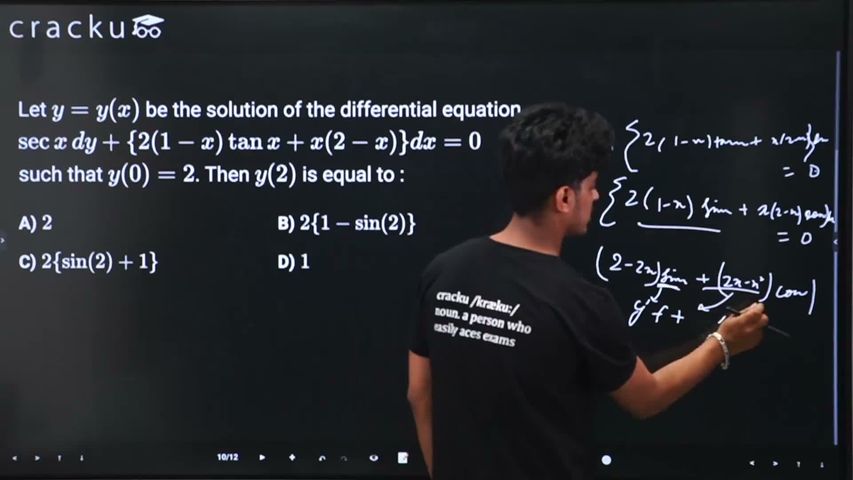
Let $$y = y(x)$$ be the solution of the differential equation $$\sec x \, dy + \{2(1 - x)\tan x + x(2 - x)\}dx = 0$$ such that $$y(0) = 2$$. Then $$y(2)$$ is equal to :
$$\sec x \, dy + \{2(1-x)\tan x + x(2-x)\}dx = 0$$.
$$ dy = -\cos x\{2(1-x)\tan x + x(2-x)\}dx $$ which simplifies to $$ dy = -\{2(1-x)\sin x + x(2-x)\cos x\}dx $$.
$$\frac{d}{dx}[(2-x)x\sin x] = (2-2x)\sin x + (2-x)x\cos x = 2(1-x)\sin x + x(2-x)\cos x$$, so $$dy = -d[(2-x)x\sin x]$$.
Integrating yields $$y = -(2-x)x\sin x + C$$.
Applying the initial condition $$y(0) = 2$$ gives $$2 = 0 + C$$, so $$C = 2$$ and thus $$y = -(2-x)x\sin x + 2$$. At $$x = 2$$, $$y(2) = -(2-2)(2)\sin 2 + 2 = 2$$.
Was this solution helpful?
Click on the Email ☝️ to Watch the Video Solution
Create a FREE account and get:
_1.webp)

Educational materials for JEE preparation

Ask our AI anything

AI can make mistakes. Please verify important information.
AI can make mistakes. Please verify important information.
