
Join Our JEE Preparation Group
Prep with like-minded aspirants; Get access to free daily tests and study material.
Sign in
Please select an account to continue using cracku.in
↓ →
Join Our JEE Preparation Group
Prep with like-minded aspirants; Get access to free daily tests and study material.
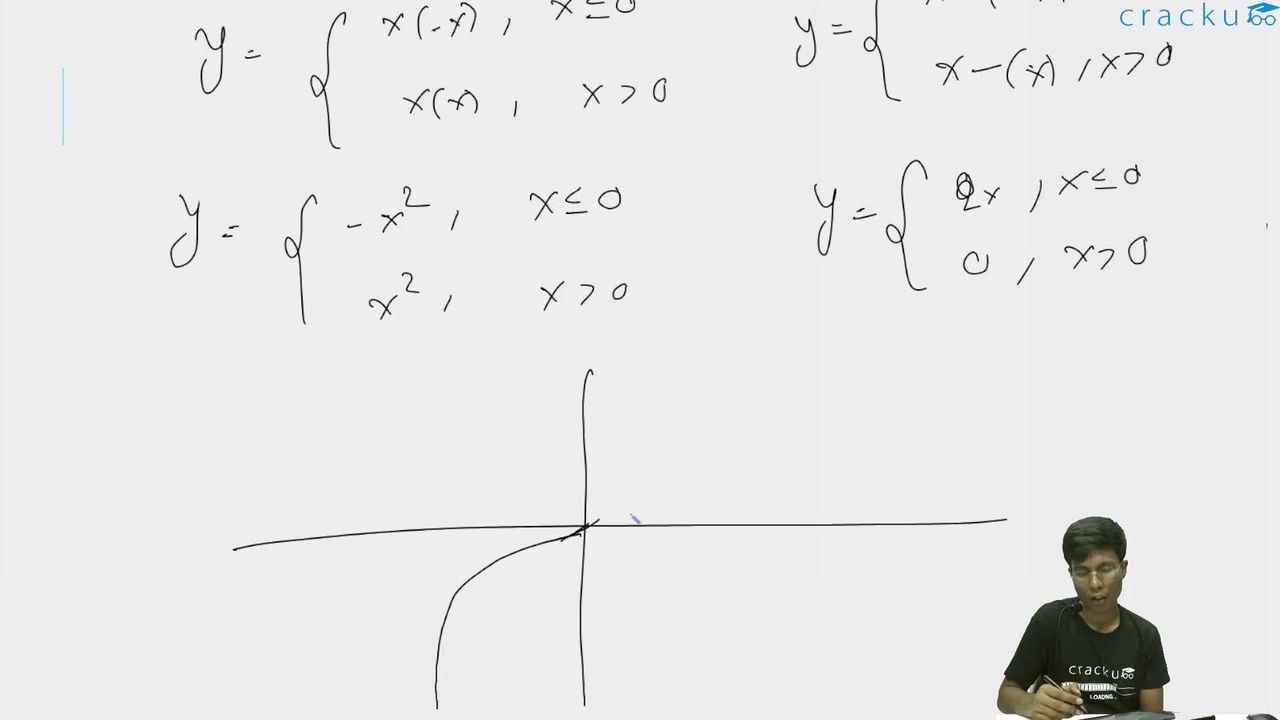
The two given curves are $$y = x\lvert x\rvert$$ and $$y = x - \lvert x\rvert$$. To integrate, first write each curve without the absolute-value signs.
Case 1: $$x \ge 0$$ • $$\lvert x\rvert = x$$, so $$y_1 = x\lvert x\rvert = x \cdot x = x^{2}$$ • $$y_2 = x - \lvert x\rvert = x - x = 0$$
Case 2: $$x \le 0$$ • $$\lvert x\rvert = -x$$, so $$y_1 = x\lvert x\rvert = x(-x) = -x^{2}$$ • $$y_2 = x - \lvert x\rvert = x - (-x) = 2x$$
Next find the points where the curves intersect.
Case 1 ($$x \ge 0$$): $$x^{2} = 0 \;\Longrightarrow\; x = 0$$
Case 2 ($$x \le 0$$): $$-x^{2} = 2x \;\Longrightarrow\; -x^{2} - 2x = 0 \;\Longrightarrow\; -x(x+2)=0 \;\Longrightarrow\; x = 0 \text{ or } x = -2$$
Thus the two curves meet at $$(-2,-4)$$ and $$(0,0)$$. Between these points the region is completely bounded; outside this interval the graphs do not enclose a finite area.
For $$x \in [-2,0]$$ the upper curve is $$y_1 = -x^{2}$$ and the lower curve is $$y_2 = 2x$$ (check at, say, $$x=-1$$: $$-1^{2}=-1$$ is above $$2(-1)=-2$$).
Required area $$A = \int_{-2}^{0} \bigl[\,(-x^{2}) - (2x)\bigr] \,dx = \int_{-2}^{0} \bigl(-x^{2} - 2x\bigr)\,dx$$
Integrate term by term: $$\int -x^{2}\,dx = -\frac{x^{3}}{3},\qquad \int -2x\,dx = -x^{2}$$
Hence $$A = \Bigl[-\frac{x^{3}}{3} - x^{2}\Bigr]_{-2}^{0}$$
Evaluate the limits:
At $$x = 0$$: $$-\frac{0^{3}}{3} - 0^{2} = 0$$
At $$x = -2$$: $$-\dfrac{(-2)^{3}}{3} - (-2)^{2}
= -\!\bigl(-\dfrac{8}{3}\bigr) - 4
= \dfrac{8}{3} - 4
= -\dfrac{4}{3}$$
Therefore $$A = 0 - \Bigl(-\dfrac{4}{3}\Bigr) = \dfrac{4}{3}$$
The enclosed area is $$\dfrac{4}{3}$$. This matches Option A.
Was this solution helpful?
Click on the Email ☝️ to Watch the Video Solution
Create a FREE account and get:
_1.webp)

Educational materials for JEE preparation

Ask our AI anything

AI can make mistakes. Please verify important information.
AI can make mistakes. Please verify important information.
