
Join Our JEE Preparation Group
Prep with like-minded aspirants; Get access to free daily tests and study material.
Sign in
Please select an account to continue using cracku.in
↓ →
Join Our JEE Preparation Group
Prep with like-minded aspirants; Get access to free daily tests and study material.
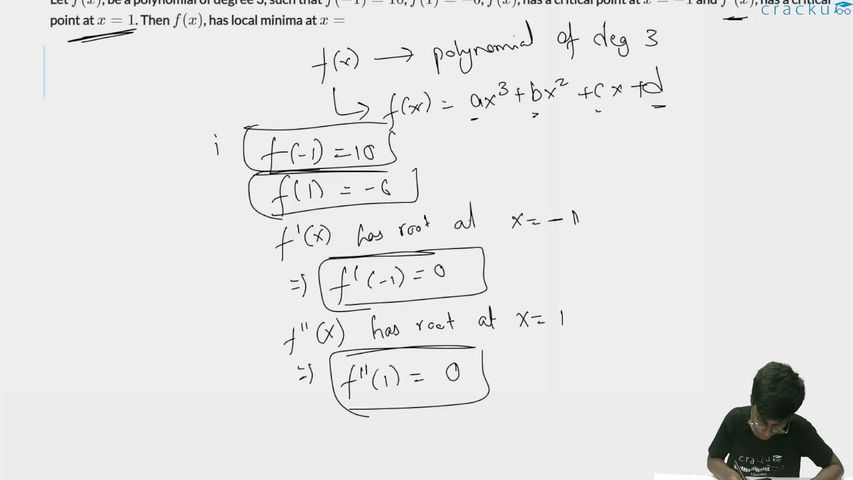
Let $$f(x)$$, be a polynomial of degree 3, such that $$f(-1) = 10$$, $$f(1) = -6$$, $$f(x)$$, has a critical point at $$x = -1$$ and $$f'(x)$$, has a critical point at $$x = 1$$. Then $$f(x)$$, has local minima at $$x =$$
Correct Answer: 3
Let us assume the required cubic polynomial to be
$$f(x)=ax^{3}+bx^{2}+cx+d.$$
First we write down its derivatives.
$$\text{Since}\;\frac{d}{dx}\,x^{3}=3x^{2},\; \frac{d}{dx}\,x^{2}=2x,$$ therefore
$$f'(x)=3ax^{2}+2bx+c,$$ $$f''(x)=6ax+2b.$$
We now translate all the data given in the question into equations involving the unknown coefficients $$a,\;b,\;c,\;d$$.
1. Function value at $$x=-1$$:
$$f(-1)=a(-1)^{3}+b(-1)^{2}+c(-1)+d =-a+b-c+d=10.$$
2. Function value at $$x=1$$:
$$f(1)=a+b+c+d=-6.$$
3. Critical point of $$f$$ at $$x=-1$$ means $$f'(-1)=0$$. Using $$f'(x)=3ax^{2}+2bx+c$$ we get
$$f'(-1)=3a(-1)^{2}+2b(-1)+c =3a-2b+c=0.$$
4. Critical point of $$f'(x)$$ at $$x=1$$ means $$f''(1)=0$$. From $$f''(x)=6ax+2b$$ we obtain
$$f''(1)=6a(1)+2b=0 \;\Longrightarrow\; 6a+2b=0 \;\Longrightarrow\; 3a+b=0 \;\Longrightarrow\; b=-3a.$$
Substituting $$b=-3a$$ in the earlier equations:
(i) From $$3a-2b+c=0$$:
$$3a-2(-3a)+c=0 \;\Longrightarrow\; 3a+6a+c=0 \;\Longrightarrow\; 9a+c=0 \;\Longrightarrow\; c=-9a.$$
(ii) From $$a+b+c+d=-6$$:
$$a+(-3a)+(-9a)+d=-6 \;\Longrightarrow\; -11a+d=-6 \;\Longrightarrow\; d=-6+11a.$$
(iii) From $$-a+b-c+d=10$$:
$$-a+(-3a)-(-9a)+d=10 \;\Longrightarrow\; -a-3a+9a+d=10 \;\Longrightarrow\; 5a+d=10 \;\Longrightarrow\; d=10-5a.$$
Equating the two expressions for $$d$$:
$$-6+11a = 10-5a \;\Longrightarrow\; 11a+5a = 10+6 \;\Longrightarrow\; 16a = 16 \;\Longrightarrow\; a = 1.$$
Now we back-substitute $$a=1$$:
$$b=-3a=-3,\qquad c=-9a=-9,\qquad d=-6+11a=-6+11=5.$$
Thus
$$f(x)=x^{3}-3x^{2}-9x+5.$$
To locate all critical points of $$f$$ we set $$f'(x)=0$$.
Since $$f'(x)=3x^{2}-6x-9=3(x^{2}-2x-3)=3(x-3)(x+1),$$ we have the critical points
$$x=-1,\qquad x=3.$$
To decide their nature we use the second derivative test: a point where $$f''(x)\gt 0$$ is a local minimum, and where $$f''(x)\lt 0$$ is a local maximum.
Because $$f''(x)=6x-6=6(x-1),$$ we compute
$$f''(-1)=6(-1)-6=-12\lt 0\quad\Longrightarrow\quad x=-1\text{ is a local maximum},$$ $$f''(3)=6(3)-6=18-6=12\gt 0\quad\Longrightarrow\quad x=3\text{ is a local minimum}.$$
Therefore the polynomial $$f(x)$$ attains its local minimum at
$$x=3.$$
Hence, the correct answer is Option 3.
Was this solution helpful?
Click on the Email ☝️ to Watch the Video Solution
Create a FREE account and get:
_1.webp)

Educational materials for JEE preparation

Ask our AI anything

AI can make mistakes. Please verify important information.
AI can make mistakes. Please verify important information.


