
Join Our JEE Preparation Group
Prep with like-minded aspirants; Get access to free daily tests and study material.
Sign in
Please select an account to continue using cracku.in
↓ →
Join Our JEE Preparation Group
Prep with like-minded aspirants; Get access to free daily tests and study material.
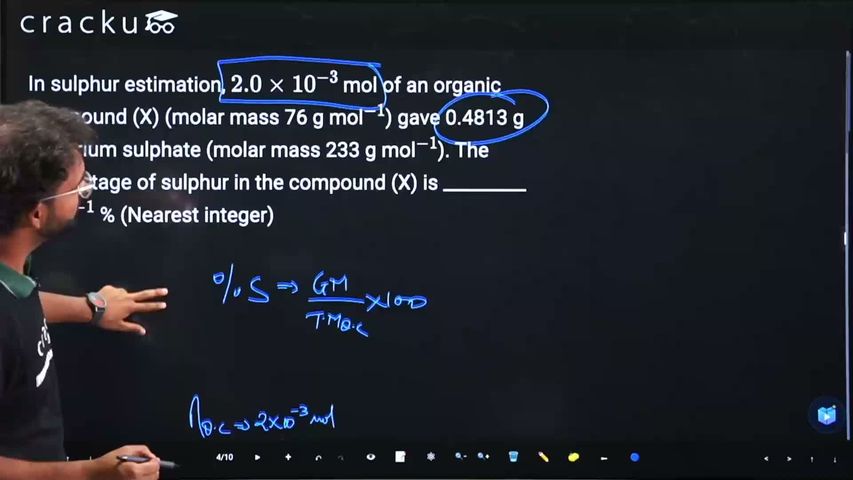
In sulphur estimation, $$2.0 \times 10^{-3}$$ mol of an organic compound (X) (molar mass 76 g mol$$^{-1}$$) gave 0.4813 g of barium sulphate (molar mass 233 g mol$$^{-1}$$). The percentage of sulphur in the compound (X) is _________ $$\times 10^{-1}$$ % (Nearest integer)
Correct Answer: 435
In the $$BaSO_4$$ method, the sulphur present in the organic compound is completely converted to $$BaSO_4$$. So, the amount of sulphur in the precipitate equals the amount of sulphur that was originally in the sample.
Step 1 Mass of the sample taken
Moles of compound $$X = 2.0 \times 10^{-3} \text{ mol}$$
Molecular weight of $$X = 76$$
$$\text{Mass of }X = 2.0 \times 10^{-3} \times 76 = 0.152\ \text{g}$$
Step 2 Moles of $$BaSO_4$$ obtained
Mass of $$BaSO_4$$ obtained $$= 0.4813\ \text{g}$$
Molecular weight of $$BaSO_4 = 233$$
$$n(\text{BaSO}_4) = \frac{0.4813}{233} = 2.066 \times 10^{-3}\ \text{mol}$$ (keep four significant figures)
Step 3 Moles and mass of sulphur present
Each mole of $$BaSO_4$$ contains one mole of sulphur.
$$n(S) = 2.066 \times 10^{-3}\ \text{mol}$$
Atomic mass of sulphur $$= 32$$
$$m(S) = 2.066 \times 10^{-3} \times 32 = 0.0661\ \text{g}$$
Step 4 Percentage of sulphur in the compound
$$\%S = \frac{m(S)}{\text{mass of }X} \times 100$$
$$\%S = \frac{0.0661}{0.152} \times 100 = 43.46\%$$
For $$--\ \times\ 10^{-1}$$= $$435\ \times\ 10^{-1}$$
Hence the required number is 435.
Was this solution helpful?
Click on the Email ☝️ to Watch the Video Solution
Create a FREE account and get:
_1.webp)

Educational materials for JEE preparation

Ask our AI anything

AI can make mistakes. Please verify important information.
AI can make mistakes. Please verify important information.


