
Join Our JEE Preparation Group
Prep with like-minded aspirants; Get access to free daily tests and study material.
Sign in
Please select an account to continue using cracku.in
↓ →
Join Our JEE Preparation Group
Prep with like-minded aspirants; Get access to free daily tests and study material.
If the angle of elevation of a cloud from a point P which is 25 m above a lake be $$30°$$ and the angle of depression of reflection of the cloud in the lake from P be $$60°$$, then the height of the cloud (in meters) from the surface of the lake is:
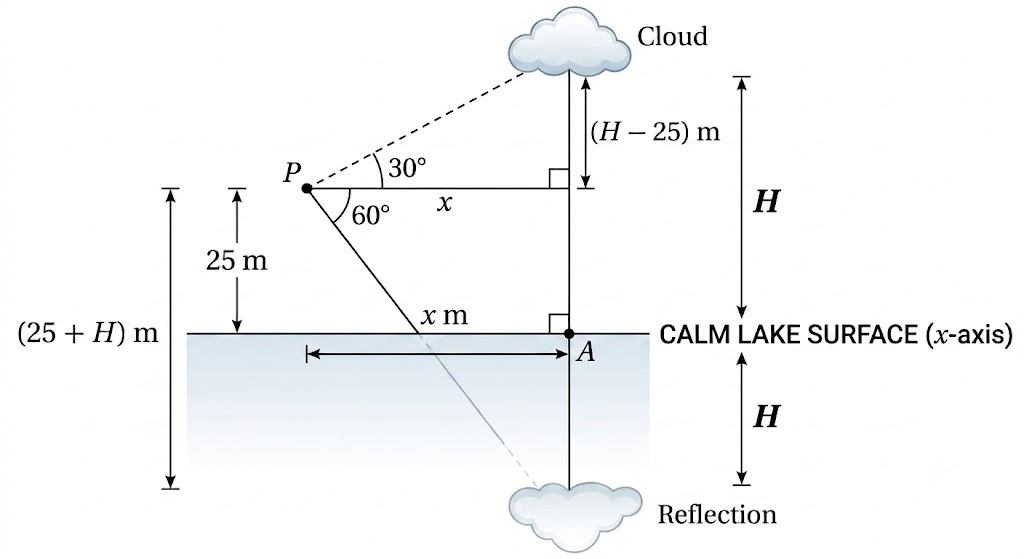
Let us imagine the calm surface of the lake as the horizontal reference line. The cloud is somewhere vertically above this surface, and its mirror image (the reflection) is the same vertical distance below the surface. The point $$P$$ is on a tower or pole that rises $$25\text{ m}$$ above the lake.
Call the unknown height of the cloud above the lake $$H\text{ m}$$. Draw a vertical line through the cloud down to the lake and further down to its reflection; call the foot of that vertical line on the lake’s surface $$A$$. Join $$P$$ to the actual cloud and also join $$P$$ to the reflection. Let the horizontal distance from $$P$$ to $$A$$ be $$x\text{ m}$$.
We now have two right-angled triangles that share the same base $$x$$:
1. Triangle $$P A$$-cloud, lying above the lake.
2. Triangle $$P A$$-reflection, lying below the lake.
The problem gives two angles:
• The angle of elevation of the cloud from $$P$$ is $$30^{\circ}$$.
• The angle of depression of the reflection from $$P$$ is $$60^{\circ}$$.
The basic trigonometric fact we will use is the definition of the tangent of an angle in a right-angled triangle:
$$\tan \theta \;=\;\frac{\text{opposite side}}{\text{adjacent side}}.$$
First apply this to the cloud itself. In triangle $$P A$$-cloud, the side opposite the $$30^{\circ}$$ angle is the vertical segment from $$P$$ down to the lake’s surface (that length is $$H-25$$, because $$H$$ is the cloud’s height above the lake and $$25\text{ m}$$ is the height of $$P$$ above the lake). The adjacent side is the horizontal segment $$P A$$ of length $$x$$. Hence
$$\tan 30^{\circ} \;=\;\frac{H-25}{x}.$$
We know $$\tan 30^{\circ}=\dfrac{1}{\sqrt3}$$, so
$$\frac{1}{\sqrt3} \;=\;\frac{H-25}{x},$$
which gives
$$x \;=\;\sqrt3\,(H-25).$$
Next apply the same idea to the reflection. In triangle $$P A$$-reflection, the angle at $$P$$ is a $$60^{\circ}$$ depression; its opposite side is the full vertical drop from $$P$$ down to the reflection. That drop equals $$25+H$$ (down $$25\text{ m}$$ to the lake and then a further $$H\text{ m}$$ to the reflection). The adjacent side is again the same horizontal length $$x$$. Therefore
$$\tan 60^{\circ} \;=\;\frac{25+H}{x}.$$
Because $$\tan 60^{\circ}=\sqrt3$$, we have
$$\sqrt3 \;=\;\frac{25+H}{x},$$
so that
$$x \;=\;\frac{25+H}{\sqrt3}.$$
Both expressions represent the same $$x$$, so we equate them:
$$\sqrt3\,(H-25) \;=\;\frac{25+H}{\sqrt3}.$$
Multiply both sides by $$\sqrt3$$ to clear the denominator:
$$3\,(H-25) \;=\;25+H.$$
Expand the left side:
$$3H - 75 \;=\;25 + H.$$
Bring the $$H$$ terms together and the constants together:
$$3H - H \;=\;25 + 75,$$
$$2H \;=\;100.$$
Divide by $$2$$:
$$H \;=\;50.$$
Thus the cloud is $$50\text{ m}$$ above the surface of the lake.
Hence, the correct answer is Option A.
Was this solution helpful?
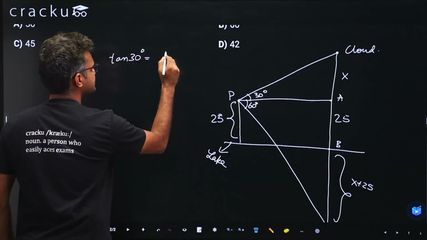
Click on the Email ☝️ to Watch the Video Solution
Create a FREE account and get:
_1.webp)

Educational materials for JEE preparation

Ask our AI anything

AI can make mistakes. Please verify important information.
AI can make mistakes. Please verify important information.


