
Join Our JEE Preparation Group
Prep with like-minded aspirants; Get access to free daily tests and study material.
Sign in
Please select an account to continue using cracku.in
↓ →
Join Our JEE Preparation Group
Prep with like-minded aspirants; Get access to free daily tests and study material.
Four fair dice are thrown independently 27 times. Then the expected number of times, at least two dice show up a three or a five, is
Correct Answer: 11
We throw four fair dice in one go and we are interested in the event that “at least two dice show a three or a five”. Let us first analyse a single throw of the four dice and then extend the result to the 27 independent repetitions.
For any single die, a face can be $$1,2,3,4,5,6$$, all equally likely. The favourable faces for our event are $$3$$ or $$5$$, so for one die we have
$$P(\text{face is }3\text{ or }5)=\frac{2}{6}=\frac13.$$
Correspondingly,
$$P(\text{face is neither }3\text{ nor }5)=1-\frac13=\frac23.$$
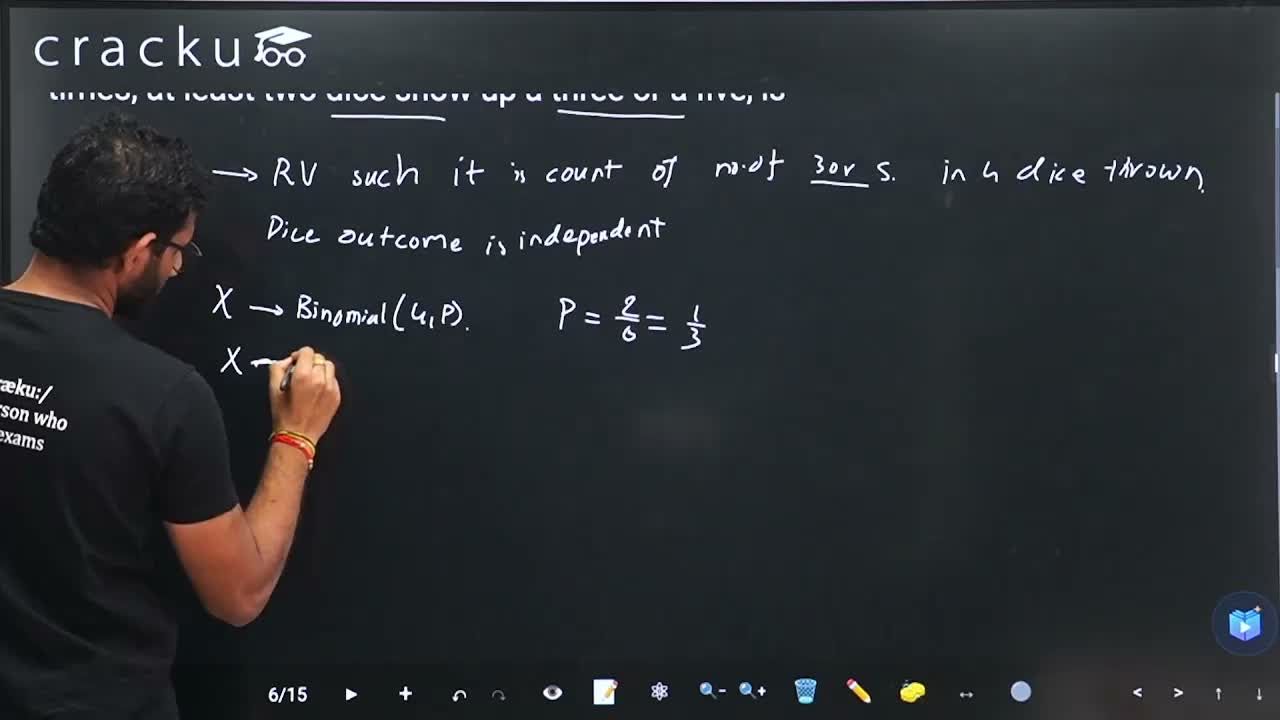
Let the random variable $$X$$ denote “the number of dice (out of four) that show a 3 or a 5” in one single throw of the four dice. Because each die acts independently, $$X$$ follows a binomial distribution with parameters $$n=4$$ and $$p=\frac13$$. Symbolically,
$$X\sim\text{Binomial}(4,\tfrac13).$$
We need the probability that at least two dice among the four are favourable, i.e.
$$P(\,X\ge 2\,)=1-P(\,X=0\,)-P(\,X=1\,).$$
Using the binomial probability formula $$P(X=k)=\binom{n}{k}p^{\,k}(1-p)^{\,n-k},$$ we compute each term step-by-step:
First, $$P(X=0)=\binom{4}{0}\Bigl(\tfrac13\Bigr)^{0}\Bigl(\tfrac23\Bigr)^{4}=1\cdot1\cdot\Bigl(\tfrac23\Bigr)^{4}=\left(\frac23\right)^{4}=\frac{16}{81}.$$
Next, $$P(X=1)=\binom{4}{1}\Bigl(\tfrac13\Bigr)^{1}\Bigl(\tfrac23\Bigr)^{3}=4\cdot\frac13\cdot\left(\frac23\right)^{3}=4\cdot\frac13\cdot\frac{8}{27}=4\cdot\frac{8}{81}=\frac{32}{81}.$$
Now we combine these values:
$$P(X\ge 2)=1-\frac{16}{81}-\frac{32}{81}=1-\frac{48}{81}=\frac{33}{81}=\frac{11}{27}.$$
This probability represents the chance of a “success” (at least two favourable faces) in one four-dice throw. Let us denote this success probability by $$p_s=\frac{11}{27}.$$
We are told that the four dice are thrown independently a total of 27 times. Let the random variable $$Y$$ count “the number of throws (out of 27) in which at least two dice show a three or a five.” Each throw is independent and has success probability $$p_s$$, so
$$Y\sim\text{Binomial}(27, p_s).$$
For a binomial random variable, the expected value is given by the well-known formula
$$E(Y)=n\,p,$$
where $$n$$ is the number of trials and $$p$$ the success probability per trial. Substituting $$n=27$$ and $$p=p_s=\frac{11}{27},$$ we obtain
$$E(Y)=27\left(\frac{11}{27}\right)=11.$$
So, on average, we expect the desired event to occur eleven times in the 27 repetitions.
So, the answer is $$11$$.
Was this solution helpful?
Click on the Email ☝️ to Watch the Video Solution
Create a FREE account and get:
_1.webp)

Educational materials for JEE preparation

Ask our AI anything

AI can make mistakes. Please verify important information.
AI can make mistakes. Please verify important information.


