
Join Our JEE Preparation Group
Prep with like-minded aspirants; Get access to free daily tests and study material.
Sign in
Please select an account to continue using cracku.in
↓ →
Join Our JEE Preparation Group
Prep with like-minded aspirants; Get access to free daily tests and study material.
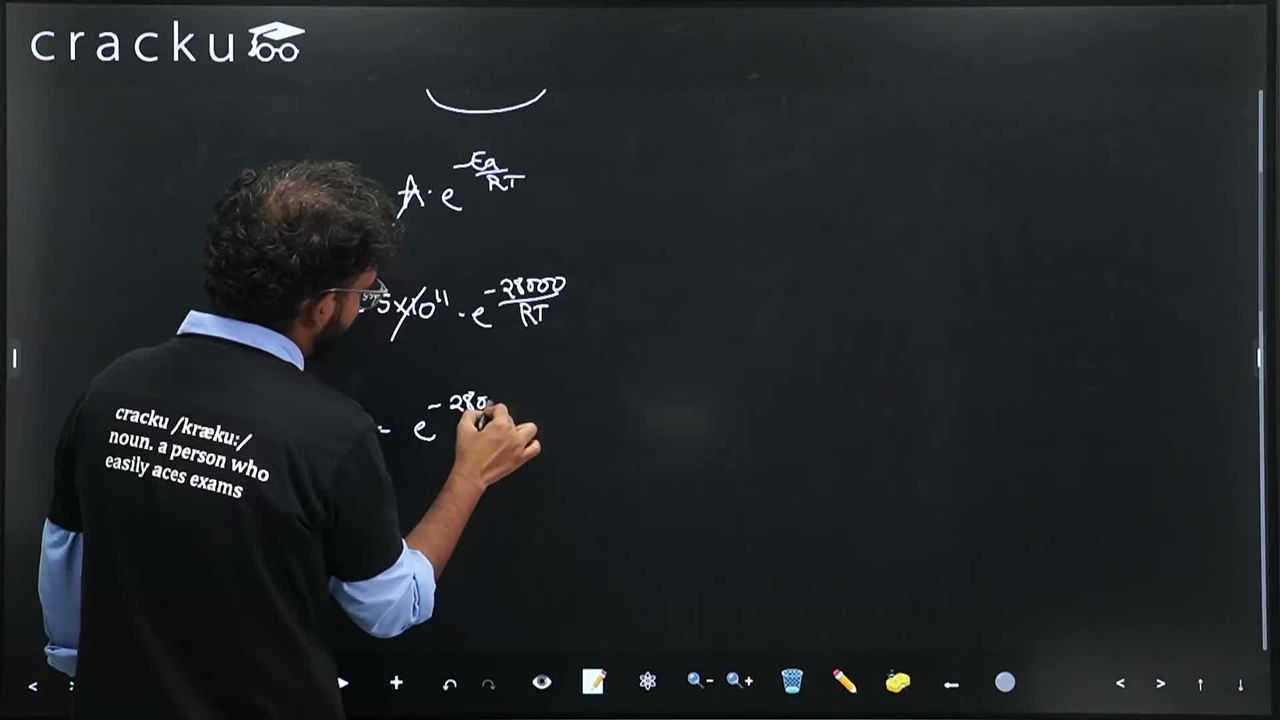
Decomposition of a hydrocarbon follows the equation $$k = (5.5 \times 10^{11} s^{-1}) e^{\frac{-28000K}{T}}$$. The activation energy of reaction is __________ kJ mol$$^{-1}$$. (Nearest Integer) Given : R = 8.3 J K$$^{-1}$$ mol$$^{-1}$$
Correct Answer: 232
The Arrhenius equation for a reaction is given by
$$k=Ae^{-\frac{E_a}{RT}}$$
where (k) is the rate constant, (A) is the Arrhenius pre-exponential factor, (E_a) is the activation energy, (R) is the universal gas constant, and (T) is the absolute temperature.
The given rate equation is
$$k=(5.5\times10^{11},s^{-1})e^{-\frac{28000}{T}}.$$
Comparing this expression with the standard Arrhenius equation,
$$e^{-\frac{E_a}{RT}}=e^{-\frac{28000}{T}},$$
we obtain
$$\frac{E_a}{R}=28000.$$
Using the value of the gas constant,
$$R=8.3\ \text{J K}^{-1}\text{mol}^{-1},$$
the activation energy is
$$E_a=28000\times8.3=232400\ \text{J mol}^{-1}.$$
Converting this into (\text{kJ mol}^{-1}),
$$E_a=\frac{232400}{1000}=232.4\ \text{kJ mol}^{-1}.$$
Rounding to the nearest integer,
$$E_a\approx232\ \text{kJ mol}^{-1}.$$
Hence, the activation energy of the reaction is (232\ \text{kJ mol}^{-1}).
Was this solution helpful?
Click on the Email ☝️ to Watch the Video Solution
Create a FREE account and get:
_1.webp)

Educational materials for JEE preparation

Ask our AI anything

AI can make mistakes. Please verify important information.
AI can make mistakes. Please verify important information.
