
Join Our JEE Preparation Group
Prep with like-minded aspirants; Get access to free daily tests and study material.
Sign in
Please select an account to continue using cracku.in
↓ →
Join Our JEE Preparation Group
Prep with like-minded aspirants; Get access to free daily tests and study material.
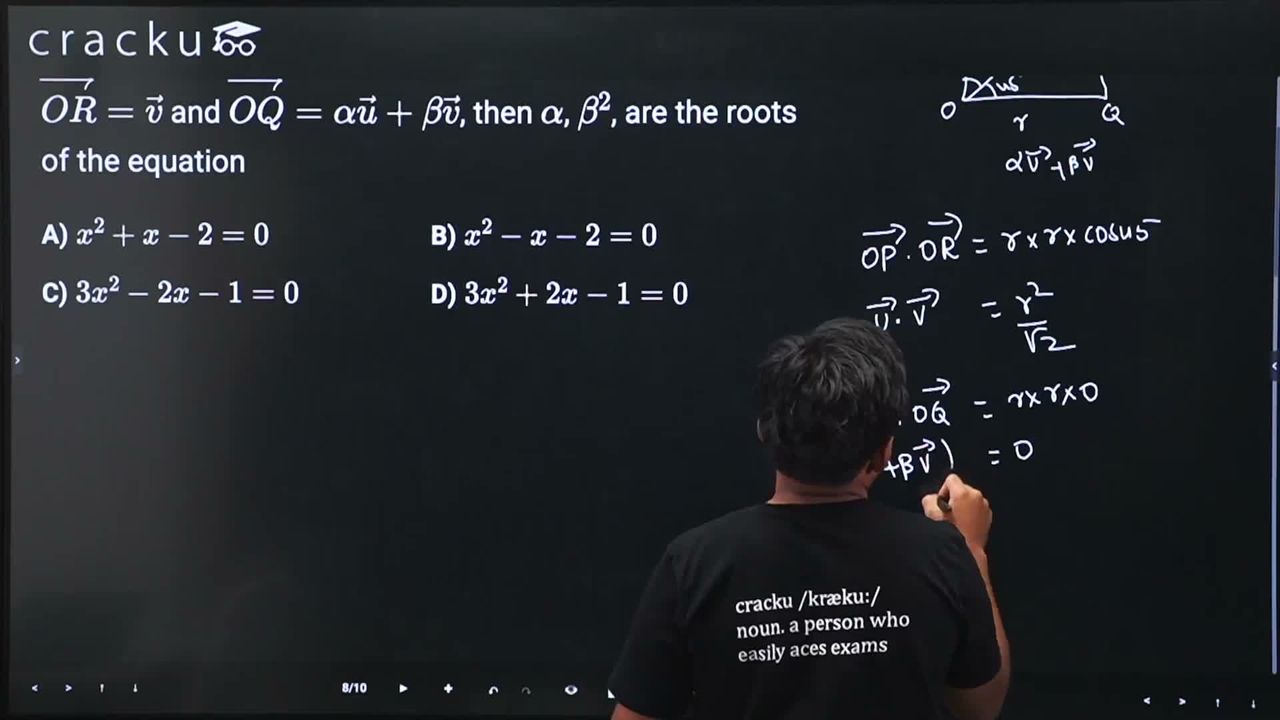
An arc $$PQ$$ of a circle subtends a right angle at its centre $$O$$. The mid point of the arc $$PQ$$ is $$R$$. If $$\overrightarrow{OP} = \vec{u}$$, $$\overrightarrow{OR} = \vec{v}$$ and $$\overrightarrow{OQ} = \alpha\vec{u} + \beta\vec{v}$$, then $$\alpha$$, $$\beta^2$$, are the roots of the equation
Let the circle have centre O and radius r. Arc PQ subtends a right angle at O, so $$\angle POQ = 90°$$.
R is the midpoint of arc PQ, so $$\angle POR = \angle ROQ = 45°$$.
Let $$\vec{u} = \overrightarrow{OP}$$, $$\vec{v} = \overrightarrow{OR}$$. Since $$|\vec{u}| = |\vec{v}| = r$$.
$$\vec{u} \cdot \vec{v} = r^2\cos 45° = \frac{r^2}{\sqrt{2}}$$
$$\overrightarrow{OQ} = \alpha\vec{u} + \beta\vec{v}$$. Also $$|\overrightarrow{OQ}| = r$$ and $$\angle QOR = 45°$$.
Taking dot product with $$\vec{u}$$: $$\overrightarrow{OQ} \cdot \vec{u} = r^2\cos 90° = 0$$
$$\alpha r^2 + \beta \frac{r^2}{\sqrt{2}} = 0$$, so $$\alpha + \frac{\beta}{\sqrt{2}} = 0$$, giving $$\alpha = -\frac{\beta}{\sqrt{2}}$$.
Taking dot product with $$\vec{v}$$: $$\overrightarrow{OQ} \cdot \vec{v} = r^2\cos 45° = \frac{r^2}{\sqrt{2}}$$
$$\alpha \frac{r^2}{\sqrt{2}} + \beta r^2 = \frac{r^2}{\sqrt{2}}$$
$$\frac{\alpha}{\sqrt{2}} + \beta = \frac{1}{\sqrt{2}}$$
Substituting $$\alpha = -\beta/\sqrt{2}$$: $$-\beta/2 + \beta = 1/\sqrt{2}$$, so $$\beta/2 = 1/\sqrt{2}$$, $$\beta = \sqrt{2}$$.
$$\alpha = -\sqrt{2}/\sqrt{2} = -1$$.
$$\beta^2 = 2$$. The roots of the equation are $$\alpha = -1$$ and $$\beta^2 = 2$$.
Equation: $$(x+1)(x-2) = 0 \Rightarrow x^2 - x - 2 = 0$$
The correct answer is Option 2.
Was this solution helpful?
Click on the Email ☝️ to Watch the Video Solution
Create a FREE account and get:
_1.webp)

Educational materials for JEE preparation

Ask our AI anything

AI can make mistakes. Please verify important information.
AI can make mistakes. Please verify important information.
