
Join Our JEE Preparation Group
Prep with like-minded aspirants; Get access to free daily tests and study material.
Sign in
Please select an account to continue using cracku.in
↓ →
Join Our JEE Preparation Group
Prep with like-minded aspirants; Get access to free daily tests and study material.
A non-volatile, non-electrolyte solid solute when dissolved in 40 g of a solvent, the vapour pressure of the solvent decreased from 760 mm Hg to 750 mm Hg. If the same solution boils at 320 K, then the number of moles of the solvent present in the solution is _____. (Nearest integer)
[Given: boiling point of the pure solvent = 319.5 K, $$K_b$$ of the solvent = 0.3 K kg mol$$^{-1}$$]
Correct Answer: 5
The vapour pressure and boiling-point data are linked to the composition of the solution through Raoult’s law and the elevation of boiling point equation. We first determine how many moles of solute are present, then use the vapour-pressure lowering to back-calculate the moles of solvent.
Step 1 : Molality from boiling-point elevation
$$\text{}$$
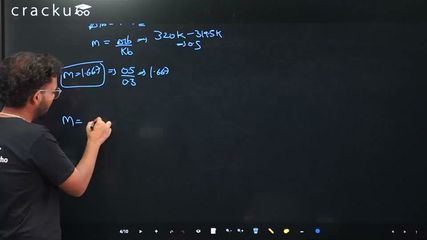
The rise in boiling point is$$\Delta T_b = 320\;\text{K} - 319.5\;\text{K} = 0.5\;\text{K}$$
$$\text{}$$
For a non-volatile, non-electrolyte solute,$$\Delta T_b = K_b \, m \quad -(1)$$
$$\text{}$$
Hence
$$m = \frac{\Delta T_b}{K_b} = \frac{0.5}{0.3} = \frac{5}{3} = 1.6667\;\text{mol kg}^{-1}$$
Step 2 : Moles of solute present
$$\text{}$$
Mass of solvent given = 40 g = 0.040 kg.
$$\text{}$$
By definition of molality,$$m = \frac{n_{\text{solute}}}{\text{mass of solvent (kg)}}$$
$$\text{}$$
Therefore
$$n_{\text{solute}} = m \times 0.040 = 1.6667 \times 0.040 = 0.06667\;\text{mol}$$
Step 3 : Mole fraction of solute from vapour-pressure lowering
$$\text{}$$
Raoult’s law for the solvent gives$$P = X_{\text{solvent}}\,P^0$$
$$\text{}$$
So the relative lowering of vapour pressure is
$$\frac{P^0 - P}{P^0} = 1 - X_{\text{solvent}} = X_{\text{solute}} \quad -(2)$$
$$\text{}$$
Given$$P^0 = 760\;\text{mm Hg},\; P = 750\;\text{mm Hg}$$
$$\text{}$$
Hence
$$X_{\text{solute}} = \frac{760 - 750}{760} = \frac{10}{760} = \frac{1}{76} = 0.0131579$$
Step 4 : Moles of solvent
$$\text{}$$
Let $$n_{\text{solvent}}$$ be the unknown moles of solvent.
$$\text{}$$
Then$$X_{\text{solute}} = \frac{n_{\text{solute}}}{n_{\text{solute}} + n_{\text{solvent}}}$$
$$\text{}$$
Substituting values,
$$0.0131579 = \frac{0.06667}{0.06667 + n_{\text{solvent}}}$$
$$\text{}$$
Cross-multiplying,
$$0.0131579\,(0.06667 + n_{\text{solvent}}) = 0.06667$$
$$\text{}$$
$$0.0008772 + 0.0131579\,n_{\text{solvent}} = 0.06667$$
$$\text{}$$
$$0.0131579\,n_{\text{solvent}} = 0.06667 - 0.0008772 = 0.06579$$
$$\text{}$$
$$n_{\text{solvent}} = \frac{0.06579}{0.0131579} \approx 5.00\;\text{mol}$$
The nearest integer value for the number of moles of solvent present in the solution is 5.
Was this solution helpful?
Click on the Email ☝️ to Watch the Video Solution
Create a FREE account and get:
_1.webp)

Educational materials for JEE preparation

Ask our AI anything

AI can make mistakes. Please verify important information.
AI can make mistakes. Please verify important information.


