
Join Our JEE Preparation Group
Prep with like-minded aspirants; Get access to free daily tests and study material.
Sign in
Please select an account to continue using cracku.in
↓ →
Join Our JEE Preparation Group
Prep with like-minded aspirants; Get access to free daily tests and study material.
Some $$CO_2$$ gas was kept in a sealed container at a pressure of 1 atm and at 273 K . This entire amount of $$CO_2$$ gas was later passed through an aqueous solution of $$Ca(OH)_2$$. The excess unreacted $$Ca(OH)_2$$ was later neutralized with 0.1 M of 40 mL HCl . If the volume of the sealed container of $$CO_2$$ was $$x$$, then $$x$$ is ________$$cm^{3}$$ (nearest integer). [Given : The entire amount of $$CO_2 (g)$$reacted with exactly half the initial amount of $$Ca(OH)_2$$ present in the aqueous solution.]
Correct Answer: 45
We need to find the volume of the sealed container of $$CO_2$$.
We start by writing the chemical reactions involved.
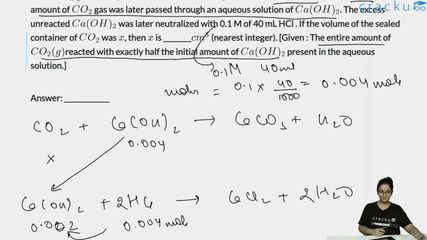
$$CO_2 + Ca(OH)_2 \rightarrow CaCO_3 + H_2O$$
Next, the excess $$Ca(OH)_2$$ is neutralized by hydrochloric acid:
$$Ca(OH)_2 + 2HCl \rightarrow CaCl_2 + 2H_2O$$
Then we calculate the moles of excess $$Ca(OH)_2$$ from the titration data.
Moles of HCl = 0.1 M × 0.040 L = 0.004 mol
Moles of excess $$Ca(OH)_2$$ = $$\frac{0.004}{2} = 0.002$$ mol
The problem states that all of the $$CO_2$$ reacted with exactly half of the initial amount of $$Ca(OH)_2$$.
If the initial $$Ca(OH)_2$$ is N mol, then the reacted portion is N/2 mol and the excess is also N/2 mol.
Therefore, $$N/2 = 0.002$$ mol, so $$N = 0.004$$ mol.
It follows that the moles of $$CO_2$$ are equal to the moles of $$Ca(OH)_2$$ that reacted, which is N/2 = 0.002 mol.
Finally, applying the ideal gas law at STP (273 K, 1 atm):
$$V = n \times 22400 \text{ cm}^3/\text{mol} = 0.002 \times 22400 = 44.8 \text{ cm}^3$$
Rounding to the nearest integer gives $$x \approx 45$$ cm³.
Therefore, the volume of the sealed container of $$CO_2$$ is 45 cm³.
Was this solution helpful?
Click on the Email ☝️ to Watch the Video Solution
Create a FREE account and get:
_1.webp)

Educational materials for JEE preparation

Ask our AI anything

AI can make mistakes. Please verify important information.
AI can make mistakes. Please verify important information.
