
Join Our JEE Preparation Group
Prep with like-minded aspirants; Get access to free daily tests and study material.
Sign in
Please select an account to continue using cracku.in
↓ →
Join Our JEE Preparation Group
Prep with like-minded aspirants; Get access to free daily tests and study material.
Sodium fusion extract of an organic compound (Y) with $$CHCl_{3}$$ and chlorine water gives violet color to the $$CHCl_{3} $$ layer. 0.15g of $$(Y)$$ gave 0.12g of the silver halide precipitate in Carius method. Percentage of halogen in the compound $$(Y)$$ is _______ . (Nearest integer)
(Given : molar mass g $$mol^{-}$$ C : 12 , H : 1, Cl : 35.5, Br : 80 , I : 127)
Correct Answer: 43
We need to find the percentage of halogen in compound Y.
First, the halogen was identified by treating the sodium fusion extract with $$CHCl_3$$ and chlorine water, which gives a violet color to the $$CHCl_3$$ layer. This is the test for iodine, since iodine dissolves in $$CHCl_3$$ giving a violet/purple color. Hence the halogen is iodine (I), with molar mass 127 g/mol.
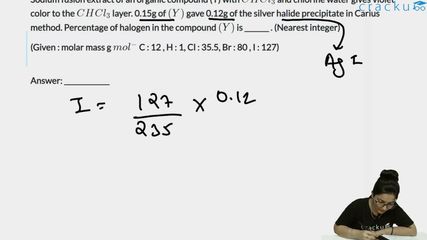
Next, using the Carius method data for iodine, the precipitate formed is AgI (molar mass = 108 + 127 = 235 g/mol). The mass of the compound taken was 0.15 g and the mass of AgI obtained was 0.12 g.
Therefore, the mass of iodine can be calculated as $$\text{Mass of I} = \frac{127}{235} \times 0.12 = \frac{15.24}{235} = 0.06485 \text{ g}$$.
From this, the percentage of iodine in the compound is $$\% \text{ of I} = \frac{0.06485}{0.15} \times 100 = 43.23\%$$.
The percentage of halogen is approximately $$43\%$$ to the nearest integer.
Therefore, the answer is 43.
Was this solution helpful?
Click on the Email ☝️ to Watch the Video Solution
Create a FREE account and get:
_1.webp)

Educational materials for JEE preparation

Ask our AI anything

AI can make mistakes. Please verify important information.
AI can make mistakes. Please verify important information.
