
Join Our JEE Preparation Group
Prep with like-minded aspirants; Get access to free daily tests and study material.
Sign in
Please select an account to continue using cracku.in
↓ →
Join Our JEE Preparation Group
Prep with like-minded aspirants; Get access to free daily tests and study material.
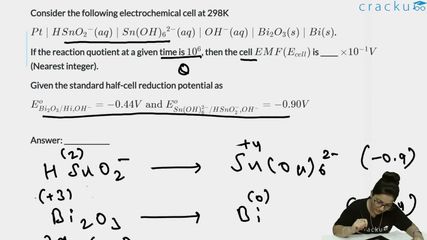
Consider the following electrochemical cell at 298K
$$ Pt \mid HSnO_2{^-}(aq)\mid Sn(OH)_6{^{2-}}(aq)\mid OH^{-}(aq)\mid Bi_{2}O_{3}(s)\mid Bi(s)$$.
If the reaction quotient at a given time is $$10^{6}$$, then the cell $$EMF (E_{cell})$$ is _____ $$\times 10^{-1} V$$ (Nearest integer).
Given the standard half-cell reduction potential as
$$E_{Bi_{2}O_{3}/Hi,OH^{-}}^{o}=-0.44V \text{ and }E_{Sn(OH)_6^{2-}/HSnO_2^{-}, OH^{-}}^{o}=-0.90V$$
Correct Answer: 4
We have an electrochemical cell: $$Pt \mid HSnO_2^-(aq) \mid Sn(OH)_6^{2-}(aq) \mid OH^-(aq) \mid Bi_2O_3(s) \mid Bi(s)$$
Given: $$E^\circ_{Bi_2O_3/Bi, OH^-} = -0.44$$ V and $$E^\circ_{Sn(OH)_6^{2-}/HSnO_2^-, OH^-} = -0.90$$ V. Reaction quotient $$Q = 10^6$$.
Anode (oxidation): $$HSnO_2^- \to Sn(OH)_6^{2-}$$ ($$E^\circ = -0.90$$ V)
Cathode (reduction): $$Bi_2O_3 \to Bi$$ ($$E^\circ = -0.44$$ V)
$$E^\circ_{cell} = E^\circ_{cathode} - E^\circ_{anode} = -0.44 - (-0.90) = 0.46$$ V
Sn goes from +2 (in $$HSnO_2^-$$) to +4 (in $$Sn(OH)_6^{2-}$$): loses 2 electrons per Sn.
Bi goes from +3 (in $$Bi_2O_3$$) to 0 (Bi): gains 3 electrons per Bi, so 6 electrons for 2 Bi.
To balance: 3 Sn atoms (losing 6 electrons total) and 1 $$Bi_2O_3$$ (gaining 6 electrons). So $$n = 6$$.
$$E_{cell} = E^\circ_{cell} - \frac{0.0592}{n}\log Q$$
$$= 0.46 - \frac{0.0592}{6}\log(10^6)$$
$$= 0.46 - \frac{0.0592}{6} \times 6$$
$$= 0.46 - 0.0592 = 0.4008 \approx 0.4$$ V
$$E_{cell} \approx 0.4$$ V $$= 4 \times 10^{-1}$$ V
The answer is 4.
Was this solution helpful?
Click on the Email ☝️ to Watch the Video Solution
Create a FREE account and get:
_1.webp)

Educational materials for JEE preparation

Ask our AI anything

AI can make mistakes. Please verify important information.
AI can make mistakes. Please verify important information.
