
Join Our JEE Preparation Group
Prep with like-minded aspirants; Get access to free daily tests and study material.
Sign in
Please select an account to continue using cracku.in
↓ →
Join Our JEE Preparation Group
Prep with like-minded aspirants; Get access to free daily tests and study material.
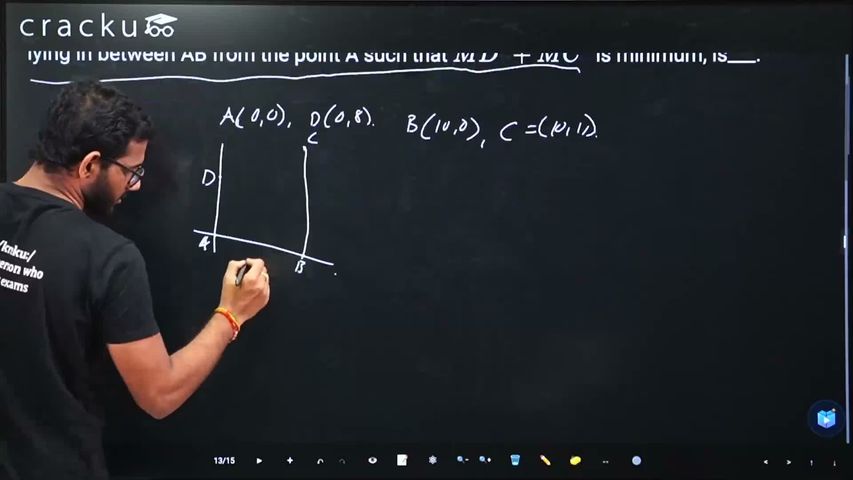
Let $$AD$$ and $$BC$$ be two vertical poles at $$A$$ and $$B$$ respectively on a horizontal ground. If $$AD = 8\,\text{m}$$, $$BC = 11\,\text{m}$$, $$AB = 10\,\text{m}$$; then the distance (in meters) of a point M lying in between AB from the point A such that $$MD^2 + MC^2$$ is minimum, is___.
Correct Answer: 5
We begin by placing the whole arrangement on an $$XY$$-plane whose $$X$$-axis is the horizontal ground. Let us choose the origin at the foot of the first pole.
Thus we take $$A(0,0),\quad D(0,8),\quad B(10,0),\quad C(10,11).$$ The heights $$AD=8\text{ m}$$ and $$BC=11\text{ m}$$ give the $$y$$-coordinates of $$D$$ and $$C$$, while the distance $$AB=10\text{ m}$$ fixes the $$x$$-coordinate of $$B$$ and $$C$$.
The point $$M$$ lies somewhere between $$A$$ and $$B$$ on the ground. If we call the distance $$AM=x\text{ m},$$ then $$M$$ has coordinates $$M(x,0),\qquad 0\lt x\lt 10.$$ Our objective is to minimise $$MD^{2}+MC^{2}.$$ Instead of the actual distances we may minimise their squares because the square‐root function is increasing.
For any two points $$\bigl(x_{1},y_{1}\bigr)$$ and $$\bigl(x_{2},y_{2}\bigr)$$ on a plane, the distance-square formula is $$\bigl(\text{distance}\bigr)^{2}=(x_{2}-x_{1})^{2}+(y_{2}-y_{1})^{2}.$$
Applying this to $$M(x,0)$$ and $$D(0,8)$$ we have $$$ \begin{aligned} MD^{2}&=(x-0)^{2}+(0-8)^{2} \\ &=x^{2}+64. \end{aligned} $$$
Similarly, between $$M(x,0)$$ and $$C(10,11)$$ we get $$$ \begin{aligned} MC^{2}&=(x-10)^{2}+(0-11)^{2} \\ &=(x-10)^{2}+121. \end{aligned} $$$
Adding these two expressions gives $$$ \begin{aligned} MD^{2}+MC^{2}&=\bigl(x^{2}+64\bigr)+\bigl((x-10)^{2}+121\bigr)\\ &=x^{2}+64+x^{2}-20x+100+121\\ &=2x^{2}-20x+285. \end{aligned} $$$
We now have a quadratic function of $$x$$: $$S(x)=2x^{2}-20x+285.$$ A quadratic $$ax^{2}+bx+c$$ attains its minimum at $$x=-\dfrac{b}{2a}.$$ Here $$a=2$$ and $$b=-20$$, so $$$ x=-\dfrac{-20}{2\cdot 2}=\dfrac{20}{4}=5. $$$
The value $$x=5$$ indeed lies between 0 and 10, so it is admissible. Therefore the point $$M$$ must be chosen $$5$$ metres from $$A$$ to minimise the required sum of squares.
So, the answer is $$5$$.
Was this solution helpful?
Click on the Email ☝️ to Watch the Video Solution
Create a FREE account and get:
_1.webp)

Educational materials for JEE preparation

Ask our AI anything

AI can make mistakes. Please verify important information.
AI can make mistakes. Please verify important information.
