
Join Our JEE Preparation Group
Prep with like-minded aspirants; Get access to free daily tests and study material.
Sign in
Please select an account to continue using cracku.in
↓ →
Join Our JEE Preparation Group
Prep with like-minded aspirants; Get access to free daily tests and study material.
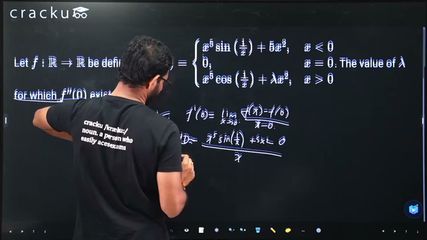
Let $$f : \mathbb{R} \to \mathbb{R}$$ be defined as $$f(x) = \begin{cases} x^5\sin\left(\frac{1}{x}\right) + 5x^2, & x < 0 \\ 0, & x = 0 \\ x^5\cos\left(\frac{1}{x}\right) + \lambda x^2, & x > 0 \end{cases}$$. The value of $$\lambda$$ for which $$f''(0)$$ exists, is___.
Correct Answer: 5
We are given the piece-wise real function
$$ f(x)= \begin{cases} x^{5}\sin\!\left(\dfrac1x\right)+5x^{2}, & x<0,\\[6pt] 0, & x=0,\\[6pt] x^{5}\cos\!\left(\dfrac1x\right)+\lambda x^{2}, & x>0. \end{cases} $$
Our task is to find the value of the constant $$\lambda$$ for which the second derivative $$f''(0)$$ exists.
According to the definition of a derivative, the first derivative at zero is
$$ f'(0)=\lim_{x\to0}\frac{f(x)-f(0)}{x}. $$
We therefore begin by computing $$f'(0)$$ from the left and from the right.
Left side ($$x<0$$)
For $$x<0$$ we have $$f(x)=x^{5}\sin\!\left(\dfrac1x\right)+5x^{2}$$, so
$$ \frac{f(x)-f(0)}{x} =\frac{x^{5}\sin\!\left(\dfrac1x\right)+5x^{2}-0}{x} =x^{4}\sin\!\left(\dfrac1x\right)+5x. $$
Because $$-1\le\sin\theta\le1$$ for every real $$\theta$$, the factor $$x^{4}$$ forces the first term to $$0$$ as $$x\to0$$, and the second term $$5x$$ also tends to $$0$$. Hence
$$ \lim_{x\to0^-}\frac{f(x)-f(0)}{x}=0. $$
Right side ($$x>0$$)
For $$x>0$$ we have $$f(x)=x^{5}\cos\!\left(\dfrac1x\right)+\lambda x^{2}$$, so
$$ \frac{f(x)-f(0)}{x} =\frac{x^{5}\cos\!\left(\dfrac1x\right)+\lambda x^{2}-0}{x} =x^{4}\cos\!\left(\dfrac1x\right)+\lambda x. $$
Again, the boundedness of $$\cos$$ and the explicit factor of $$x$$ make both terms approach $$0$$ as $$x\to0$$. Thus
$$ \lim_{x\to0^+}\frac{f(x)-f(0)}{x}=0. $$
Since both one-sided limits are equal, we have
$$ f'(0)=0. $$
Next we recall the definition of the second derivative:
$$ f''(0)=\lim_{x\to0}\frac{f'(x)-f'(0)}{x}. $$
Therefore we now compute the first derivative away from zero and then take the above limit.
Derivative for $$x<0$$
Write $$g(x)=x^{5}\sin\!\left(\tfrac1x\right).$$ Using the product rule and the chain rule,
$$ \frac{d}{dx}\,x^{5}\sin\!\left(\tfrac1x\right) =5x^{4}\sin\!\left(\tfrac1x\right) +x^{5}\cos\!\left(\tfrac1x\right)\left(-\frac1{x^{2}}\right) =5x^{4}\sin\!\left(\tfrac1x\right)-x^{3}\cos\!\left(\tfrac1x\right). $$
The derivative of $$5x^{2}$$ is plainly $$10x$$. Hence for $$x<0$$
$$ f'(x)=5x^{4}\sin\!\left(\tfrac1x\right)-x^{3}\cos\!\left(\tfrac1x\right)+10x. $$
Derivative for $$x>0$$
For $$x^{5}\cos\!\left(\tfrac1x\right)$$, again apply the product and chain rules:
$$ \frac{d}{dx}\,x^{5}\cos\!\left(\tfrac1x\right) =5x^{4}\cos\!\left(\tfrac1x\right) +x^{5}\!\left(-\sin\!\left(\tfrac1x\right)\right)\!\left(-\frac1{x^{2}}\right) =5x^{4}\cos\!\left(\tfrac1x\right)+x^{3}\sin\!\left(\tfrac1x\right). $$
The derivative of $$\lambda x^{2}$$ is $$2\lambda x$$. Consequently, for $$x>0$$
$$ f'(x)=5x^{4}\cos\!\left(\tfrac1x\right)+x^{3}\sin\!\left(\tfrac1x\right)+2\lambda x. $$
We now evaluate the limit that defines $$f''(0)$$ separately from the left and from the right.
Left-hand limit
For $$x<0$$, subtract $$f'(0)=0$$ and divide by $$x$$:
$$ \frac{f'(x)-f'(0)}{x} =\frac{5x^{4}\sin\!\left(\tfrac1x\right)-x^{3}\cos\!\left(\tfrac1x\right)+10x}{x} =5x^{3}\sin\!\left(\tfrac1x\right)-x^{2}\cos\!\left(\tfrac1x\right)+10. $$
The first two terms contain factors $$x^{3}$$ and $$x^{2}$$, respectively, both of which drive them to $$0$$ because $$\sin$$ and $$\cos$$ stay between $$-1$$ and $$1$$. Therefore
$$ \lim_{x\to0^-}\frac{f'(x)-f'(0)}{x}=10. $$
Right-hand limit
For $$x>0$$ we get
$$ \frac{f'(x)-f'(0)}{x} =\frac{5x^{4}\cos\!\left(\tfrac1x\right)+x^{3}\sin\!\left(\tfrac1x\right)+2\lambda x}{x} =5x^{3}\cos\!\left(\tfrac1x\right)+x^{2}\sin\!\left(\tfrac1x\right)+2\lambda. $$
Again the first two terms shrink to $$0$$ as $$x\to0$$, leaving
$$ \lim_{x\to0^+}\frac{f'(x)-f'(0)}{x}=2\lambda. $$
For the second derivative $$f''(0)$$ to exist, the left-hand and right-hand limits must coincide; hence we require
$$ 10 = 2\lambda. $$
Solving immediately yields
$$ \lambda = 5. $$
So, the answer is $$5$$.
Was this solution helpful?
Click on the Email ☝️ to Watch the Video Solution
Create a FREE account and get:
_1.webp)

Educational materials for JEE preparation

Ask our AI anything

AI can make mistakes. Please verify important information.
AI can make mistakes. Please verify important information.
