
Join Our JEE Preparation Group
Prep with like-minded aspirants; Get access to free daily tests and study material.
Sign in
Please select an account to continue using cracku.in
↓ →
Join Our JEE Preparation Group
Prep with like-minded aspirants; Get access to free daily tests and study material.
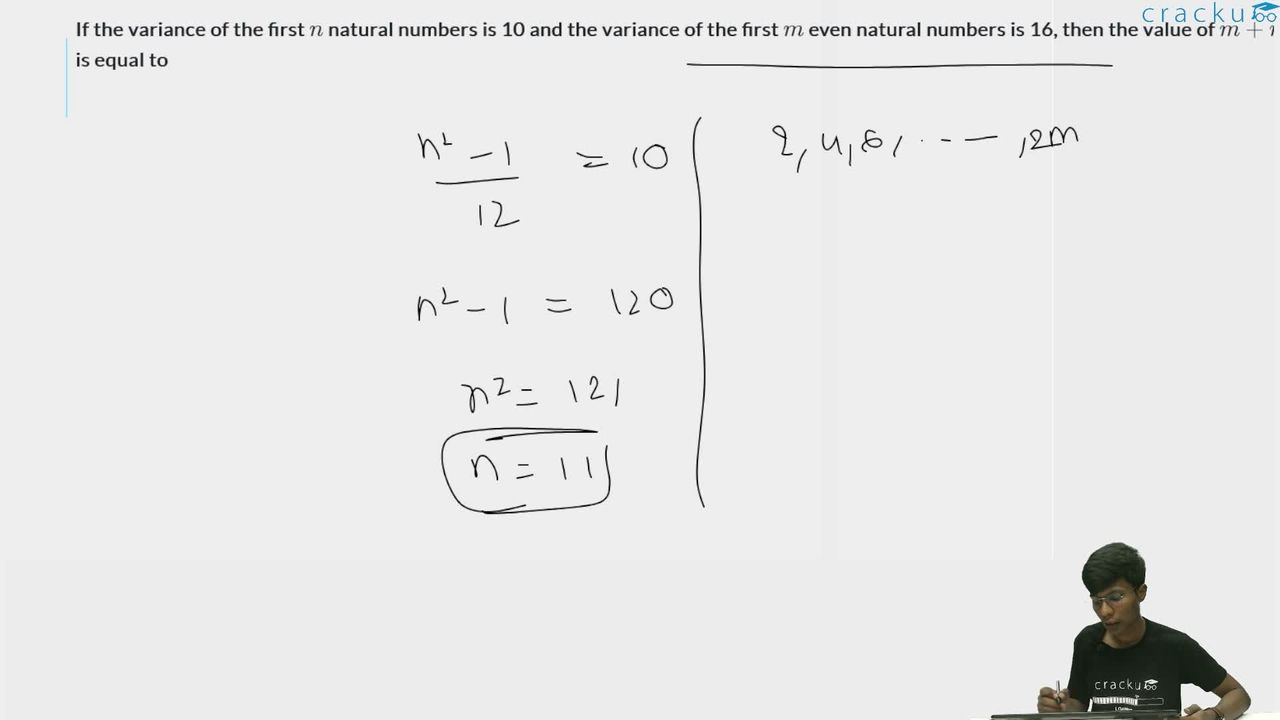
If the variance of the first $$n$$ natural numbers is 10 and the variance of the first $$m$$ even natural numbers is 16, then the value of $$m + n$$ is equal to
Correct Answer: 18
We begin by recalling that the variance of a data set having $$N$$ observations $$x_1,\;x_2,\;\dots ,x_N$$ is given by the formula
$$\text{Variance}= \frac{\displaystyle\sum_{i=1}^{N}x_i^{2}}{N}-\left(\frac{\displaystyle\sum_{i=1}^{N}x_i}{N}\right)^{2}.$$
First we deal with the variance of the first $$n$$ natural numbers, i.e. $$1,2,3,\dots ,n.$$
The number of terms is clearly $$N=n.$$
The sum of the first $$n$$ natural numbers is the well-known result
$$\sum_{k=1}^{n}k=\frac{n(n+1)}{2}.$$
The sum of the squares of the first $$n$$ natural numbers is
$$\sum_{k=1}^{n}k^{2}= \frac{n(n+1)(2n+1)}{6}.$$
Substituting these expressions into the variance formula, we obtain
$$\text{Var}_{\text{first }n}= \frac{\dfrac{n(n+1)(2n+1)}{6}}{n}-\left(\frac{\dfrac{n(n+1)}{2}}{n}\right)^{2}.$$
Simplifying the fractions one at a time, we have
$$\text{Var}_{\text{first }n}= \frac{(n+1)(2n+1)}{6}-\left(\frac{n+1}{2}\right)^{2}.$$
Taking the common factor $$(n+1)$$ out, the expression becomes
$$\text{Var}_{\text{first }n}= (n+1)\left[\frac{2n+1}{6}-\frac{n+1}{4}\right].$$
We now combine the two fractions inside the square brackets by using the common denominator 12:
$$\frac{2n+1}{6}=\frac{2(2n+1)}{12}=\frac{4n+2}{12}, \quad \frac{n+1}{4}=\frac{3(n+1)}{12}=\frac{3n+3}{12}.$$
Subtracting gives
$$\frac{4n+2}{12}-\frac{3n+3}{12}= \frac{(4n+2)-(3n+3)}{12}= \frac{n-1}{12}.$$
Hence,
$$\text{Var}_{\text{first }n}= (n+1)\left(\frac{n-1}{12}\right)=\frac{n^{2}-1}{12}.$$
According to the question, this variance equals 10, so
$$\frac{n^{2}-1}{12}=10 \;\Longrightarrow\; n^{2}-1=120 \;\Longrightarrow\; n^{2}=121 \;\Longrightarrow\; n=11.$$
Next, we consider the first $$m$$ even natural numbers, namely $$2,4,6,\dots ,2m.$$ Observe that each term is exactly twice the corresponding term in the set $$1,2,3,\dots ,m.$$
If a data set is multiplied by a constant factor $$c,$$ its variance is multiplied by $$c^{2}.$$ Here the constant factor is $$c=2,$$ so the variance of $$2,4,6,\dots ,2m$$ is
$$\text{Var}_{\text{even}} = 2^{2}\times\text{Var}_{\text{first }m}=4\times\frac{m^{2}-1}{12}=\frac{m^{2}-1}{3}.$$
We are told that this variance equals 16, hence
$$\frac{m^{2}-1}{3}=16 \;\Longrightarrow\; m^{2}-1=48 \;\Longrightarrow\; m^{2}=49 \;\Longrightarrow\; m=7.$$
Finally, the problem asks for $$m+n,$$ and we have found $$m=7$$ and $$n=11,$$ so
$$m+n = 7+11 = 18.$$
So, the answer is $$18$$.
Was this solution helpful?
Click on the Email ☝️ to Watch the Video Solution
Create a FREE account and get:
_1.webp)

Educational materials for JEE preparation

Ask our AI anything

AI can make mistakes. Please verify important information.
AI can make mistakes. Please verify important information.


