
Join Our JEE Preparation Group
Prep with like-minded aspirants; Get access to free daily tests and study material.
Sign in
Please select an account to continue using cracku.in
↓ →
Join Our JEE Preparation Group
Prep with like-minded aspirants; Get access to free daily tests and study material.
The sum $$\sum_{k=1}^{20} (1 + 2 + 3 + \ldots + k)$$ is
Correct Answer: 1540
We have to evaluate the series $$\displaystyle\sum_{k=1}^{20}\left(1+2+3+\dots+k\right).$$
First recall the standard result for the sum of the first $$k$$ natural numbers. The formula is
$$1+2+3+\dots+k=\frac{k(k+1)}{2}.$$
Using this, the given series becomes
$$\sum_{k=1}^{20}\left(1+2+3+\dots+k\right)=\sum_{k=1}^{20}\frac{k(k+1)}{2}.$$
Because the constant $$\tfrac12$$ can be factored out of the summation, we write
$$\sum_{k=1}^{20}\frac{k(k+1)}{2}=\frac12\sum_{k=1}^{20}k(k+1).$$
Now expand $$k(k+1)$$:
$$k(k+1)=k^2+k.$$
Substituting this expansion into the sum gives
$$\frac12\sum_{k=1}^{20}\bigl(k^2+k\bigr)=\frac12\left(\sum_{k=1}^{20}k^2+\sum_{k=1}^{20}k\right).$$
We now evaluate the two standard summations separately. For the sum of the first $$n$$ natural numbers, the formula is
$$\sum_{k=1}^{n}k=\frac{n(n+1)}{2}.$$
Taking $$n=20$$ we obtain
$$\sum_{k=1}^{20}k=\frac{20\cdot21}{2}=210.$$
For the sum of the squares of the first $$n$$ natural numbers, the formula is
$$\sum_{k=1}^{n}k^2=\frac{n(n+1)(2n+1)}{6}.$$
Again putting $$n=20$$, we find
$$\sum_{k=1}^{20}k^2=\frac{20\cdot21\cdot41}{6}.$$
Calculate step by step: First $$20\cdot21=420$$. Next $$420\cdot41=17220$$. Finally divide by $$6$$:
$$\frac{17220}{6}=2870.$$
Now substitute the two results back into the big expression:
$$\frac12\left(\sum_{k=1}^{20}k^2+\sum_{k=1}^{20}k\right)=\frac12\left(2870+210\right).$$
Simplify inside the parentheses:
$$2870+210=3080.$$
Multiplying by $$\tfrac12$$ gives
$$\frac12\cdot3080=1540.$$
So, the answer is $$1540$$.
Was this solution helpful?
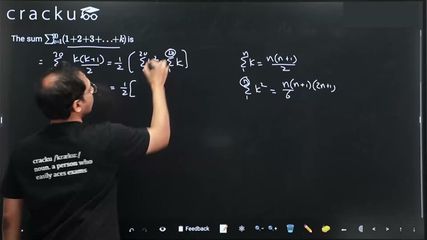
Click on the Email ☝️ to Watch the Video Solution
Create a FREE account and get:
_1.webp)

Educational materials for JEE preparation

Ask our AI anything

AI can make mistakes. Please verify important information.
AI can make mistakes. Please verify important information.
