
Join Our JEE Preparation Group
Prep with like-minded aspirants; Get access to free daily tests and study material.
Sign in
Please select an account to continue using cracku.in
↓ →
Join Our JEE Preparation Group
Prep with like-minded aspirants; Get access to free daily tests and study material.
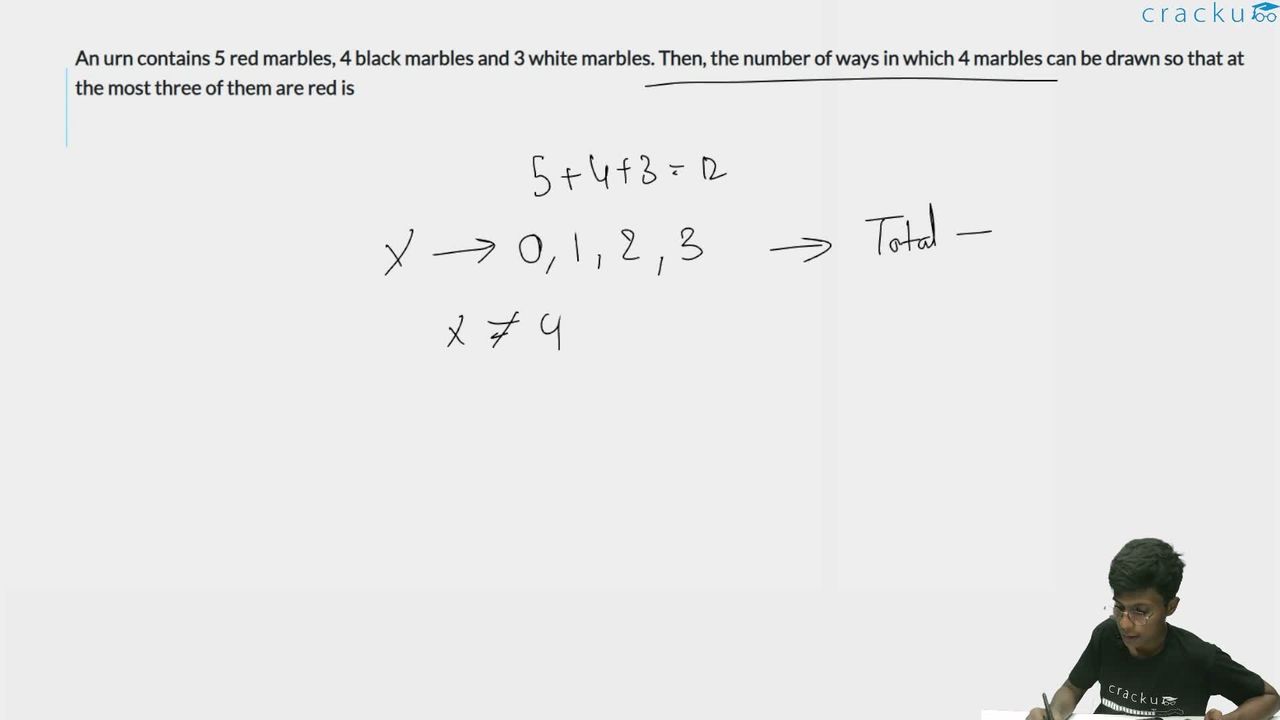
An urn contains 5 red marbles, 4 black marbles and 3 white marbles. Then, the number of ways in which 4 marbles can be drawn so that at the most three of them are red is
Correct Answer: 490
The urn has $$5$$ red, $$4$$ black and $$3$$ white marbles, so the total number of marbles is $$5+4+3=12$$.
We must select $$4$$ marbles. When every marble is distinguishable, the basic counting rule for choosing $$r$$ objects from $$n$$ distinct objects is the combination formula
$$^nC_r=\dfrac{n!}{r!(n-r)!}.$$
Applying this formula to the complete set of $$12$$ marbles, the total number of possible samples of $$4$$ marbles is
$$^{12}C_4=\dfrac{12!}{4!\,8!}=495.$$
However, the condition “at the most three of them are red” forbids exactly one case: all four chosen marbles being red. We therefore compute how many selections consist of four red marbles and then subtract those unwanted selections from the total.
Among the $$5$$ red marbles, the number of ways to choose $$4$$ red marbles is
$$^{5}C_4=\dfrac{5!}{4!\,1!}=5.$$
No other selection violates the condition, because any mixture containing $$0,1,2$$ or $$3$$ red marbles is allowed. Thus the required number of favourable selections is obtained by excluding the $$5$$ completely red selections from the total $$495$$ selections:
$$\text{Favourable ways}=^{12}C_4-^{5}C_4=495-5=490.$$
So, the answer is $$490$$.
Was this solution helpful?
Click on the Email ☝️ to Watch the Video Solution
Create a FREE account and get:
_1.webp)

Educational materials for JEE preparation

Ask our AI anything

AI can make mistakes. Please verify important information.
AI can make mistakes. Please verify important information.
