
Join Our JEE Preparation Group
Prep with like-minded aspirants; Get access to free daily tests and study material.
Sign in
Please select an account to continue using cracku.in
↓ →
Join Our JEE Preparation Group
Prep with like-minded aspirants; Get access to free daily tests and study material.
We begin with the expression $$\sim(\sim p \to q)$$ and shall simplify it carefully, showing every algebraic detail.
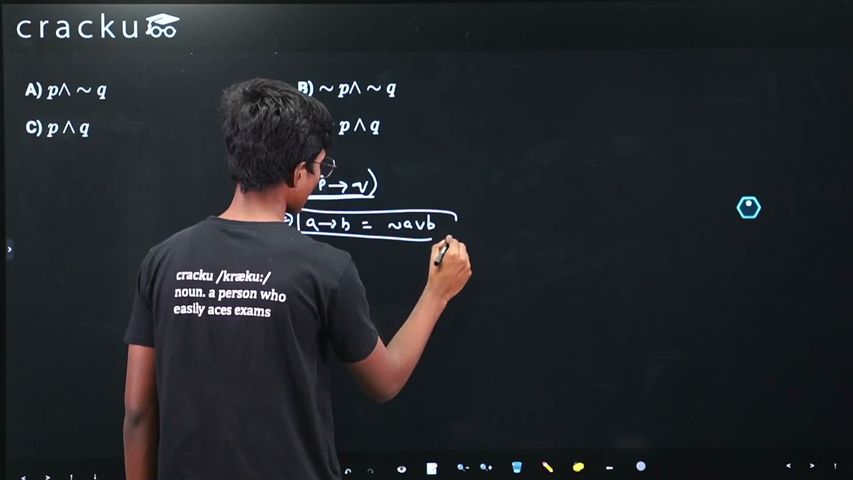
First, we recall the implication law:
$$x \to y \;\equiv\; \sim x \;\vee\; y.$$
Here the part playing the role of $$x$$ is $$\sim p$$ and the part playing the role of $$y$$ is $$q$$. Substituting these symbols into the implication law we obtain
$$\bigl(\,\sim p \to q\,\bigr) \;\equiv\; \sim(\,\sim p\,)\;\vee\;q.$$
Now, inside the negation we have a double negation $$\sim(\,\sim p\,)$$, and the rule of double negation states that $$\sim(\,\sim p\,)\equiv p$$. Hence we get
$$\bigl(\,\sim p \to q\,\bigr) \;\equiv\; p \;\vee\; q.$$
Returning to the original expression, we must negate this result. So we write
$$\sim(\,\sim p \to q\,) \;\equiv\; \sim\bigl(p \;\vee\; q\bigr).$$
Next, we invoke De Morgan’s law, which tells us that the negation of a disjunction is the conjunction of the negations:
$$\sim\bigl(p \;\vee\; q\bigr) \;\equiv\; \bigl(\sim p\bigr) \;\wedge\; \bigl(\sim q\bigr).$$
Thus, after carrying out all transformations, the original expression simplifies completely to
$$\sim p \;\wedge\; \sim q.$$
Looking at the options, this matches Option B.
Hence, the correct answer is Option B.
Was this solution helpful?
Click on the Email ☝️ to Watch the Video Solution
Create a FREE account and get:
_1.webp)

Educational materials for JEE preparation

Ask our AI anything

AI can make mistakes. Please verify important information.
AI can make mistakes. Please verify important information.


