
Join Our JEE Preparation Group
Prep with like-minded aspirants; Get access to free daily tests and study material.
Sign in
Please select an account to continue using cracku.in
↓ →
Join Our JEE Preparation Group
Prep with like-minded aspirants; Get access to free daily tests and study material.
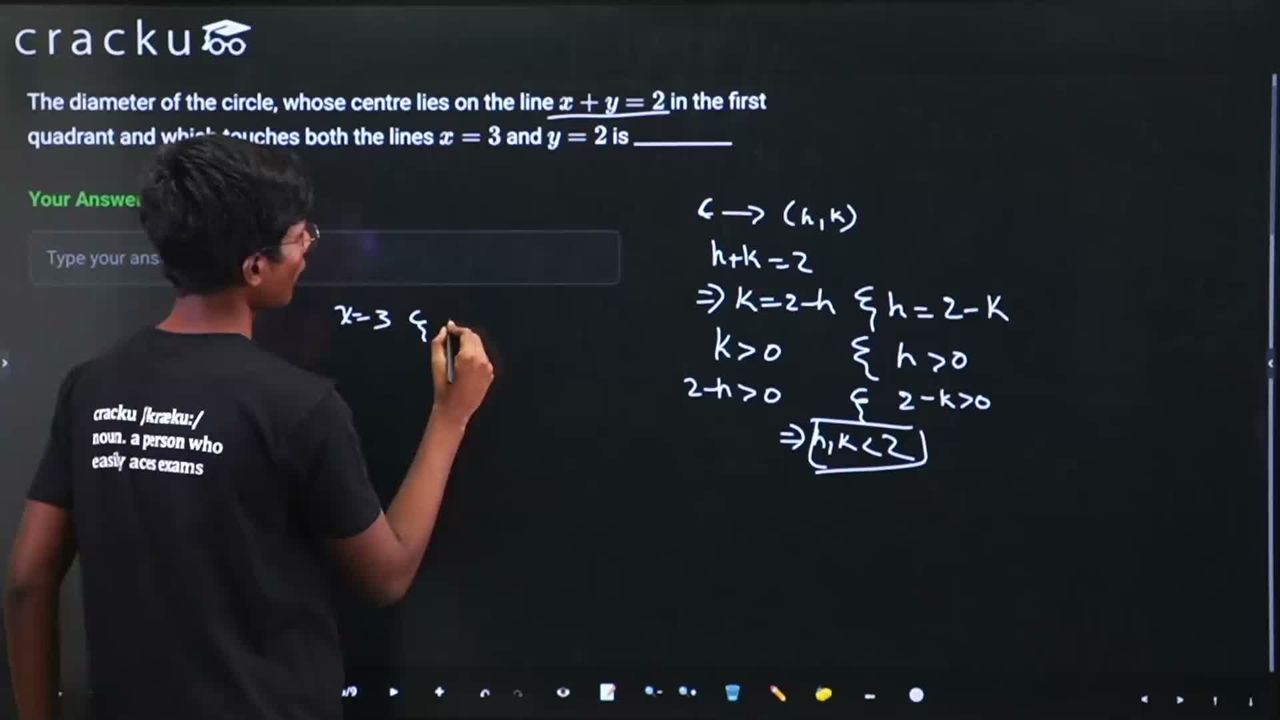
The diameter of the circle, whose centre lies on the line $$x + y = 2$$ in the first quadrant and which touches both the lines $$x = 3$$ and $$y = 2$$ is __________
Correct Answer: 3
Let the centre of the required circle be the point $$(h,\,k)$$. Because the centre lies on the straight line $$x + y = 2$$ we can write
$$h + k = 2 \quad\quad (1)$$
We are told that the circle touches the vertical line $$x = 3$$. For any point $$(h,\,k)$$ the perpendicular distance to the line $$x = 3$$ equals the absolute difference of their $$x$$-coordinates, so
$$\text{Distance from }(h,k)\text{ to }x = 3 = |h - 3|.$$
This distance is exactly the radius $$r$$ of the circle, hence
$$r = |h - 3|.$$
Similarly, the circle also touches the horizontal line $$y = 2$$. The perpendicular distance from $$(h,\,k)$$ to this line is the absolute difference of their $$y$$-coordinates, giving
$$\text{Distance from }(h,k)\text{ to }y = 2 = |k - 2|.$$
This distance must be the same radius $$r$$, so we also have
$$r = |k - 2|.$$
Because the centre lies in the first quadrant and we already know from (1) that $$h + k = 2,$$ each of $$h$$ and $$k$$ is positive and less than $$2.$$ That means $$h \lt 2$$ and $$k \lt 2,$$ placing the centre to the left of $$x = 3$$ and below $$y = 2.$$ Therefore the absolute value signs can be removed by inserting negative signs inside, yielding
$$r = 3 - h \quad\text{and}\quad r = 2 - k.$$
Equating these two expressions for the same radius gives
$$3 - h = 2 - k.$$
Simplifying, we obtain
$$-h + k = -1$$
or, more neatly,
$$k - h = -1 \quad\quad (2)$$
Now we have the pair of linear equations
$$\begin{aligned} h + k &= 2 \quad\quad&(1)\\ k - h &= -1 \quad\quad&(2) \end{aligned}$$
Adding equations (1) and (2) eliminates $$h$$:
$$\bigl(h + k\bigr) + \bigl(k - h\bigr) = 2 + (-1) \implies 2k = 1 \implies k = \dfrac12.$$
Substituting $$k = \dfrac12$$ back into equation (1) gives
$$h + \dfrac12 = 2 \implies h = 2 - \dfrac12 = \dfrac32.$$
Thus the centre is $$(h,\,k) = \left(\dfrac32,\,\dfrac12\right).$$
Using either expression for $$r,$$ say $$r = 3 - h,$$ we find
$$r = 3 - \dfrac32 = \dfrac32.$$
The diameter $$D$$ of the circle is twice the radius:
$$D = 2r = 2\left(\dfrac32\right) = 3.$$
Hence, the correct answer is Option 3.
Was this solution helpful?
Click on the Email ☝️ to Watch the Video Solution
Create a FREE account and get:
_1.webp)

Educational materials for JEE preparation

Ask our AI anything

AI can make mistakes. Please verify important information.
AI can make mistakes. Please verify important information.
