
Join Our JEE Preparation Group
Prep with like-minded aspirants; Get access to free daily tests and study material.
Sign in
Please select an account to continue using cracku.in
↓ →
Join Our JEE Preparation Group
Prep with like-minded aspirants; Get access to free daily tests and study material.
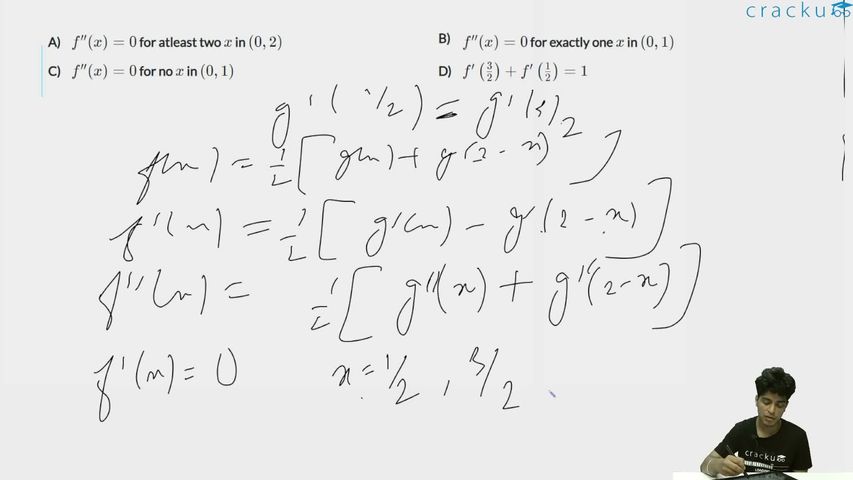
Let $$g : \mathbb{R} \rightarrow \mathbb{R}$$ be a non constant twice differentiable such that $$g'\left(\frac{1}{2}\right) = g'\left(\frac{3}{2}\right)$$. If a real valued function $$f$$ is defined as $$f(x) = \frac{1}{2}[g(x) + g(2 - x)]$$, then
Given $$f(x) = \frac{1}{2}[g(x) + g(2-x)]$$.
Then $$f'(x) = \frac{1}{2}[g'(x) - g'(2-x)]$$.
Note: $$f'(1) = \frac{1}{2}[g'(1) - g'(1)] = 0$$.
Also, $$f'(\frac{1}{2}) = \frac{1}{2}[g'(\frac{1}{2}) - g'(\frac{3}{2})] = 0$$ (given $$g'(\frac{1}{2}) = g'(\frac{3}{2})$$).
And $$f'(\frac{3}{2}) = \frac{1}{2}[g'(\frac{3}{2}) - g'(\frac{1}{2})] = 0$$.
So $$f'$$ has zeros at $$x = \frac{1}{2}, 1, \frac{3}{2}$$ in $$(0, 2)$$.
By Rolle's theorem applied to $$f'$$: $$f''(x) = 0$$ for at least one point in $$(\frac{1}{2}, 1)$$ and at least one point in $$(1, \frac{3}{2})$$.
So $$f''(x) = 0$$ for at least two $$x$$ in $$(0, 2)$$.
The answer is Option (1): $$\boxed{f''(x) = 0 \text{ for at least two } x \text{ in } (0, 2)}$$.
Was this solution helpful?
Click on the Email ☝️ to Watch the Video Solution
Create a FREE account and get:
_1.webp)

Educational materials for JEE preparation

Ask our AI anything

AI can make mistakes. Please verify important information.
AI can make mistakes. Please verify important information.
