
Join Our JEE Preparation Group
Prep with like-minded aspirants; Get access to free daily tests and study material.
Sign in
Please select an account to continue using cracku.in
↓ →
Join Our JEE Preparation Group
Prep with like-minded aspirants; Get access to free daily tests and study material.
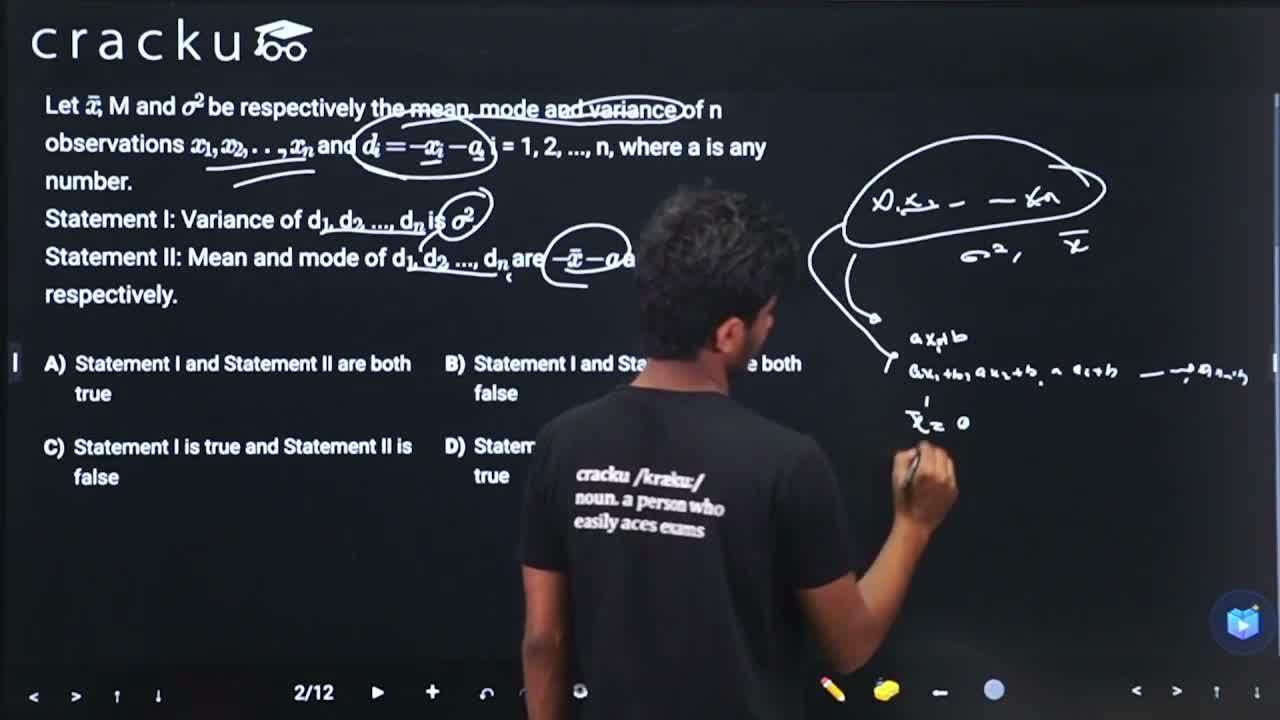
Let $$\bar{x}$$, M and $$\sigma^2$$ be respectively the mean, mode and variance of n observations $$x_1, x_2, \ldots, x_n$$ and $$d_i = -x_i - a$$, i = 1, 2, ..., n, where a is any number.
Statement I: Variance of d$$_1$$, d$$_2$$, ..., d$$_n$$ is $$\sigma^2$$.
Statement II: Mean and mode of d$$_1$$, d$$_2$$, ..., d$$_n$$ are $$-\bar{x} - a$$ and $$-M - a$$, respectively.
We are given n observations $$x_1, x_2, \ldots, x_n$$ with mean $$\bar{x}$$, mode $$M$$, and variance $$\sigma^2$$. We define new observations $$d_i = -x_i - a$$ for $$i = 1, 2, \ldots, n$$, where $$a$$ is any constant. We need to verify two statements about the mean, mode, and variance of the $$d_i$$ observations.
First, let's find the mean of the $$d_i$$ observations. The mean $$\bar{d}$$ is calculated as follows:
$$\bar{d} = \frac{1}{n} \sum_{i=1}^{n} d_i = \frac{1}{n} \sum_{i=1}^{n} (-x_i - a)$$
Splitting the summation:
$$\bar{d} = \frac{1}{n} \left( \sum_{i=1}^{n} (-x_i) + \sum_{i=1}^{n} (-a) \right) = \frac{1}{n} \left( -\sum_{i=1}^{n} x_i - a \sum_{i=1}^{n} 1 \right)$$
Since $$\sum_{i=1}^{n} x_i = n\bar{x}$$ and $$\sum_{i=1}^{n} 1 = n$$, we substitute:
$$\bar{d} = \frac{1}{n} \left( -n\bar{x} - a \cdot n \right) = \frac{1}{n} \cdot (-n) (\bar{x} + a) = -(\bar{x} + a) = -\bar{x} - a$$
So, the mean of $$d_i$$ is $$-\bar{x} - a$$.
Next, let's find the mode of the $$d_i$$ observations. The mode is the value that appears most frequently in the data. Since $$d_i = -x_i - a$$, each value in the original data is negated and shifted by $$-a$$. If $$M$$ is the mode of the original data, meaning $$M$$ occurs most frequently, then $$-M - a$$ will occur with the same frequency in the new data because the transformation is one-to-one. Therefore, the mode of $$d_i$$ is $$-M - a$$.
Now, let's check the variance of the $$d_i$$ observations. The variance $$\sigma_d^2$$ is given by:
$$\sigma_d^2 = \frac{1}{n} \sum_{i=1}^{n} (d_i - \bar{d})^2$$
We already have $$\bar{d} = -\bar{x} - a$$. Substitute $$d_i = -x_i - a$$:
$$d_i - \bar{d} = (-x_i - a) - (-\bar{x} - a) = -x_i - a + \bar{x} + a = -x_i + \bar{x} = -(x_i - \bar{x})$$
Squaring both sides:
$$(d_i - \bar{d})^2 = [-(x_i - \bar{x})]^2 = (-1)^2 (x_i - \bar{x})^2 = (x_i - \bar{x})^2$$
Now, substitute into the variance formula:
$$\sigma_d^2 = \frac{1}{n} \sum_{i=1}^{n} (d_i - \bar{d})^2 = \frac{1}{n} \sum_{i=1}^{n} (x_i - \bar{x})^2 = \sigma^2$$
So, the variance of $$d_i$$ is $$\sigma^2$$.
Statement I claims that the variance of $$d_i$$ is $$\sigma^2$$, which we have confirmed. Statement II claims that the mean is $$-\bar{x} - a$$ and the mode is $$-M - a$$, both of which we have also confirmed. Therefore, both statements are true.
Hence, the correct answer is Option A.
Was this solution helpful?
Click on the Email ☝️ to Watch the Video Solution
Create a FREE account and get:
_1.webp)

Educational materials for JEE preparation

Ask our AI anything

AI can make mistakes. Please verify important information.
AI can make mistakes. Please verify important information.
