
Join Our JEE Preparation Group
Prep with like-minded aspirants; Get access to free daily tests and study material.
Sign in
Please select an account to continue using cracku.in
↓ →
Join Our JEE Preparation Group
Prep with like-minded aspirants; Get access to free daily tests and study material.
If $$\lim_{x \to 1} \frac{x + x^2 + x^3 + \ldots + x^n - n}{x - 1} = 820$$, $$(n \in N)$$ then the value of $$n$$ is equal to ___________.
Correct Answer: 40
We need to evaluate the limit
$$\lim_{x \to 1}\frac{x + x^{2} + x^{3} + \ldots + x^{n} - n}{\,x - 1\,}$$
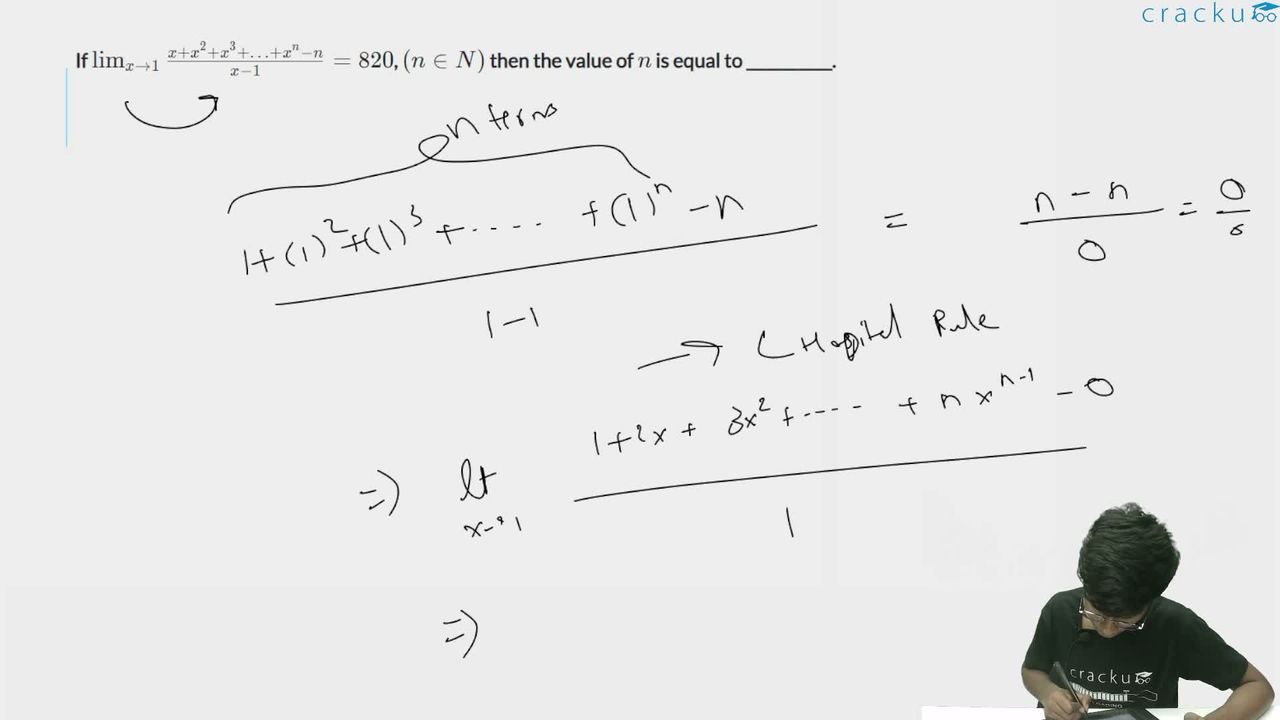
The numerator is the series $$x^{1} + x^{2} + \ldots + x^{n}$$ minus $$n$$, so when $$x = 1$$ it becomes $$1 + 1 + \ldots + 1 - n = n - n = 0$$. Similarly the denominator $$x-1$$ also becomes $$0$$ at $$x = 1$$. Thus we have an indeterminate form $$\dfrac{0}{0}$$, and we can apply L’Hospital’s Rule.
L’Hospital’s Rule states: if $$\displaystyle\lim_{x \to a} \dfrac{f(x)}{g(x)}$$ gives $$\dfrac{0}{0}$$ or $$\dfrac{\infty}{\infty}$$, then, provided derivatives exist and the second limit exists,
$$\lim_{x \to a}\frac{f(x)}{g(x)} = \lim_{x \to a}\frac{f'(x)}{g'(x)}.$$
Here we take
$$f(x)=x + x^{2} + x^{3} + \ldots + x^{n}-n,\qquad g(x)=x-1.$$
Differentiating term by term:
$$f'(x)=\frac{d}{dx}\bigl(x + x^{2} + x^{3} + \ldots + x^{n}-n\bigr) = 1 + 2x + 3x^{2} + \ldots + n x^{\,n-1},$$
because $$\dfrac{d}{dx}(x^{k}) = k x^{k-1}$$ and $$\dfrac{d}{dx}(-n)=0$$. Also
$$g'(x)=\frac{d}{dx}(x-1)=1.$$
Therefore, by L’Hospital’s Rule,
$$\lim_{x \to 1}\frac{x + x^{2} + x^{3} + \ldots + x^{n} - n}{x - 1} = \lim_{x \to 1} \frac{1 + 2x + 3x^{2} + \ldots + n x^{\,n-1}}{1}.$$
Now put $$x = 1$$ directly into the differentiated expression:
$$1 + 2(1) + 3(1)^{2} + \ldots + n(1)^{\,n-1} = 1 + 2 + 3 + \ldots + n.$$
We recognize this as the sum of the first $$n$$ natural numbers. The standard formula is
$$1 + 2 + 3 + \ldots + n = \frac{n(n+1)}{2}.$$
According to the question this limit equals $$820$$, so
$$\frac{n(n+1)}{2}=820.$$
Multiplying both sides by $$2$$:
$$n(n+1)=1640.$$
Expanding gives the quadratic equation
$$n^{2}+n-1640=0.$$
We solve using the quadratic formula $$n=\dfrac{-b \pm \sqrt{b^{2}-4ac}}{2a}$$ for $$ax^{2}+bx+c=0$$. Here $$a=1,\; b=1,\; c=-1640$$, so
$$n=\frac{-1 \pm \sqrt{1^{2}-4(1)(-1640)}}{2} =\frac{-1 \pm \sqrt{1+6560}}{2} =\frac{-1 \pm \sqrt{6561}}{2}.$$
Since $$6561=81^{2}$$, we have
$$n=\frac{-1 \pm 81}{2}.$$
This gives two numerical values:
$$n=\frac{-1+81}{2}=\frac{80}{2}=40,\qquad n=\frac{-1-81}{2}=\frac{-82}{2}=-41.$$
We discard $$-41$$ because $$n$$ must be a natural number $$(n\in\mathbb N)$$. Thus $$n=40.$$
Hence, the correct answer is Option 40.
Click on the Email ☝️ to Watch the Video Solution
Create a FREE account and get:
_1.webp)

Educational materials for JEE preparation

Ask our AI anything

AI can make mistakes. Please verify important information.
AI can make mistakes. Please verify important information.


