
Join Our JEE Preparation Group
Prep with like-minded aspirants; Get access to free daily tests and study material.
Sign in
Please select an account to continue using cracku.in
↓ →
Join Our JEE Preparation Group
Prep with like-minded aspirants; Get access to free daily tests and study material.
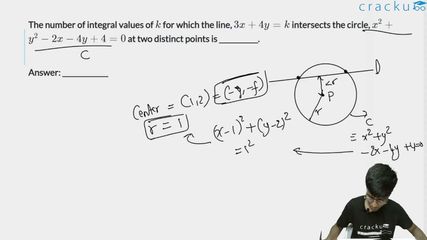
The number of integral values of $$k$$ for which the line, $$3x + 4y = k$$ intersects the circle, $$x^2 + y^2 - 2x - 4y + 4 = 0$$ at two distinct points is ___________.
Correct Answer: 9
We have the circle
$$x^{2}+y^{2}-2x-4y+4=0$$
First, we put this equation into centre-radius form. We add and subtract the appropriate constants:
$$x^{2}-2x+1+y^{2}-4y+4=0+1+4$$
$$\bigl(x^{2}-2x+1\bigr)+\bigl(y^{2}-4y+4\bigr)=1$$
$$(x-1)^{2}+(y-2)^{2}=1$$
Thus the centre of the circle is $$C(1,\,2)$$ and the radius is $$r=1$$.
The straight line is
$$3x+4y=k.$$
For the line to cut the circle at two distinct points, the perpendicular distance from the centre of the circle to the line must be strictly less than the radius. We now state the distance formula:
For a line $$ax+by+c=0$$ and a point $$(x_{0},y_{0})$$, the perpendicular distance is
$$\displaystyle d=\frac{|ax_{0}+by_{0}+c|}{\sqrt{a^{2}+b^{2}}}\,.$$
First we rewrite the given line in the required form:
$$3x+4y-k=0,$$
so $$a=3,\;b=4,\;c=-k.$$ Substituting the centre $$(1,2)$$ into the formula gives
$$d=\frac{|3(1)+4(2)-k|}{\sqrt{3^{2}+4^{2}}} =\frac{|3+8-k|}{\sqrt{9+16}} =\frac{|11-k|}{5}.$$
For two distinct intersection points we need
$$d<r \;\; \Longrightarrow \;\; \frac{|11-k|}{5}<1.$$
Multiplying both sides by $$5$$ we get
$$|11-k|<5.$$
Now we convert the modulus inequality into a double inequality:
$$-5<11-k<5.$$
Subtracting $$11$$ everywhere,
$$-16<-k<-6.$$
Multiplying through by $$-1$$ (and reversing the inequality signs) gives
$$6<k<16.$$
The integral values satisfying this are
$$k=7,\,8,\,9,\,10,\,11,\,12,\,13,\,14,\,15.$$
Counting them, we find $$9$$ such integers.
So, the answer is $$9$$.
Click on the Email ☝️ to Watch the Video Solution
Create a FREE account and get:
_1.webp)

Educational materials for JEE preparation

Ask our AI anything

AI can make mistakes. Please verify important information.
AI can make mistakes. Please verify important information.


