
Join Our JEE Preparation Group
Prep with like-minded aspirants; Get access to free daily tests and study material.
Sign in
Please select an account to continue using cracku.in
↓ →
Join Our JEE Preparation Group
Prep with like-minded aspirants; Get access to free daily tests and study material.
A box contains 15 green and 10 yellow balls. If 10 balls are randomly drawn, one-by-one, with replacement, then the variance of the number of green balls drawn is:
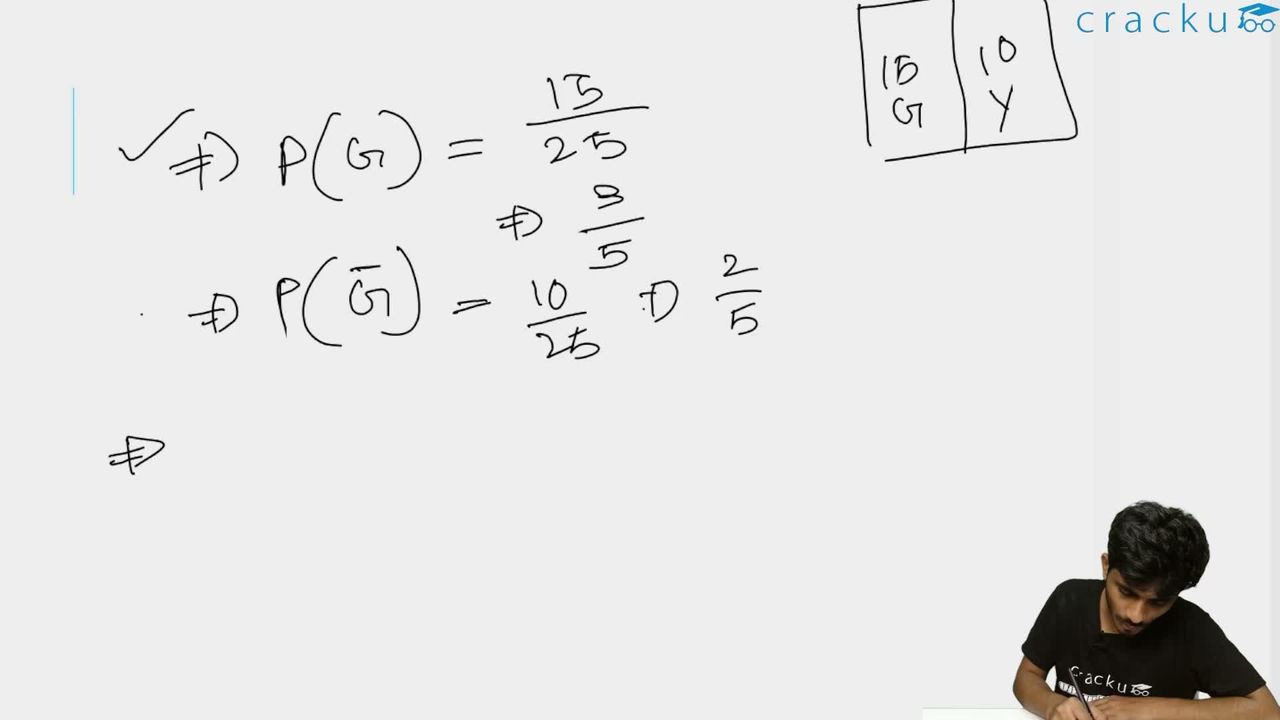
We start by noting the composition of the box. There are 15 green balls and 10 yellow balls, making a total of
$$15+10 = 25$$
balls in the box. In every single draw (because the ball is replaced), the probability of choosing a green ball remains constant. That probability is simply the ratio of green balls to total balls, namely
$$p = \frac{\text{number of green balls}}{\text{total balls}} = \frac{15}{25} = \frac{3}{5}.$$
Correspondingly, the probability of drawing a yellow ball is
$$q = 1-p = 1-\frac{3}{5} = \frac{2}{5}.$$
Let us introduce random variables to model the situation clearly. Let
$$X_i = \begin{cases}
1, &\text{if the $$i$$-th draw yields a green ball},\\[4pt]
0, &\text{if the $$i$$-th draw yields a yellow ball},
\end{cases}\qquad i = 1,2,\dots ,10.$$
Because each draw is made with replacement, the outcomes of different draws are independent and the probability of success (getting green) stays the same for every draw. Hence each $$X_i$$ is a Bernoulli random variable with
$$P(X_i = 1) = p = \frac{3}{5}, \qquad P(X_i = 0) = q = \frac{2}{5}.$$
The total number of green balls drawn in 10 attempts is then
$$X = X_1 + X_2 + \dots + X_{10}.$$
Now, the sum of independent Bernoulli($$p$$) variables is a Binomial($$n,p$$) random variable. Therefore
$$X \sim \text{Binomial}(n = 10,\; p = \frac{3}{5}).$$
For a Binomial($$n,p$$) distribution, the variance formula is first recalled:
$$\text{Variance of Binomial}(n,p):\quad \operatorname{Var}(X) = n\,p\,q,$$
where $$q = 1-p$$. Substituting the known values $$n = 10,\; p = \frac{3}{5},\; q = \frac{2}{5},$$ we get
$$\operatorname{Var}(X) = 10 \times \frac{3}{5} \times \frac{2}{5}.$$
Multiplying step by step, we have
$$10 \times \frac{3}{5} = \frac{30}{5} = 6,$$
$$6 \times \frac{2}{5} = \frac{12}{5}.$$
Thus, the variance of the number of green balls drawn is
$$\operatorname{Var}(X) = \frac{12}{5}.$$
Among the given options, this value corresponds to Option A.
Hence, the correct answer is Option A.
Was this solution helpful?
Click on the Email ☝️ to Watch the Video Solution
Create a FREE account and get:
_1.webp)

Educational materials for JEE preparation

Ask our AI anything

AI can make mistakes. Please verify important information.
AI can make mistakes. Please verify important information.
