
Join Our JEE Preparation Group
Prep with like-minded aspirants; Get access to free daily tests and study material.
Sign in
Please select an account to continue using cracku.in
↓ →
Join Our JEE Preparation Group
Prep with like-minded aspirants; Get access to free daily tests and study material.
Consider the function $$f : [\frac{1}{2}, 1] \to R$$ defined by $$f(x) = 4\sqrt{2}x^3 - 3\sqrt{2}x - 1$$. Consider the statements
(I) The curve $$y = f(x)$$ intersects the $$x$$-axis exactly at one point
(II) The curve $$y = f(x)$$ intersects the $$x$$-axis at $$x = \cos\frac{\pi}{12}$$
Then
$$f(x) = 4\sqrt{2}x^3 - 3\sqrt{2}x - 1$$ on $$[\frac{1}{2}, 1]$$.
Statement (I): The curve intersects the x-axis exactly at one point.
Statement (II): The curve intersects the x-axis at $$x = \cos\frac{\pi}{12}$$.
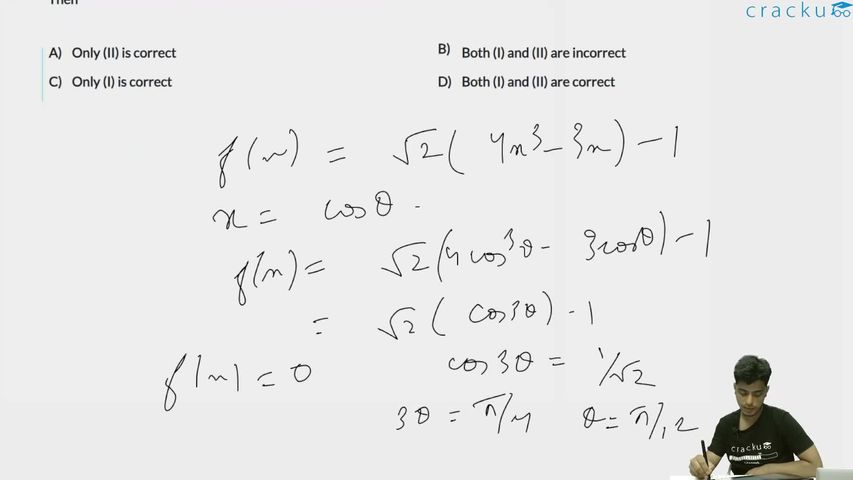
Check Statement (II) by recognising the triple angle formula.
Recall that $$\cos 3\theta = 4\cos^3\theta - 3\cos\theta$$.
If $$x = \cos\theta$$, then $$4x^3 - 3x = \cos 3\theta$$.
$$f(x) = \sqrt{2}(4x^3 - 3x) - 1 = \sqrt{2}\cos 3\theta - 1$$
Setting $$f(x) = 0$$: $$\sqrt{2}\cos 3\theta = 1$$, so $$\cos 3\theta = \frac{1}{\sqrt{2}}$$.
$$3\theta = \frac{\pi}{4} \implies \theta = \frac{\pi}{12}$$
$$x = \cos\frac{\pi}{12} \approx 0.9659$$, which lies in $$[\frac{1}{2}, 1]$$. Statement (II) is correct.
Check Statement (I) - uniqueness.
$$f'(x) = 12\sqrt{2}x^2 - 3\sqrt{2} = 3\sqrt{2}(4x^2 - 1)$$
$$f'(x) = 0 \implies x = \frac{1}{2}$$ (the only critical point in the domain).
$$f(\frac{1}{2}) = 4\sqrt{2} \cdot \frac{1}{8} - 3\sqrt{2} \cdot \frac{1}{2} - 1 = \frac{\sqrt{2}}{2} - \frac{3\sqrt{2}}{2} - 1 = -\sqrt{2} - 1 < 0$$
$$f(1) = 4\sqrt{2} - 3\sqrt{2} - 1 = \sqrt{2} - 1 > 0$$
Since $$f(\frac{1}{2}) < 0$$ and $$f(1) > 0$$, and $$f'(x) > 0$$ for $$x > \frac{1}{2}$$, the function is strictly increasing on $$(\frac{1}{2}, 1]$$. There is exactly one root. Statement (I) is correct.
Both statements are correct. The answer is Option 4.
Was this solution helpful?
Click on the Email ☝️ to Watch the Video Solution
Create a FREE account and get:
_1.webp)

Educational materials for JEE preparation

Ask our AI anything

AI can make mistakes. Please verify important information.
AI can make mistakes. Please verify important information.
