
Join Our JEE Preparation Group
Prep with like-minded aspirants; Get access to free daily tests and study material.
Sign in
Please select an account to continue using cracku.in
↓ →
Join Our JEE Preparation Group
Prep with like-minded aspirants; Get access to free daily tests and study material.
Consider the following gas phase reaction being carried out in a closed vessel at 25°C.
$$2A(g) \to 4B(g) + C(g)$$
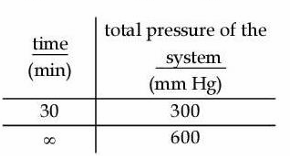
The pressure of $$C(g)$$ at 30 minutes time interval would be _____ mm Hg. (nearest integer)
Correct Answer: 20
Let the reaction be carried out in a rigid closed vessel (constant volume) at constant temperature 25 °C. Under these conditions, pressure is directly proportional to the total number of moles of gas present.
Assume the initial amount of $$A$$ is $$n_0$$ moles, with no $$B$$ or $$C$$ present.
Define the extent of reaction after time $$t$$ as $$\xi_t$$. Using the stoichiometry
$$2A \;\longrightarrow\; 4B + C$$
the number of moles of each species at time $$t$$ is
$$\begin{aligned} n_A &= n_0 - 2\xi_t, \\ n_B &= 4\xi_t, \\ n_C &= \xi_t. \end{aligned}$$
The total number of moles at time $$t$$ is therefore
$$n_{\text{tot},t} = n_A + n_B + n_C = n_0 - 2\xi_t + 4\xi_t + \xi_t = n_0 + 3\xi_t.$$
Final state (time $$\infty$$)
At completion all $$A$$ has reacted, so $$n_A = 0 \Rightarrow n_0 = 2\xi_{\infty}$$, giving $$\xi_{\infty} = \dfrac{n_0}{2}.$$
The total moles then are
$$n_{\text{tot},\infty} = n_0 + 3\left(\dfrac{n_0}{2}\right) = n_0 + \dfrac{3n_0}{2} = \dfrac{5n_0}{2} = 2.5\,n_0.$$
This final state corresponds to the given total pressure of 600 mm Hg:
$$P_{\infty} \propto n_{\text{tot},\infty} = 2.5\,n_0 \quad \Rightarrow \quad P_{\infty} = 600\text{ mm Hg}.$$
State after 30 min
Let $$\xi_{30}$$ be the extent after 30 min. The total moles are
$$n_{\text{tot},30} = n_0 + 3\xi_{30}$$
and the corresponding pressure is 300 mm Hg.
Because pressure is proportional to total moles (same $$T$$ and $$V$$),
$$\frac{P_{30}}{P_{\infty}} = \frac{n_{\text{tot},30}}{n_{\text{tot},\infty}} \;\Longrightarrow\; \frac{300}{600} = \frac{n_0 + 3\xi_{30}}{2.5\,n_0}.$$
Simplifying:
$$\frac{1}{2} = \frac{n_0 + 3\xi_{30}}{2.5\,n_0} \;\Longrightarrow\; n_0 + 3\xi_{30} = 1.25\,n_0 \;\Longrightarrow\; 3\xi_{30} = 0.25\,n_0 \;\Longrightarrow\; \xi_{30} = \frac{n_0}{12}.$$
Partial pressure of $$C$$ after 30 min
Number of moles of $$C$$: $$n_C = \xi_{30} = \dfrac{n_0}{12}.$$
Mole fraction of $$C$$:
$$x_C = \frac{n_C}{n_{\text{tot},30}} = \frac{n_0/12}{n_0 + 3\xi_{30}} = \frac{n_0/12}{n_0 + n_0/4} = \frac{1/12}{1 + 1/4} = \frac{1/12}{1.25} = \frac{1}{15}.$$
Therefore the partial pressure of $$C$$ is
$$P_C = x_C \times P_{30} = \frac{1}{15} \times 300 \text{ mm Hg} = 20 \text{ mm Hg}.$$
Hence, the pressure of $$C(g)$$ at 30 minutes is 20 mm Hg.
Was this solution helpful?
Create a FREE account and get:
_1.webp)

Educational materials for JEE preparation

Ask our AI anything

AI can make mistakes. Please verify important information.
AI can make mistakes. Please verify important information.
