
Join Our JEE Preparation Group
Prep with like-minded aspirants; Get access to free daily tests and study material.
Sign in
Please select an account to continue using cracku.in
↓ →
Join Our JEE Preparation Group
Prep with like-minded aspirants; Get access to free daily tests and study material.
$$ A \rightarrow B $$ The molecule A changes into its isomeric form B by following a first order kinetics at a temperature
of 1000 K . If the energy barrier with respect to reactant energy for such isomeric transformation is $$191.48kJ$$ $$Mol^{-1}$$ and the frequency factor is $$10^{20},$$ the time required for 50% molecules of A to become B is
_________ picoseconds (nearest integer). $$[R=8.314 JK^{-1} mol^{-1}]$$
Correct Answer: 69
We need to find the time for 50% conversion using first order kinetics.
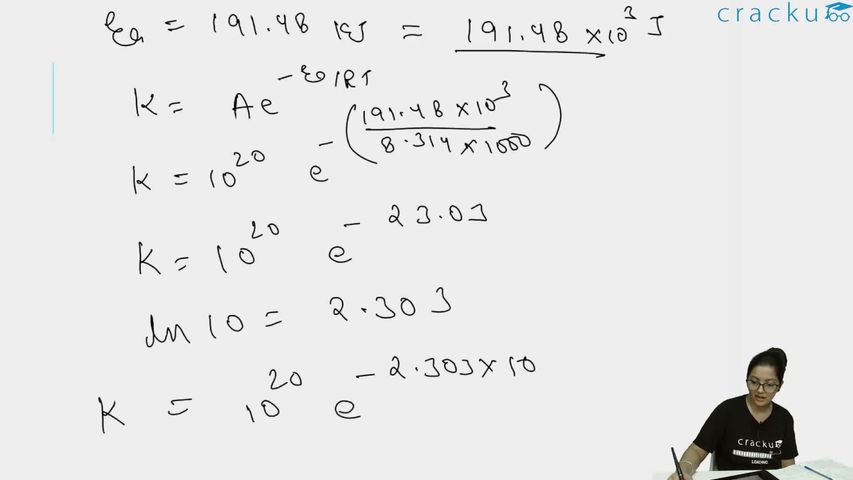
At T = 1000 K, the activation energy is 191.48 kJ/mol = 191480 J/mol, the frequency factor is A = 10^{20}, and R = 8.314 J K⁻¹ mol⁻¹.
We start by calculating the rate constant using the Arrhenius equation:
$$k = A \cdot e^{-E_a/RT}$$
Next, we compute the exponent:
$$\frac{E_a}{RT} = \frac{191480}{8.314 \times 1000} = \frac{191480}{8314} = 23.03$$
This gives:
$$k = 10^{20} \times e^{-23.03}$$
Since ln(10) = 2.303, we have:
$$e^{-23.03} = e^{-10 \times 2.303} = 10^{-10}$$
Substituting back yields:
$$k = 10^{20} \times 10^{-10} = 10^{10} \text{ s}^{-1}$$
For 50% conversion, the half-life in first order kinetics is given by:
$$t_{1/2} = \frac{\ln 2}{k} = \frac{0.693}{10^{10}} = 6.93 \times 10^{-11} \text{ s}$$
Converting this to picoseconds using 1 ps = $$10^{-12}$$ s:
$$t_{1/2} = \frac{6.93 \times 10^{-11}}{10^{-12}} = 69.3 \text{ ps}$$
Rounding to the nearest integer gives a half-life of approximately 69 picoseconds.
Was this solution helpful?
Click on the Email ☝️ to Watch the Video Solution
Create a FREE account and get:
_1.webp)

Educational materials for JEE preparation

Ask our AI anything

AI can make mistakes. Please verify important information.
AI can make mistakes. Please verify important information.
