
Join Our JEE Preparation Group
Prep with like-minded aspirants; Get access to free daily tests and study material.
Sign in
Please select an account to continue using cracku.in
↓ →
Join Our JEE Preparation Group
Prep with like-minded aspirants; Get access to free daily tests and study material.
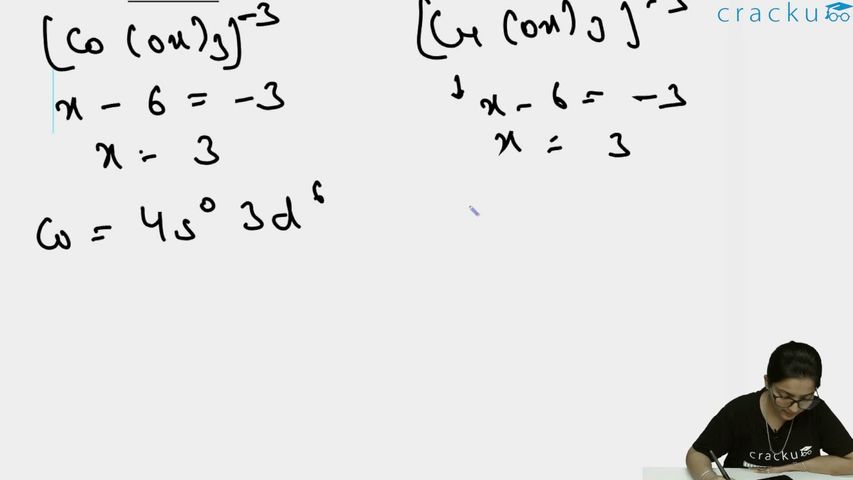
The crystal field splitting energy of $$[Co(oxalate)_{3}]^{3-}$$ complex is 'n' times that of the $$[Cr(oxalate)_{3}]^{3-}$$ complex. Here 'n' is_______. (Assume d $$\triangle_{\circ} > > P$$)
Correct Answer: 2
Both $$[Co(oxalate)_3]^{3-}$$ and $$[Cr(oxalate)_3]^{3-}$$ are octahedral coordination compounds because each bidentate $$C_2O_4^{2-}$$ (oxalate) ligand donates two pairs of electrons, giving a total of six donor atoms around the metal ion.
Given the condition $$\triangle_o \gg P$$ (crystal-field splitting energy much larger than pairing energy), the electrons prefer to pair up in the lower-energy $$t_{2g}$$ set before occupying the higher-energy $$e_g$$ set: this is called a low-spin arrangement.
Case 1: $$Co^{3+}$$ in $$[Co(oxalate)_3]^{3-}$$
Atomic number of Co = 27, so $$Co^{3+}$$ has $$27-3 = 24$$ electrons ⇒ $$3d^6$$ configuration.
For a low-spin $$d^6$$ ion in an octahedral field:
Orbital occupancy: $$t_{2g}^6\,e_g^0$$
Crystal-field stabilisation energy (CFSE) formula for an octahedral field:
each $$t_{2g}$$ electron contributes $$-0.4\triangle_o$$,
each $$e_g$$ electron contributes $$+0.6\triangle_o$$.
Therefore, CFSE for $$Co^{3+}$$ complex:
$$\text{CFSE}_{Co} = 6(-0.4\triangle_o) + 0(+0.6\triangle_o) = -2.4\triangle_o$$
Case 2: $$Cr^{3+}$$ in $$[Cr(oxalate)_3]^{3-}$$
Atomic number of Cr = 24, so $$Cr^{3+}$$ has $$24-3 = 21$$ electrons ⇒ $$3d^3$$ configuration.
For a low-spin $$d^3$$ ion (high-spin and low-spin are identical for $$d^3$$):
Orbital occupancy: $$t_{2g}^3\,e_g^0$$
Therefore, CFSE for $$Cr^{3+}$$ complex:
$$\text{CFSE}_{Cr} = 3(-0.4\triangle_o) + 0(+0.6\triangle_o) = -1.2\triangle_o$$
Now, the question states that the crystal-field splitting energy of the cobalt complex is $$n$$ times that of the chromium complex, i.e.
$$|\text{CFSE}_{Co}| = n \times |\text{CFSE}_{Cr}|$$
Taking magnitudes (because the energies are negative):
$$2.4\triangle_o = n \times 1.2\triangle_o$$
Dividing both sides by $$1.2\triangle_o$$:
$$n = \frac{2.4}{1.2} = 2$$
Hence, the required value of $$n$$ is $$2$$.
Was this solution helpful?
Click on the Email ☝️ to Watch the Video Solution
Create a FREE account and get:
_1.webp)

Educational materials for JEE preparation

Ask our AI anything

AI can make mistakes. Please verify important information.
AI can make mistakes. Please verify important information.
