
Join Our JEE Preparation Group
Prep with like-minded aspirants; Get access to free daily tests and study material.
Sign in
Please select an account to continue using cracku.in
↓ →
Join Our JEE Preparation Group
Prep with like-minded aspirants; Get access to free daily tests and study material.
For the following gas phase equilibrium reaction at constant temperature,
$$NH_{3}(g)\rightleftharpoons 1/2N_{2}(g)+3/2H_{2}(g)$$
if the to tal pressure is $$\sqrt{3}$$ atm and the pressure equilibrium constant ($$K_{p}$$) is 9 atm, then the degree of dissociation is given as $$(x\times 10^{-2})^{-1/2}$$.The value of x is ______. (nearest integer)
Correct Answer: 125
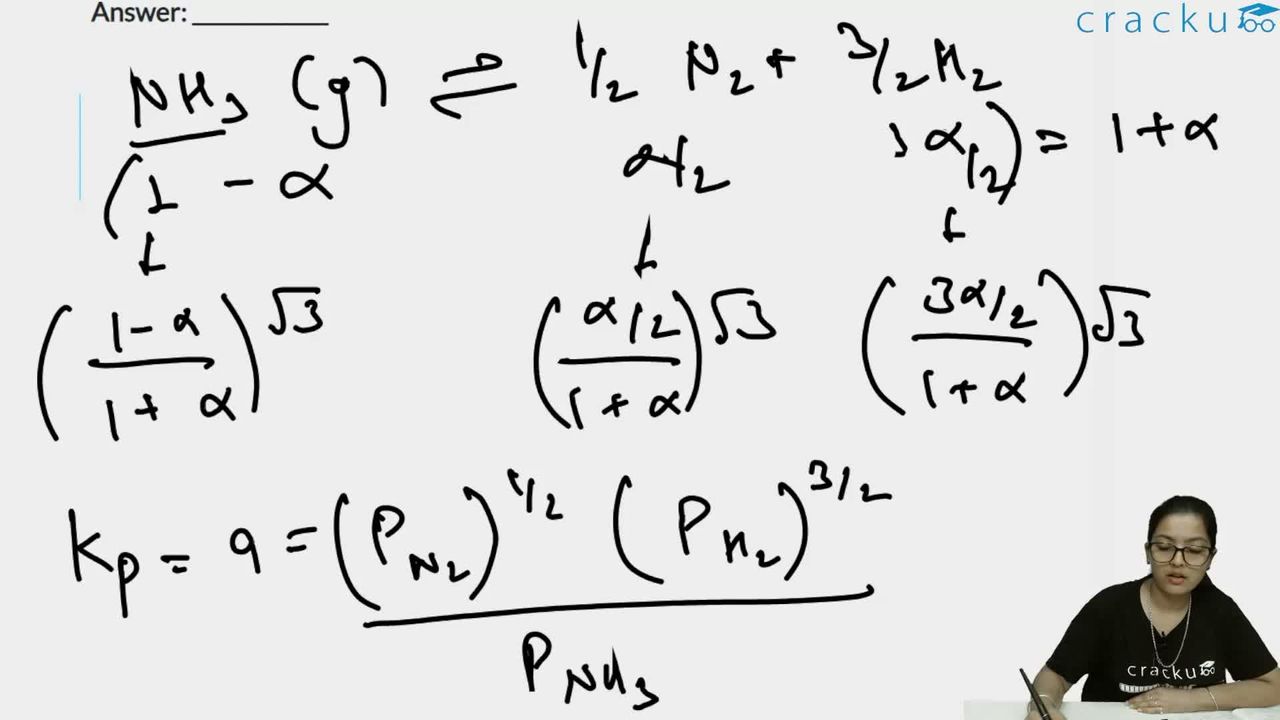
To find the value of $$x$$ for the equilibrium $$NH_3(g) \rightleftharpoons \frac{1}{2}N_2(g) + \frac{3}{2}H_2(g)$$, let the initial moles of $$NH_3$$ be 1 and the degree of dissociation be $$\alpha$$. At equilibrium, the moles are $$NH_3 = 1 - \alpha$$, $$N_2 = \frac{\alpha}{2}$$, and $$H_2 = \frac{3\alpha}{2}$$, so the total moles equal $$1 - \alpha + \frac{\alpha}{2} + \frac{3\alpha}{2} = 1 + \alpha$$.
The total pressure $$P_T$$ is given as $$\sqrt{3}$$ atm, which leads to the partial pressures $$p_{NH_3} = \frac{1-\alpha}{1+\alpha} \cdot \sqrt{3}$$, $$p_{N_2} = \frac{\alpha/2}{1+\alpha} \cdot \sqrt{3}$$, and $$p_{H_2} = \frac{3\alpha/2}{1+\alpha} \cdot \sqrt{3}$$.
The expression for $$K_p$$ is $$K_p = \frac{p_{N_2}^{1/2} \cdot p_{H_2}^{3/2}}{p_{NH_3}} = 9 \text{ atm}$$, so substitution gives $$K_p = \frac{\left(\frac{\alpha\sqrt{3}}{2(1+\alpha)}\right)^{1/2} \cdot \left(\frac{3\alpha\sqrt{3}}{2(1+\alpha)}\right)^{3/2}}{\frac{(1-\alpha)\sqrt{3}}{1+\alpha}}$$.
In the numerator, $$\left(\frac{\alpha\sqrt{3}}{2(1+\alpha)}\right)^{1/2} \cdot \left(\frac{3\alpha\sqrt{3}}{2(1+\alpha)}\right)^{3/2} = \frac{\alpha^{1/2} \cdot 3^{1/4}}{2^{1/2}(1+\alpha)^{1/2}} \cdot \frac{3^{3/2}\alpha^{3/2} \cdot 3^{3/4}}{2^{3/2}(1+\alpha)^{3/2}} = \frac{3^{1/4+3/2+3/4} \cdot \alpha^2}{2^2 \cdot (1+\alpha)^2} = \frac{3^{5/2} \cdot \alpha^2}{4(1+\alpha)^2}$$.
Hence $$K_p = \frac{3^{5/2}\alpha^2}{4(1+\alpha)^2} \cdot \frac{(1+\alpha)}{(1-\alpha)\sqrt{3}} = \frac{3^{5/2}\alpha^2}{4(1+\alpha)(1-\alpha)\sqrt{3}} = \frac{3^2 \alpha^2}{4(1-\alpha^2)} = \frac{9\alpha^2}{4(1-\alpha^2)} = 9$$.
Solving $$\frac{\alpha^2}{4(1-\alpha^2)} = 1$$ gives $$\alpha^2 = 4 - 4\alpha^2$$ and hence $$5\alpha^2 = 4$$, so $$\alpha^2 = \frac{4}{5}$$ and $$\alpha = \frac{2}{\sqrt{5}}$$.
Since $$\alpha = (x \times 10^{-2})^{-1/2}$$, it follows that $$\alpha^2 = \frac{1}{x \times 10^{-2}} = \frac{100}{x}$$. Equating $$\frac{4}{5} = \frac{100}{x}$$ yields $$x = \frac{500}{4} = 125$$.
Therefore, the answer is $$\boxed{125}$$.
Was this solution helpful?
Click on the Email ☝️ to Watch the Video Solution
Create a FREE account and get:
_1.webp)

Educational materials for JEE preparation

Ask our AI anything

AI can make mistakes. Please verify important information.
AI can make mistakes. Please verify important information.
