
Join Our JEE Preparation Group
Prep with like-minded aspirants; Get access to free daily tests and study material.
Sign in
Please select an account to continue using cracku.in
↓ →
Join Our JEE Preparation Group
Prep with like-minded aspirants; Get access to free daily tests and study material.
The coefficient of $$x^4$$ in the expansion of $$(1 + x + x^2 + x^3)^6$$ in powers of $$x$$, is.......
Correct Answer: 120
Let us first simplify the expression inside the parentheses by factoring it. We notice that:
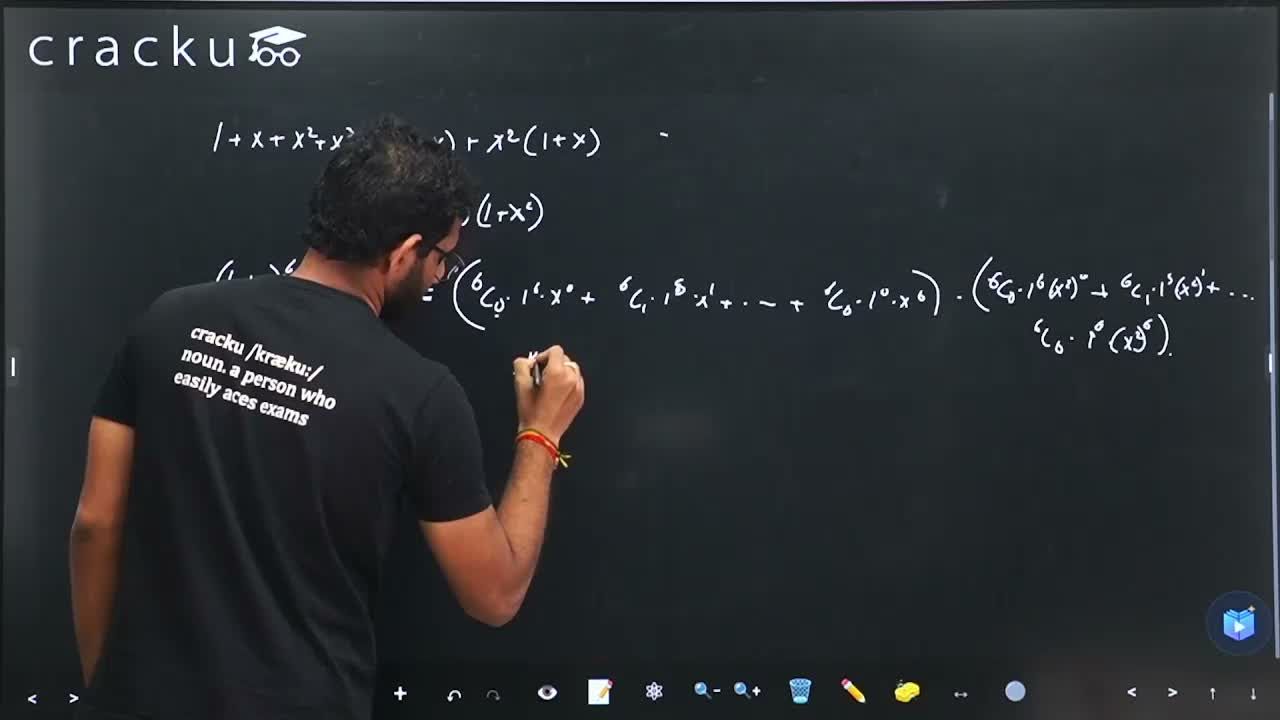
$$1 + x + x^2 + x^3 = (1 + x) + x^2(1 + x) = (1 + x)(1 + x^2)$$
Therefore, we can rewrite the entire expression raised to the power of 6 as:
$$(1 + x + x^2 + x^3)^6 = \left[(1 + x)(1 + x^2)\right]^6 = (1 + x)^6(1 + x^2)^6$$
Now, we expand each of these two components using the Binomial Theorem:
$$(1 + x)^6 = \binom{6}{0} + \binom{6}{1}x + \binom{6}{2}x^2 + \binom{6}{3}x^3 + \binom{6}{4}x^4 + \dots$$
$$(1 + x^2)^6 = \binom{6}{0} + \binom{6}{1}x^2 + \binom{6}{2}x^4 + \dots$$
Let us evaluate the specific combinations (binomial coefficients) needed for our calculations:
$$\binom{6}{0} = 1$$
$$\binom{6}{1} = 6$$
$$\binom{6}{2} = \frac{6 \times 5}{2} = 15$$
$$\binom{6}{3} = \frac{6 \times 5 \times 4}{6} = 20$$
$$\binom{6}{4} = \binom{6}{2} = 15$$
Substituting these values back into our expansions yields:
$$(1 + x)^6 = 1 + 6x + 15x^2 + 20x^3 + 15x^4 + \dots$$
$$(1 + x^2)^6 = 1 + 6x^2 + 15x^4 + \dots$$
We want to find the coefficient of $$x^4$$ in the product of these two series:
$$\left(1 + 6x + 15x^2 + 20x^3 + 15x^4 + \dots\right) \times \left(1 + 6x^2 + 15x^4 + \dots\right)$$
Let us collect all combinations of terms from the first and second parentheses whose powers of $$x$$ add up to exactly 4:
1) The $$x^4$$ term from the first parentheses multiplied by the constant term ($$1$$) from the second:
$$15x^4 \times 1 = 15x^4$$
2) The $$x^2$$ term from the first parentheses multiplied by the $$x^2$$ term from the second:
$$15x^2 \times 6x^2 = 90x^4$$
3) The constant term ($$1$$) from the first parentheses multiplied by the $$x^4$$ term from the second:
$$1 \times 15x^4 = 15x^4$$
Now, we sum the coefficients of these three cases together to get the total coefficient of $$x^4$$:
$$\text{Coefficient of } x^4 = 15 + 90 + 15 = 120$$
Was this solution helpful?
Click on the Email ☝️ to Watch the Video Solution
Create a FREE account and get:
_1.webp)

Educational materials for JEE preparation

Ask our AI anything

AI can make mistakes. Please verify important information.
AI can make mistakes. Please verify important information.
