
Join Our JEE Preparation Group
Prep with like-minded aspirants; Get access to free daily tests and study material.
Sign in
Please select an account to continue using cracku.in
↓ →
Join Our JEE Preparation Group
Prep with like-minded aspirants; Get access to free daily tests and study material.
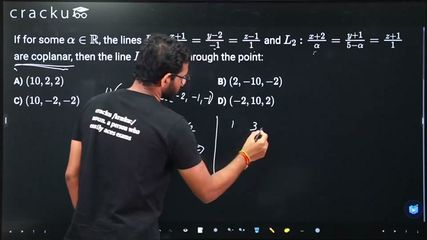
If for some $$\alpha \in \mathbb{R}$$, the lines $$L_1 : \frac{x+1}{2} = \frac{y-2}{-1} = \frac{z-1}{1}$$ and $$L_2 : \frac{x+2}{\alpha} = \frac{y+1}{5-\alpha} = \frac{z+1}{1}$$ are coplanar, then the line $$L_2$$ passes through the point:
We have two lines given in symmetric form. For line $$L_1$$ the equation is
$$\frac{x+1}{2}= \frac{y-2}{-1}= \frac{z-1}{1}.$$
In this form, the numerators give one fixed point on the line while the denominators give the direction ratios. So, for $$L_1$$
Point on the line (taking the parameter $$\lambda=0$$): $$S_1(-1,\,2,\,1).$$
Direction vector $$\vec{v_1}=(2,\,-1,\,1).$$
Similarly, for line $$L_2$$ we have
$$\frac{x+2}{\alpha}= \frac{y+1}{5-\alpha}= \frac{z+1}{1}.$$
So, for $$L_2$$
Point on the line (again parameter $$\mu=0$$): $$S_2(-2,\,-1,\,-1),$$
Direction vector $$\vec{v_2}=(\alpha,\,5-\alpha,\,1).$$
Now, the two lines will be coplanar when the scalar triple product of $$\vec{v_1},\ \vec{v_2}$$ and the vector joining the two given points $$\vec{w}=S_2S_1$$ is zero. The condition we use is:
$$[\vec{w}\ \vec{v_1}\ \vec{v_2}]=0.$$
First we find the joining vector
$$\vec{w}=S_2-S_1 =(-2-(-1),\,-1-2,\,-1-1) =(-1,\,-3,\,-2).$$
Next we evaluate the cross-product $$\vec{v_1}\times\vec{v_2}.$$ Writing the determinant,
$$\vec{v_1}\times\vec{v_2}= \begin{vmatrix} \mathbf i & \mathbf j & \mathbf k\\ 2 & -1 & 1\\ \alpha & 5-\alpha & 1 \end{vmatrix}.$$
Expanding,
$$\begin{aligned} \mathbf i:&\;(-1)(1)-1(5-\alpha)= -1-(5-\alpha)=\alpha-6,\\ \mathbf j:&\;-\bigl(2\cdot1-1\cdot\alpha\bigr)=-(2-\alpha)=\alpha-2,\\ \mathbf k:&\;2(5-\alpha)-(-1)\alpha=10-2\alpha+\alpha=10-\alpha. \end{aligned}$$
Hence
$$\vec{v_1}\times\vec{v_2}=(\alpha-6,\ \alpha-2,\ 10-\alpha).$$
We now take the dot product with $$\vec{w}$$:
$$\vec{w}\cdot(\vec{v_1}\times\vec{v_2}) =(-1)(\alpha-6)+(-3)(\alpha-2)+(-2)(10-\alpha).$$
Expanding each term carefully,
$$\begin{aligned} (-1)(\alpha-6)&=-\alpha+6,\\ (-3)(\alpha-2)&=-3\alpha+6,\\ (-2)(10-\alpha)&=-20+2\alpha. \end{aligned}$$
Adding them:
$$(-\alpha+6)+(-3\alpha+6)+(-20+2\alpha)=0.$$
Combining like terms,
Coefficient of $$\alpha: -\alpha-3\alpha+2\alpha=-2\alpha,$$ Constant term: $$6+6-20=-8.$$
So we obtain
$$-2\alpha-8=0.$$
Dividing by $$-2$$ gives
$$\alpha+4=0 \;\;\Longrightarrow\;\; \alpha=-4.$$
This is the only real value of $$\alpha$$ for which the two lines are coplanar.
We now substitute $$\alpha=-4$$ back into the equation of $$L_2$$. With $$\alpha=-4$$ the line becomes
$$\frac{x+2}{-4}= \frac{y+1}{5-(-4)}= \frac{y+1}{9}= \frac{z+1}{1}.$$
Let the common ratio be $$t$$. Then
$$\begin{aligned} x+2&=-4t \;\;\Longrightarrow\;\; x=-2-4t,\\ y+1&=9t \;\;\Longrightarrow\;\; y=-1+9t,\\ z+1&=t \;\;\Longrightarrow\;\; z=-1+t. \end{aligned}$$
We examine the four given points to see which one satisfies these equations for the same value of $$t$$.
Take the coordinate $$z$$ because its relation is simplest. For the point $$(2,-10,-2)$$ (Option B) we have
$$z=-2\;\Rightarrow\;-1+t=-2\;\Rightarrow\;t=-1.$$
Using $$t=-1$$ in the remaining equations,
$$x=-2-4(-1)= -2+4=2,$$ $$y=-1+9(-1)= -1-9=-10.$$
Both $$x$$ and $$y$$ match perfectly, so $$(2,-10,-2)$$ indeed lies on $$L_2$$ when $$\alpha=-4$$.
Checking quickly, none of the other three options satisfy all three coordinates for a single value of $$t$$, hence they cannot lie on the required line.
Hence, the correct answer is Option B.
Was this solution helpful?
Click on the Email ☝️ to Watch the Video Solution
Create a FREE account and get:
_1.webp)

Educational materials for JEE preparation

Ask our AI anything

AI can make mistakes. Please verify important information.
AI can make mistakes. Please verify important information.
