
Join Our JEE Preparation Group
Prep with like-minded aspirants; Get access to free daily tests and study material.
Sign in
Please select an account to continue using cracku.in
↓ →
Join Our JEE Preparation Group
Prep with like-minded aspirants; Get access to free daily tests and study material.
Let $$A = \begin{pmatrix} 1 & 2 \\ -2 & -5 \end{pmatrix}$$. Let $$\alpha, \beta \in \mathbb{R}$$ be such that $$\alpha A^2 + \beta A = 2I$$. Then $$\alpha + \beta$$ is equal to
First compute
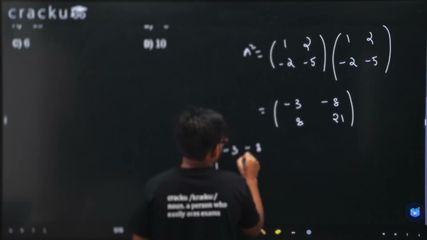
$$A^2=\begin{pmatrix}1&2\\-2&-5\end{pmatrix}\begin{pmatrix}1&2\\-2&-5\end{pmatrix}$$
$$=\begin{pmatrix}-3&-8\\8&21\end{pmatrix}$$
Now,
$$\alpha A^2+\beta A=2I$$
gives
$$\alpha\begin{pmatrix}-3&-8\\8&21\end{pmatrix}+\beta\begin{pmatrix}1&2\\-2&-5\end{pmatrix}=\begin{pmatrix}2&0\\0&2\end{pmatrix}$$
Comparing the off-diagonal entries,
$$-8\alpha+2\beta=0$$
$$-4\alpha+\beta=0$$
$$\beta=4\alpha$$
Now compare the
$$(1,1)$$
entry:
$$-3\alpha+\beta=2$$
Substituting
$$\beta=4\alpha$$
gives
$$\alpha=2$$
Hence
$$\beta=8$$
Therefore,
$$\alpha+\beta=2+8$$
$$=10$$
Final Answer :
$$10$$
Was this solution helpful?
Click on the Email ☝️ to Watch the Video Solution
Create a FREE account and get:
_1.webp)

Educational materials for JEE preparation

Ask our AI anything

AI can make mistakes. Please verify important information.
AI can make mistakes. Please verify important information.
