
Join Our JEE Preparation Group
Prep with like-minded aspirants; Get access to free daily tests and study material.
Sign in
Please select an account to continue using cracku.in
↓ →
Join Our JEE Preparation Group
Prep with like-minded aspirants; Get access to free daily tests and study material.
Consider the system of linear equation $$x + y + z = 4\mu$$, $$x + 2y + 2\lambda z = 10\mu$$, $$x + 3y + 4\lambda^2 z = \mu^2 + 15$$, where $$\lambda, \mu \in \mathbb{R}$$. Which one of the following statements is NOT correct?
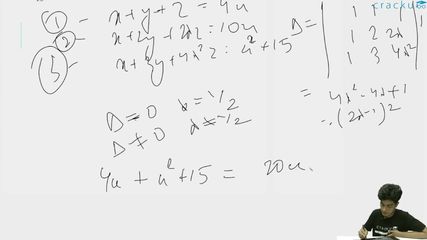
The system is: $$x + y + z = 4\mu$$, $$x + 2y + 2\lambda z = 10\mu$$, $$x + 3y + 4\lambda^2 z = \mu^2 + 15$$.
The coefficient matrix determinant: $$D = \begin{vmatrix} 1 & 1 & 1 \\ 1 & 2 & 2\lambda \\ 1 & 3 & 4\lambda^2 \end{vmatrix}$$
$$= 1(8\lambda^2 - 6\lambda) - 1(4\lambda^2 - 2\lambda) + 1(3 - 2) = 8\lambda^2 - 6\lambda - 4\lambda^2 + 2\lambda + 1 = 4\lambda^2 - 4\lambda + 1 = (2\lambda - 1)^2$$
$$D = 0$$ when $$\lambda = \frac{1}{2}$$.
When $$\lambda = \frac{1}{2}$$: the system becomes $$x + y + z = 4\mu$$, $$x + 2y + z = 10\mu$$, $$x + 3y + z = \mu^2 + 15$$.
From equations 1 and 2: $$y = 6\mu$$. From equations 2 and 3: $$y = \mu^2 + 15 - 10\mu$$.
So $$6\mu = \mu^2 - 10\mu + 15 \Rightarrow \mu^2 - 16\mu + 15 = 0 \Rightarrow (\mu-1)(\mu-15) = 0$$.
For consistency at $$\lambda = \frac{1}{2}$$: $$\mu = 1$$ or $$\mu = 15$$.
Checking the options:
Option (1): Unique solution if $$\lambda \neq \frac{1}{2}$$ and $$\mu \neq 1, 15$$ — True (since $$D \neq 0$$).
Option (2): Inconsistent if $$\lambda = \frac{1}{2}$$ and $$\mu \neq 1$$ — This should say $$\mu \neq 1$$ AND $$\mu \neq 15$$. If $$\mu = 15$$, the system is consistent. So if $$\mu \neq 1$$ but $$\mu = 15$$, it's consistent. Hence this statement is NOT correct.
Option (3): Infinite solutions if $$\lambda = \frac{1}{2}$$ and $$\mu = 15$$ — True.
Option (4): Consistent if $$\lambda \neq \frac{1}{2}$$ — True (unique solution exists).
The answer is Option (2): The statement that is NOT correct.
Was this solution helpful?
Click on the Email ☝️ to Watch the Video Solution
Create a FREE account and get:
_1.webp)

Educational materials for JEE preparation

Ask our AI anything

AI can make mistakes. Please verify important information.
AI can make mistakes. Please verify important information.
