
Join Our JEE Preparation Group
Prep with like-minded aspirants; Get access to free daily tests and study material.
Sign in
Please select an account to continue using cracku.in
↓ →
Join Our JEE Preparation Group
Prep with like-minded aspirants; Get access to free daily tests and study material.
The equation of a tangent to the parabola, $$x^2 = 8y$$, which makes an angle $$\theta$$ with the positive direction of x-axis, is
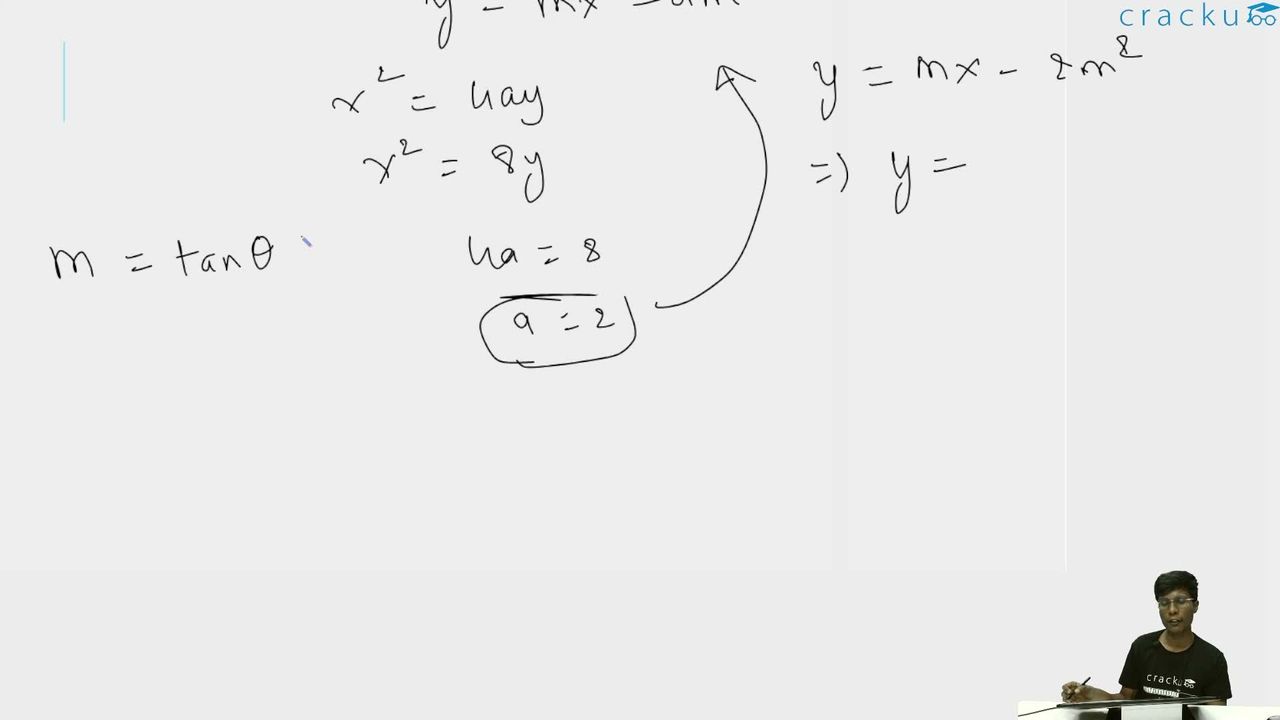
We begin with the given parabola $$x^{2}=8y$$.
First we compare this with the standard form $$x^{2}=4ay$$. By comparison we have $$4a=8\;\Longrightarrow\;a=2.$$
Now we recall the standard result: for the parabola $$x^{2}=4ay,$$ the equation of the tangent having slope $$m$$ is given by the formula
$$y=mx-am^{2}.$$
In the present problem the tangent is said to make an angle $$\theta$$ with the positive direction of the x-axis. The slope of such a line is therefore
$$m=\tan\theta.$$
Substituting $$m=\tan\theta$$ and $$a=2$$ into the tangent formula, we get
$$y=\bigl(\tan\theta\bigr)x-2\bigl(\tan\theta\bigr)^{2}.$$
To compare this with the options, we now isolate $$x$$. Transposing terms yields
$$x\tan\theta=y+2\tan^{2}\theta.$$
Dividing every term by $$\tan\theta$$ (which is non-zero for a valid angle of inclination), we have
$$x=y\cot\theta+2\tan\theta.$$
This equation exactly matches Option C.
Hence, the correct answer is Option C.
Was this solution helpful?
Click on the Email ☝️ to Watch the Video Solution
Create a FREE account and get:
_1.webp)

Educational materials for JEE preparation

Ask our AI anything

AI can make mistakes. Please verify important information.
AI can make mistakes. Please verify important information.


