
Join Our JEE Preparation Group
Prep with like-minded aspirants; Get access to free daily tests and study material.
Sign in
Please select an account to continue using cracku.in
↓ →
Join Our JEE Preparation Group
Prep with like-minded aspirants; Get access to free daily tests and study material.
Let $$[x]$$ denote the greatest integer less than or equal to $$x$$. Then, the values of $$x \in R$$ satisfying the equation $$[e^x]^2 + [e^x + 1] - 3 = 0$$ lie in the interval:
We need to solve $$[e^x]^2 + [e^x + 1] - 3 = 0$$, where $$[y]$$ is the greatest integer (floor) function.
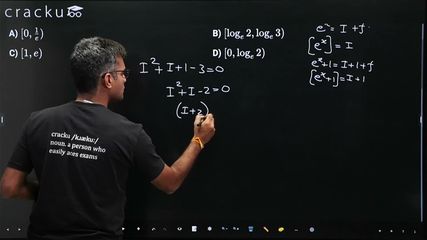
Using the property $$[y + n] = [y] + n$$ for any integer $$n$$: $$[e^x + 1] = [e^x] + 1$$.
The equation becomes $$[e^x]^2 + [e^x] + 1 - 3 = 0$$, i.e., $$[e^x]^2 + [e^x] - 2 = 0$$.
Let $$t = [e^x]$$. Then $$t^2 + t - 2 = 0$$, so $$(t+2)(t-1) = 0$$, giving $$t = 1$$ or $$t = -2$$.
Since $$e^x > 0$$ for all real $$x$$, we have $$[e^x] \geq 0$$, so $$t = -2$$ is rejected.
Thus $$[e^x] = 1$$, meaning $$1 \leq e^x < 2$$.
Taking natural logarithm: $$0 \leq x < \log_e 2$$.
The values of $$x$$ lie in $$[0, \log_e 2)$$, which is Option D.
Was this solution helpful?
Click on the Email ☝️ to Watch the Video Solution
Create a FREE account and get:
_1.webp)

Educational materials for JEE preparation

Ask our AI anything

AI can make mistakes. Please verify important information.
AI can make mistakes. Please verify important information.
