
Join Our JEE Preparation Group
Prep with like-minded aspirants; Get access to free daily tests and study material.
Sign in
Please select an account to continue using cracku.in
↓ →
Join Our JEE Preparation Group
Prep with like-minded aspirants; Get access to free daily tests and study material.
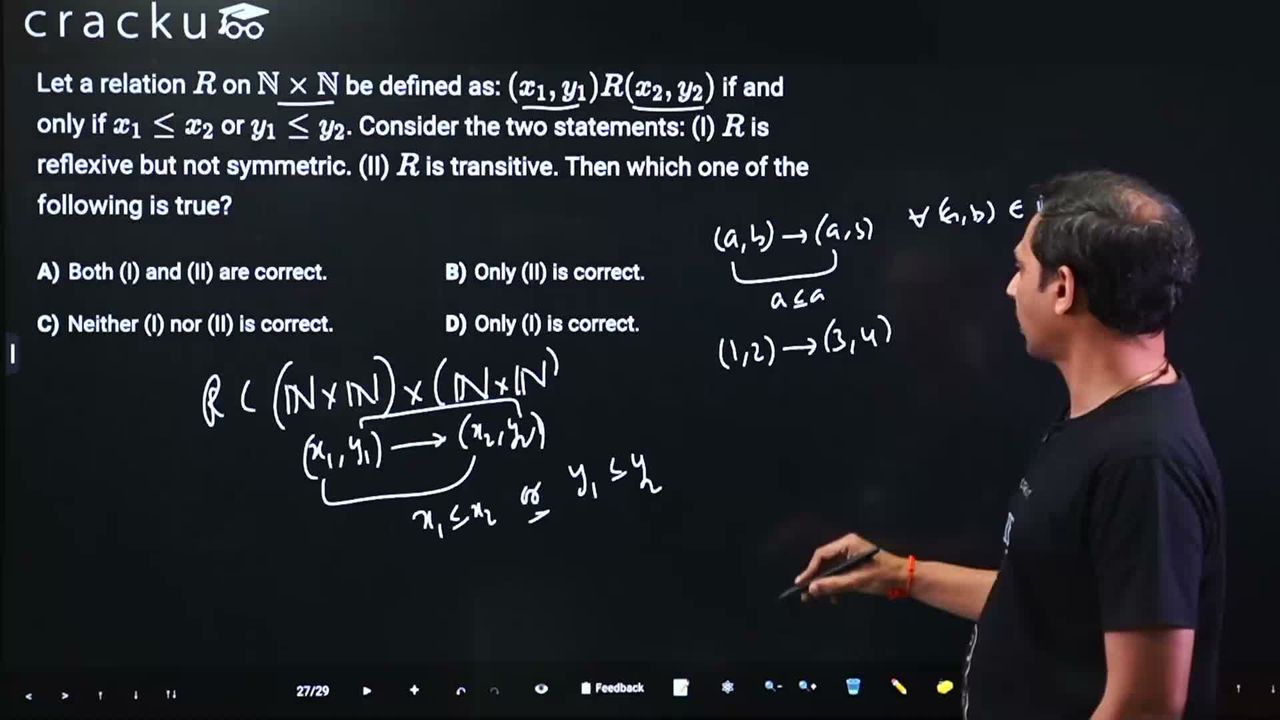
Let a relation $$R$$ on $$\mathbb{N} \times \mathbb{N}$$ be defined as: $$(x_1, y_1) R (x_2, y_2)$$ if and only if $$x_1 \leq x_2$$ or $$y_1 \leq y_2$$. Consider the two statements: (I) $$R$$ is reflexive but not symmetric. (II) $$R$$ is transitive. Then which one of the following is true?
We have a relation $$R$$ on $$\mathbb{N} \times \mathbb{N}$$ defined as: $$(x_1, y_1)\,R\,(x_2, y_2)$$ if and only if $$x_1 \leq x_2$$ or $$y_1 \leq y_2$$.
For any $$(a, b) \in \mathbb{N} \times \mathbb{N}$$, we need $$(a, b)\,R\,(a, b)$$, that is $$a \leq a$$ or $$b \leq b$$. Since $$a \leq a$$ is always true, $$R$$ is reflexive. ✓
To check symmetry, consider $$(1, 1)$$ and $$(2, 2)$$. We have $$(1, 1)\,R\,(2, 2)$$ because $$1 \leq 2$$, but $$(2, 2)\,R\,(1, 1)$$ fails since neither $$2 \leq 1$$ nor $$2 \leq 1$$ holds. Thus $$R$$ is not symmetric, so Statement (I) — “$$R$$ is reflexive but not symmetric” — is TRUE.
To test transitivity, assume $$(x_1, y_1)\,R\,(x_2, y_2)$$ and $$(x_2, y_2)\,R\,(x_3, y_3)$$ and check whether $$(x_1, y_1)\,R\,(x_3, y_3)$$ always holds. As a counterexample, take $$(5, 2)$$, $$(1, 5)$$, and $$(4, 1)$$. First, $$(5, 2)\,R\,(1, 5)$$ holds because $$5 \leq 1$$ is false but $$2 \leq 5$$ is true. Next, $$(1, 5)\,R\,(4, 1)$$ holds since $$1 \leq 4$$. However, $$(5, 2)\,R\,(4, 1)$$ fails because both $$5 \leq 4$$ and $$2 \leq 1$$ are false. Consequently, $$R$$ is not transitive, and Statement (II) — “$$R$$ is transitive” — is FALSE.
Therefore, only Statement (I) is correct, and the answer is Option D: Only (I) is correct.
Was this solution helpful?
Click on the Email ☝️ to Watch the Video Solution
Create a FREE account and get:
_1.webp)

Educational materials for JEE preparation

Ask our AI anything

AI can make mistakes. Please verify important information.
AI can make mistakes. Please verify important information.
