
Join Our JEE Preparation Group
Prep with like-minded aspirants; Get access to free daily tests and study material.
Sign in
Please select an account to continue using cracku.in
↓ →
Join Our JEE Preparation Group
Prep with like-minded aspirants; Get access to free daily tests and study material.
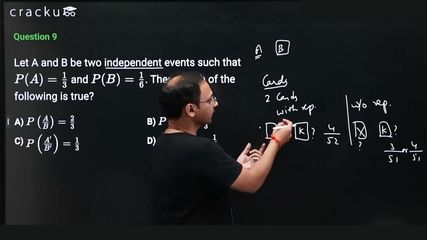
Let A and B be two independent events such that $$P(A) = \frac{1}{3}$$ and $$P(B) = \frac{1}{6}$$. Then, which of the following is true?
We are given two independent events A and B with probabilities
$$P(A)=\frac13, \qquad P(B)=\frac16.$$
Because A and B are independent, the fundamental fact we shall use again and again is
$$P(A\cap B)=P(A)\,P(B).$$
Independence also carries over to complements; that is, A is independent of B′ and A′ is independent of both B and B′. Now we test each option one by one.
Option A asks for the conditional probability $$P\!\left(A\;|\;B\right).$$ The definition of conditional probability is
$$P\!\left(A\;|\;B\right)=\frac{P(A\cap B)}{P(B)}.$$
Substituting the values, we have
$$P(A\cap B)=P(A)\,P(B)=\frac13\cdot\frac16=\frac1{18},$$
so
$$P\!\left(A\;|\;B\right)=\frac{\dfrac1{18}}{\dfrac16}=\frac1{18}\times\frac61=\frac6{18}=\frac13.$$
The option claims $$\frac23,$$ therefore Option A is false.
Option B requires the conditional probability $$P\!\left(A\;|\;B'\right),$$ where B′ is the complement of B. First, evaluate $$P(B')$$:
$$P(B')=1-P(B)=1-\frac16=\frac56.$$
Because A is independent of B′, we write
$$P(A\cap B')=P(A)\,P(B')=\frac13\cdot\frac56=\frac5{18}.$$
Applying the conditional-probability formula,
$$P\!\left(A\;|\;B'\right)=\frac{P(A\cap B')}{P(B')}=\frac{\dfrac5{18}}{\dfrac56}=\frac5{18}\times\frac65=\frac6{18}=\frac13.$$
This exactly matches the value stated in Option B, so Option B is true.
Option C asks for $$P\!\left(A'\;|\;B'\right).$$ First compute $$P(A')$$:
$$P(A')=1-P(A)=1-\frac13=\frac23.$$
Since A′ and B′ are independent,
$$P(A'\cap B')=P(A')\,P(B')=\frac23\cdot\frac56=\frac{10}{18}=\frac59.$$
Then
$$P\!\left(A'\;|\;B'\right)=\frac{P(A'\cap B')}{P(B')}=\frac{\dfrac59}{\dfrac56}=\frac59\times\frac65=\frac{30}{45}=\frac23.$$
Option C claims $$\frac13,$$ so it is incorrect.
Option D involves $$P\!\left(A\;|\;A\cup B\right).$$ First, notice that
$$A\cap(A\cup B)=A,$$
so the numerator of the conditional probability is simply $$P(A)=\frac13.$$ Next we need $$P(A\cup B).$$ Using the addition rule,
$$P(A\cup B)=P(A)+P(B)-P(A\cap B).$$
We already have $$P(A\cap B)=\frac1{18},$$ hence
$$P(A\cup B)=\frac13+\frac16-\frac1{18}=\frac6{18}+\frac3{18}-\frac1{18}=\frac8{18}=\frac49.$$
Now compute the conditional probability:
$$P\!\left(A\;|\;A\cup B\right)=\frac{P(A)}{P(A\cup B)}=\frac{\dfrac13}{\dfrac49}=\frac13\times\frac94=\frac{9}{12}=\frac34.$$
The option lists $$\frac14,$$ so Option D is false.
Only Option B agrees with the actual calculation.
Hence, the correct answer is Option 2.
Was this solution helpful?
Click on the Email ☝️ to Watch the Video Solution
Create a FREE account and get:
_1.webp)

Educational materials for JEE preparation

Ask our AI anything

AI can make mistakes. Please verify important information.
AI can make mistakes. Please verify important information.
