
Join Our JEE Preparation Group
Prep with like-minded aspirants; Get access to free daily tests and study material.
Sign in
Please select an account to continue using cracku.in
↓ →
Join Our JEE Preparation Group
Prep with like-minded aspirants; Get access to free daily tests and study material.
The shortest distance between the lines $$\frac{x-3}{3} = \frac{y-8}{-1} = \frac{z-3}{1}$$ and $$\frac{x+3}{-3} = \frac{y+7}{2} = \frac{z-6}{4}$$ is
We have two skew lines written in symmetric (or continuous) form
$$\frac{x-3}{3}\;=\;\frac{y-8}{-1}\;=\;\frac{z-3}{1}\qquad\text{and}\qquad \frac{x+3}{-3}\;=\;\frac{y+7}{2}\;=\;\frac{z-6}{4}.$$
For every such line we first read off one point through which it passes and the direction vector along it.
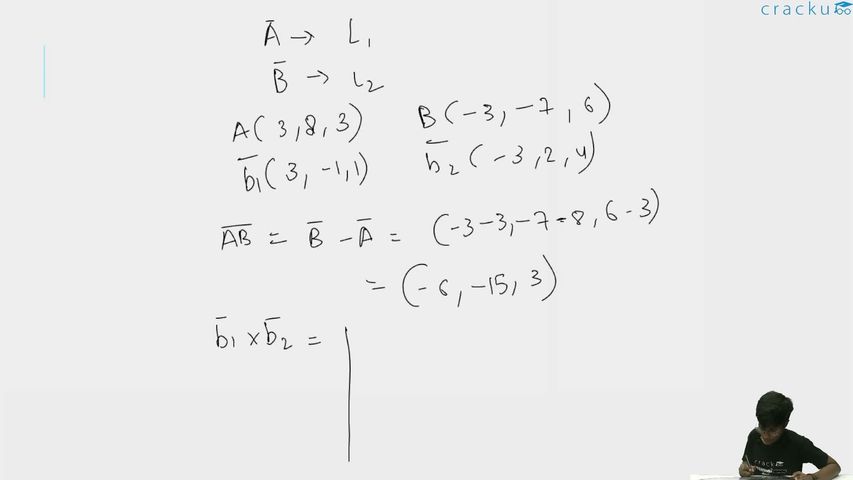
For the first line the point is clearly obtained by taking the numerators equal to zero, so we get $$P_1\,(3,\,8,\,3).$$ Its direction numbers are the denominators, therefore the direction vector is $$\vec a=\langle 3,\,-1,\,1\rangle.$$
For the second line the point is obtained in exactly the same way, giving $$P_2\,(-3,\,-7,\,6),$$ and the direction vector comes from the denominators, giving $$\vec b=\langle-3,\,2,\,4\rangle.$$
To obtain the shortest distance between two skew lines we employ the well-known formula
$$D=\frac{\bigl|(\vec b-\vec a_0)\cdot(\vec a\times\vec b)\bigr|} {\lVert\vec a\times\vec b\rVert},$$
where $$\vec a$$ and $$\vec b$$ are the direction vectors of the two lines and $$\vec a_0$$ is the vector joining any chosen point on the first line to any chosen point on the second line. Here we shall take the joining vector from $$P_1$$ to $$P_2$$:
$$\vec r=P_2-P_1 =\langle-3-3,\,-7-8,\,6-3\rangle =\langle-6,\,-15,\,3\rangle.$$
Now we need the cross product of the two direction vectors. Using the determinant definition of the cross product,
$$\vec a\times\vec b =\begin{vmatrix} \mathbf i & \mathbf j & \mathbf k\\[2pt] 3 & -1 & 1\\ -3 & 2 & 4 \end{vmatrix} =\mathbf i\bigl((-1)(4)-1(2)\bigr) -\mathbf j\bigl(3(4)-1(-3)\bigr) +\mathbf k\bigl(3(2)-(-1)(-3)\bigr).$$
Simplifying each component one by one we obtain
$$\vec a\times\vec b =\langle-4-2,\;-(12+3),\;6-3\rangle =\langle-6,\,-15,\,3\rangle.$$
Notice that the cross product has exactly the same direction as $$\vec r$$. Its magnitude is therefore
$$\lVert\vec a\times\vec b\rVert =\sqrt{(-6)^2+(-15)^2+3^2} =\sqrt{36+225+9} =\sqrt{270} =\sqrt{9\times30} =3\sqrt{30}.$$
The numerator in the distance formula is the absolute value of the scalar triple product
$$\bigl|\,\vec r\cdot(\vec a\times\vec b)\bigr| =\bigl|\langle-6,\,-15,\,3\rangle \cdot \langle-6,\,-15,\,3\rangle\bigr| =\bigl|36+225+9\bigr| =270.$$
Putting these two values into the distance formula gives
$$D =\frac{270}{3\sqrt{30}} =\frac{90}{\sqrt{30}} =\frac{90\sqrt{30}}{30} =3\sqrt{30}.$$
Thus the shortest distance between the two given skew lines is $$3\sqrt{30}.$$
Among the options provided, this value corresponds to Option C.
Hence, the correct answer is Option C.
Was this solution helpful?
Click on the Email ☝️ to Watch the Video Solution
Create a FREE account and get:
_1.webp)

Educational materials for JEE preparation

Ask our AI anything

AI can make mistakes. Please verify important information.
AI can make mistakes. Please verify important information.
