
Join Our JEE Preparation Group
Prep with like-minded aspirants; Get access to free daily tests and study material.
Sign in
Please select an account to continue using cracku.in
↓ →
Join Our JEE Preparation Group
Prep with like-minded aspirants; Get access to free daily tests and study material.
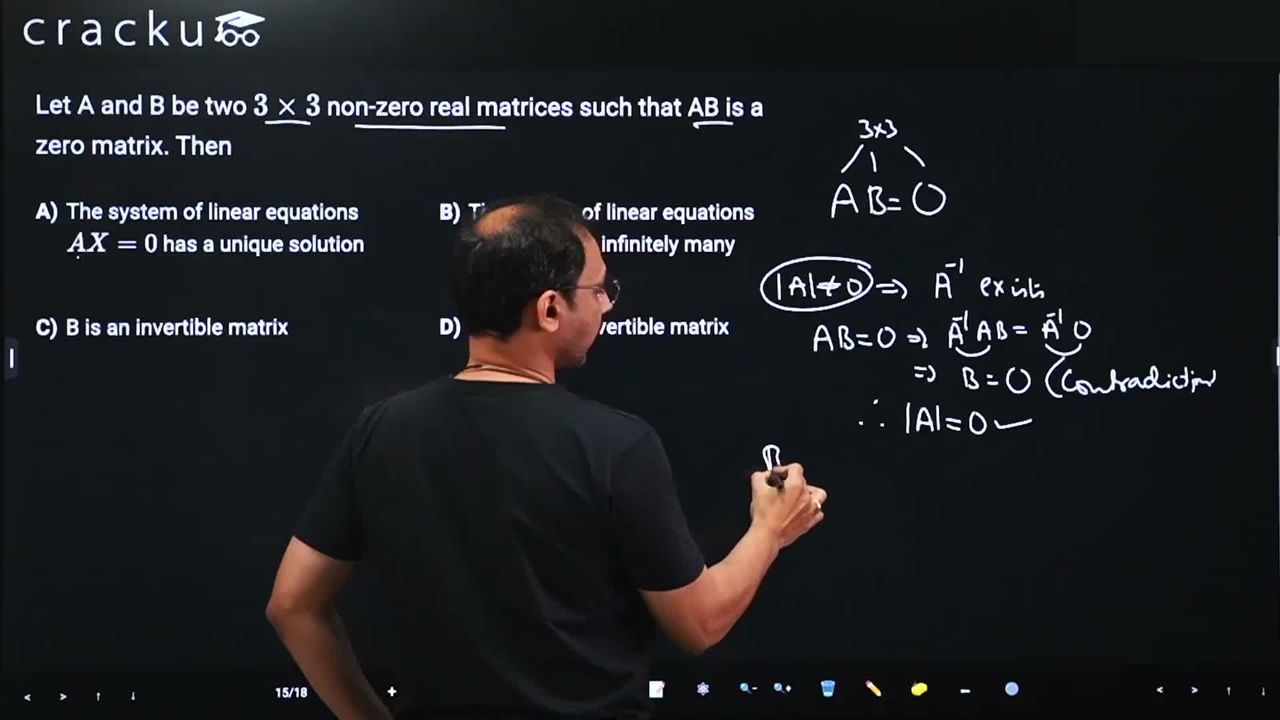
Let A and B be two $$3 \times 3$$ non-zero real matrices such that AB is a zero matrix. Then
We have two $$3 \times 3$$ non-zero real matrices $$A$$ and $$B$$ such that $$AB = O$$ (the zero matrix). We need to determine which statement is correct.
Since $$B$$ is a non-zero matrix, there exists at least one column of $$B$$, say $$\mathbf{b}_j$$, that is a non-zero vector. Now, $$AB = O$$ means that $$A\mathbf{b}_j = \mathbf{0}$$ for every column $$\mathbf{b}_j$$ of $$B$$. In particular, $$A\mathbf{b}_j = \mathbf{0}$$ with $$\mathbf{b}_j \neq \mathbf{0}$$.
This shows that the homogeneous system $$AX = \mathbf{0}$$ has a non-trivial solution (namely $$X = \mathbf{b}_j$$). A homogeneous system that admits a non-trivial solution must have infinitely many solutions (since any scalar multiple of a non-trivial solution is also a solution). Hence Option B is correct.
We can also verify that the other options are incorrect. Since $$AX = \mathbf{0}$$ has a non-trivial solution, $$\det(A) = 0$$, which means $$A$$ is singular. Consequently, $$\text{adj}(A)$$ is not invertible (because for a singular $$3 \times 3$$ matrix, $$\det(\text{adj}(A)) = (\det A)^2 = 0$$). This rules out Options A and D. Also, since $$AB = O$$ and $$A \neq O$$, if $$B$$ were invertible we could multiply on the right by $$B^{-1}$$ to get $$A = O$$, a contradiction. So $$B$$ is not invertible, ruling out Option C.
Hence, the correct answer is Option B.
Was this solution helpful?
Click on the Email ☝️ to Watch the Video Solution
Create a FREE account and get:
_1.webp)

Educational materials for JEE preparation

Ask our AI anything

AI can make mistakes. Please verify important information.
AI can make mistakes. Please verify important information.
